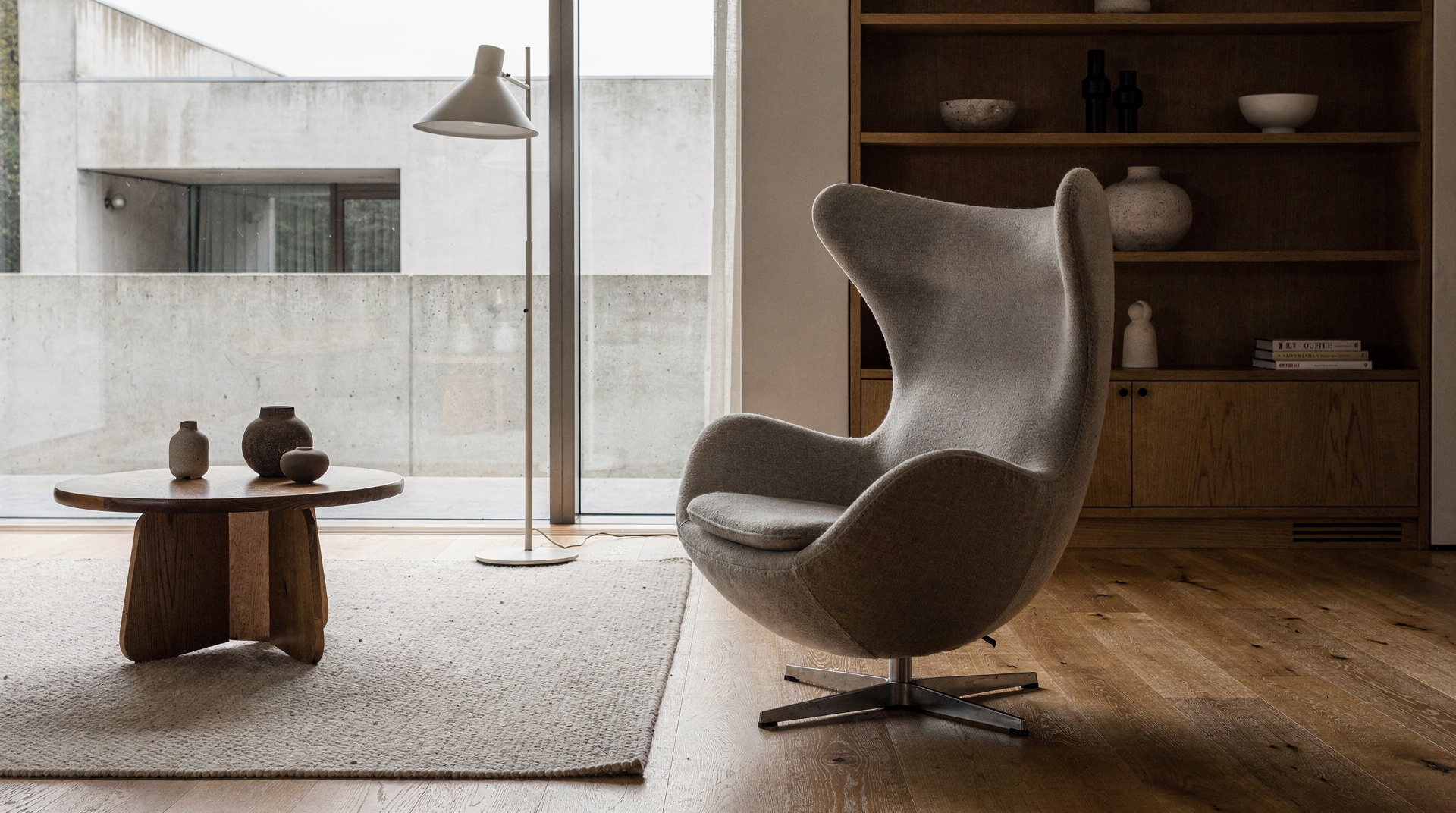
Arne Jacobsen – The Universal Designer
Arne Jacobsen (1902–1971) belongs to the rare group of 20th-century designers whose work cannot be reduced to a single piece of furniture, a single building type or a single discipline. He was a trained architect from the Royal Danish Academy of Fine Arts in Copenhagen, designed public buildings and private homes, created cutlery, lighting, textiles, sanitary fittings and clocks, and with chairs such as the Ant (1952), the Series 7 (1955), the Egg and the Swan (both 1958) produced icons that remain in production to this day. His self-conception was that of a total designer: if he built a hotel, he also designed the door handles, the ashtrays and the spoons. The SAS Royal Hotel in Copenhagen, completed in 1960, is the most frequently cited manifesto of this attitude.
Collectors approaching Jacobsen would do well not to read him exclusively through the silhouettes of the Egg or Swan. His work becomes most interesting where architecture, serial furniture and small objects merge into a consistent language: reduced, functional, with a quiet precision that derives more from craft than from manifesto. For connoisseurs, Jacobsen is less a stylist than a systems thinker, whose designs draw on a few hard-won constants: continuous formal control, trust in industrial manufacturing combined with an uncompromisingly high craft standard, and an almost austere economy in material and detail.
Characteristic Materials and Techniques
Jacobsen’s furniture work is inseparable from his collaboration with Fritz Hansen. The Ant, originally designed for the canteen of the pharmaceutical company Novo Nordisk, introduced the three-dimensionally moulded plywood shell into Scandinavian serial production. From this technique evolved the Series 7 and the Grand Prix (1957). The material is typically formed laminated wood consisting of several veneer layers – in classic versions beech, teak, rosewood or oak, and increasingly lacquered in colour from the late 1960s onwards. The bases are chrome-plated steel, usually round tubing, attached to the shell with visible rivets or screw connections fitted with anti-slip caps.
With the Egg and Swan, a different process comes into play: a shell of cold-cured polyurethane foam injected into a steel mould, covered with a fixed backrest of plastic and upholstered in fabric or leather. The star base is cast aluminium, satin-finished in the original. Textiles were historically sourced frequently from Kvadrat or from Jacobsen’s own drawings. In architecture and object design, stainless steel dominates (the AJ cutlery for Georg Jensen, 1957), along with brass, matte glass and enamelled steel. The AJ lamp series, designed for the SAS Royal Hotel and today produced by Louis Poulsen, exemplifies Jacobsen’s characteristic material discipline: a single folded sheet-metal form, a visible joint, no ornamentation.
Regional Context and Contemporaries
Jacobsen is a central protagonist of the Copenhagen School, yet he occupies an idiosyncratic position within it relative to the craft-oriented colleagues around Kaare Klint, Hans J. Wegner, Finn Juhl and Børge Mogensen. While Klint studied the furniture tradition and Wegner collaborated with master cabinetmakers such as Johannes Hansen, Jacobsen committed earlier and more decisively to industrial serial production. Fritz Hansen in Allerød thus became the industrial counterpart to the Copenhagen cabinetmakers’ exhibitions (Snedkerlaugets Møbeludstillinger), where the craft faction presented its prototypes.
Formative was the exchange with Charles and Ray Eames in California, whose experiments with moulded plywood Jacobsen followed closely. Equally relevant is his relationship to Poul Kjærholm, who from 1955 presented his steel-and-leather series through Fritz Hansen, occupying a cooler, Mies van der Rohe-inflected position within the same manufacturer. Jacobsen’s collaborators and companions – among them Verner Panton, who worked in his office for a period – carried his approach forward: reduction, clear formal language, trust in new materials. When attributing a piece, it is worth keeping these neighbourhoods in mind, because they explain why certain details – such as the connection between shell and base – were resolved as they were and not otherwise.
Authenticity and Condition for Collectors
Provenance for Jacobsen furniture is comparatively well documented, because Fritz Hansen, Louis Poulsen and Georg Jensen as manufacturers have produced continuously and their markings are attested across the decades. An original Series 7 typically bears an embossed or adhesive Fritz Hansen label on the underside of the seat shell, with a date stamp (month and year) or, in earlier versions, the abbreviation “FH” and a model number. Early Ant chairs were initially delivered with three legs; the four-legged variant followed later. These details are decisive for dating.
With the Egg and Swan, it is worth examining the foam structure (brittle, hardened foam is a sign of ageing that may require reupholstering), the seam and wedge routing at the rear, and the original upholstery material. A professionally reupholstered example does not necessarily lose value, provided the shell, the tilt mechanism and the aluminium base are original and the work is documented. Caution is advised with later replacement bases, subsequently lacquered shells and Egg or Swan reproductions without a label; the latter can usually be identified by proportions, base diameter and the quality of the tilt mechanism. For AJ lamps, the manufacturer’s stamp from Louis Poulsen inside the shade and on the base is authoritative, as are the original socket and original cable – though a professionally executed electrical upgrade is common and accepted for safety reasons.
For the AJ cutlery by Georg Jensen: early versions bear the “Georg Jensen” punch in a double oval; later series additionally carry “Denmark” and model designations. Complete sets from the original production run are rare, because the cutlery was long considered too radical and only gained broader acceptance after its appearance in Kubrick’s “2001: A Space Odyssey” (1968).
On mid-centurydesigns.com, Jacobsen pieces are examined individually: we document manufacturer marks, date items based on labels and construction features, transparently note restored sections and distinguish original condition from later interventions. Where possible, we add provenance information and comparative examples from the literature. In this way, a piece of furniture becomes a traceable object whose history you know before you own it.