CATEGORY · CYLINDA-LINE

Cylinda-Line – strict cylinders, controlled handles and a design classic with unusually solid documentation

Stelton traces the project back to 1964 and launched it in 1967 after three years of development

For many buyers, Cylinda-Line first reads as a generic symbol of Scandinavian stainless steel. The sources tell a more exact story: Stelton places the origin at a family dinner in 1964 and says the line reached production only after three years of development; Stelton’s Arne Jacobsen page also records two early awards; and the V&A documents individual pieces with designer, maker, material, place and production dates. That makes Cylinda-Line unusually easy to discuss factually in a shop context.

mid-century·designs

Cylinda-Line

ESSAY · 01

Work & Context

mid-century·designs

Cylinda-Line is not just “Scandinavian steel” but a precisely documented product story

With Cylinda-Line, it helps to resist shorthand. On Stelton’s official Cylinda-line page, the story begins at a family dinner in spring 1964 at Arne Jacobsen’s home. There, Peter Holmblad—then owner of Stelton and Jacobsen’s stepson—tried to persuade him to design a complete range for the home bar, together with pieces for coffee and tea service. The crucial detail follows on the same page: an entirely new production method had to be developed, and the line was only launched in 1967 after three years of intensive development.

That matters in a shop context. Many steel objects are casually sold as “Scandinavian” or “in the style of Jacobsen”. Cylinda-Line is much more tightly anchored than that: idea in 1964, launch in 1967, Stelton as maker and Arne Jacobsen as designer. For buyers at mid-century·designs, this means the series can be discussed as a documented design programme rather than as a loose aesthetic mood.

The V&A objects show that the series is functionally specific as well as formally strict

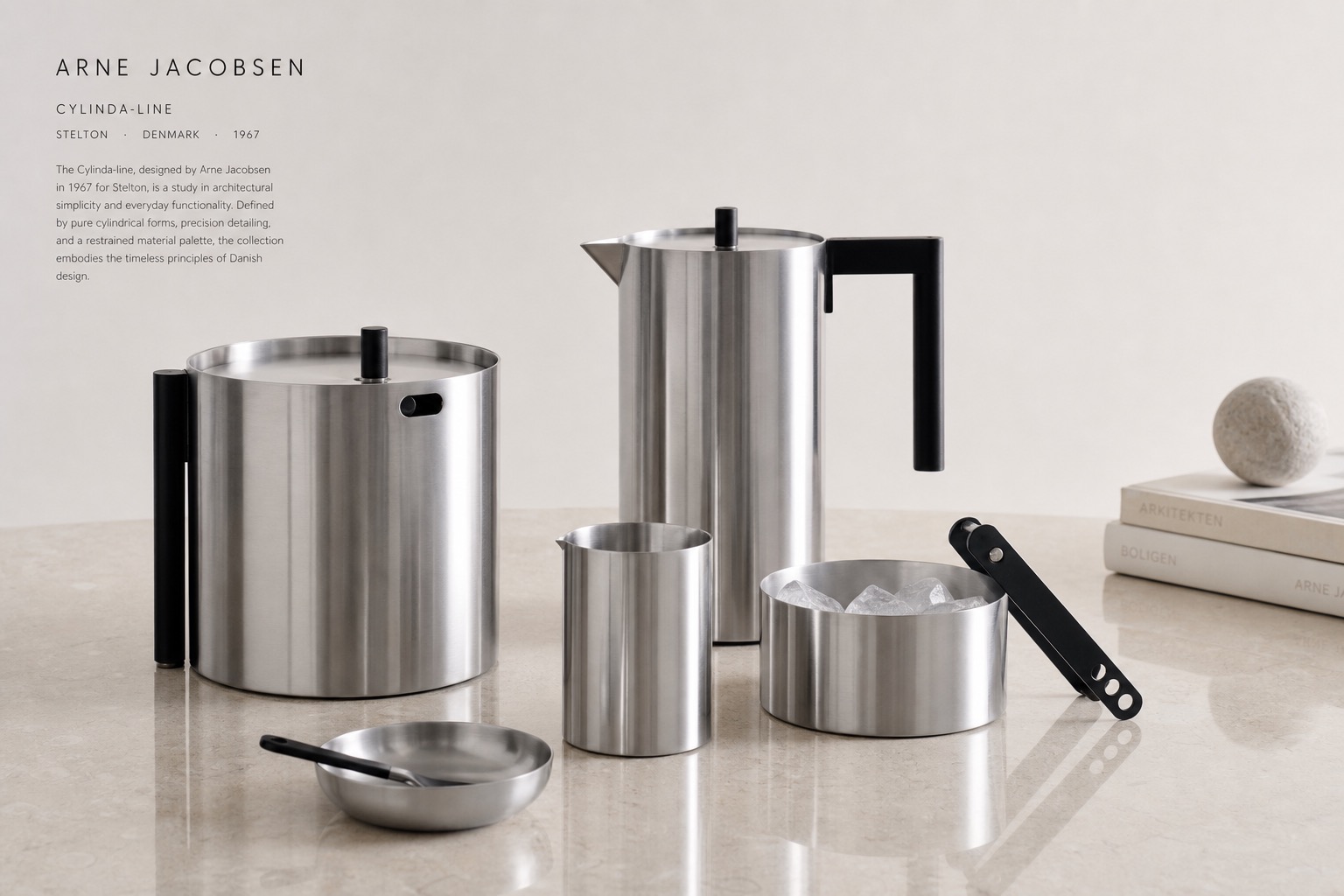
The Victoria and Albert Museum makes the line especially legible because it documents individual objects separately. Its Cylinda Line teapot is recorded as designed in 1967 and made in 1968; the V&A names Stelton Ltd as maker, Arne Emil Jacobsen as designer, and lists a stainless-steel body with a handle of synthetic composition. The physical description is unusually useful: a broad cylindrical body, a long tapering spout of semi-circular section, and a black handle built from a right-angled outer form.

The museum’s Cylinda Line ice bucket carries the same dates but adds equally practical details. The V&A describes an insulated inner lining and two semi-circular handles that rest horizontally outside the bucket and swing upward to meet above it. That is why Cylinda-Line is more than a reflective metal finish. The line is rigorous, but never abstract for its own sake: each object solves a specific domestic task through very controlled geometry.

Stelton itself explains why Cylinda-Line still sits at the core of the brand

On Stelton’s Arne Jacobsen page, the company says something quite direct: Cylinda-Line has become “the essence of Stelton’s design DNA.” The same page states that the series received the ID-prize in 1967 from the Danish Society of Industrial Design and the International Design Award in 1968 from the American Institute of Interior Designers. Those are useful facts because they show how quickly the line was institutionally recognised.

For buyers, this helps separate vaguely similar stainless-steel wares from documented Cylinda-Line pieces. Condition matters, of course, but so do proportions, handle geometry, lid construction, material contrast and secure attribution. For related context, see our page on Arne Jacobsen and the main shop.

Sources

FAQ · 02

Frequently asked about Cylinda-Line

5 Answers

01
When did Cylinda-Line actually begin?
Stelton dates the origin story to a family dinner in spring 1964 at Arne Jacobsen’s home. The company says development then took three years, while the V&A records the teapot and ice bucket as designed in 1967 and made in 1968.
02
Who designed and made the series?
The V&A collection pages identify Arne Emil Jacobsen as designer and Stelton Ltd as maker. Stelton’s own Arne Jacobsen page also attributes Cylinda-Line directly to him.
03
What materials define the series?
The V&A records the featured pieces as stainless-steel objects. For the teapot it also specifies a black handle in synthetic composition, and for the ice bucket it notes an insulated inner lining.
04
Why is the series historically important?
Stelton describes Cylinda-Line as central to the company’s design DNA and notes the ID-prize in 1967 and the International Design Award in 1968. The V&A objects show how consistently Jacobsen extended one geometric idea across multiple domestic functions.
05
What should buyers inspect on older Cylinda-Line pieces?
Look for disciplined proportions, clean cylindrical bodies, correct handle and lid solutions, and faithful materials. On pots, the spout, handle, lid ring and base are especially useful; on ice buckets, the semi-circular swing handles and insulated interior are key comparison points.

GLOSSARY · 03

Related Terms

6 Entries

Peter Holmblad
Stelton owner and Arne Jacobsen’s stepson, identified by Stelton as the person who pushed for a complete bar and serving series and drew Jacobsen into the project in 1964.
Cylinda-Line
Stainless-steel series for Stelton launched in 1967 according to Stelton, defined by the disciplined translation of cylindrical geometry into domestic objects.
ID-prize 1967
Award cited by Stelton on its Arne Jacobsen page as an early distinction for Cylinda-Line, granted by the Danish Society of Industrial Design.
International Design Award 1968
Second award named by Stelton for Cylinda-Line, attributed by the company to the American Institute of Interior Designers.
V&A Collections
The Victoria and Albert Museum’s collection database, used here because it records concrete data for the Cylinda-Line teapot and ice bucket, including dates, materials, maker and designer.
Synthetic composition
V&A material note for the black handle of the Cylinda-Line teapot, reminding buyers that the line’s appeal depends on controlled contrasts as much as on polished steel.