CATEGORY · BRIONVEGA RR126

Brionvega RR126 — Castiglioni, modular speakers and a radiogram with an almost human face

The V&A and Brionvega present the RR126 as an Italian sound object suspended between furniture, technology and Pop staging

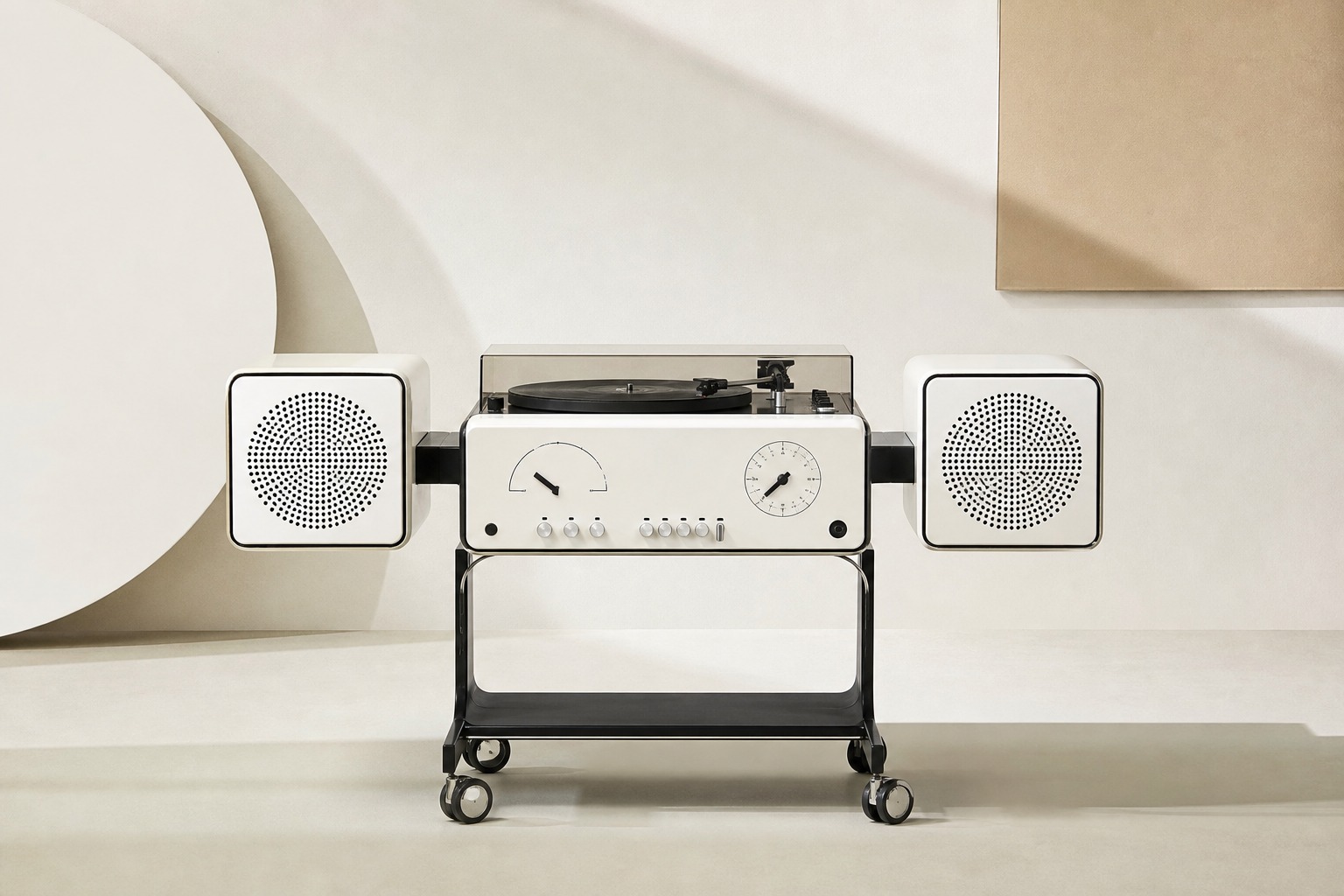
The Brionvega RR126 is one of the sharpest audio-furniture objects of the 1960s. The V&A dates the design to 1965 and first manufacture to 1966, describing a radiogram body in plywood, white plastic laminate, aluminium and electronic components, while treating the movable speakers as the defining feature. Brionvega still presents the radiofonografo as one of its enduring icons today, and that combination of documented object history and living brand continuity is exactly what makes the RR126 so compelling in a collecting context.

mid-century·designs

Brionvega RR126

ESSAY · 01

Work & Context

mid-century·designs

The Brionvega RR126 is better read as a configurable domestic object than as a merely photogenic 1960s stereo

With the Brionvega RR126, it helps to move beyond the Pop silhouette. The V&A records the radiofonografo as a radiogram designed by Achille and Pier Giacomo Castiglioni in 1965 and first manufactured in Milan in 1966. For collectors, that split between design date and first production matters, because it lets you read listings with more precision than broad labels such as “1960s Italian stereo.”

The material description is equally concrete. According to the V&A collection, the main body and speakers are made from plywood laminated with thin white plastic, alongside aluminium, polycarbonate, wood and electronic components. The V&A blog adds a black-painted aluminium stand, castors, and a Garrard turntable. That is much more useful in a market context than generic language about “space-age audio,” because the RR126 is identifiable through its exact material mix and wheeled furniture base.

The speakers are not decorative extras but the core of the design idea

The defining point of the RR126 is reconfigurability. The V&A describes three main arrangements: the speakers can sit on top of the body, attach to the sides, or be placed separately in the room. The V&A blog makes clear that this changed not only the look of the object but also its stereo effect. In the stacked arrangement the object is more compact and the turntable is concealed; once the speakers move outward, the furniture opens up visually and acoustically.

That is also where the object’s near-human readability comes from. The V&A blog explicitly calls the RR126 a “musical pet”: speakers as ears, controls as a face, and a body on castors that behaves more like a companion than a sealed technical box. Readers who already know our pages on the antique radio or the 1960s can see here how entertainment technology became furniture with personality.

Brionvega’s own page shows that the radiofonografo is still a brand myth, not just a museum piece

Brionvega’s current official page is revealing in a different way. It still presents the radiofonografo as a 1965 Castiglioni design whose identity rests on detachable loudspeakers, a metal base on castors, and a highly recognisable front panel. The page now speaks through a re-edition model family, but that continuity is exactly the point: the RR126 is not only historically significant, it still functions as one of the signatures of Italian sound design. For mid-century·designs, that makes it a strong buying subject because it sits clearly at the intersection of Italian Pop culture, furniture design and audio history. For more curated objects, see the shop.

Sources

FAQ · 02

Frequently asked about Brionvega RR126

5 Answers

01
Who designed the Brionvega RR126?
The V&A and Brionvega’s official radiofonografo page both credit Achille and Pier Giacomo Castiglioni with the 1965 project.
02
When did the RR126 reach production?
The V&A records the RR126 as designed in 1965 and first manufactured in 1966. That distinction is useful when evaluating market listings.
03
Which materials are documented for the RR126?
The V&A describes plywood laminated with thin white plastic, plus aluminium, polycarbonate, wood and electronic components. The V&A blog adds a black-painted aluminium stand, castors and a Garrard turntable.
04
Why are the speakers so important on this model?
The V&A collection and V&A blog both stress that the speakers could sit on top, hook onto the sides or stand separately in the room. That changed both the object’s appearance and its stereo performance.
05
Why does the RR126 matter to buyers today?
Because it links design history and real-use technology unusually tightly. The RR126 is not just decorative; it is legible as a configurable Hi-Fi furniture object with documented materials and authorship.

GLOSSARY · 03

Related Terms

6 Entries

Radiofonografo
Italian name for Brionvega’s combined radio and record-player furniture object. In the RR126 it signals the merger of audio equipment and domestic design.
Radiogram
Category used by the V&A for a furniture piece that integrates radio and record-player technology within one body.
Castiglioni brothers
Achille and Pier Giacomo Castiglioni, named by the V&A and Brionvega as the designers of the 1965 RR126 project.
Modular speakers
Detachable speakers that, according to the V&A, could sit on top of the body, hook to its sides or be placed separately in the room.
Pop design
Term explicitly used by the V&A blog for the RR126’s playful, anthropomorphic and vividly staged design character.
Brionvega
Italian manufacturer that, according to the V&A blog, was founded in Milan in 1945 as BPM and renamed Brionvega in 1960.