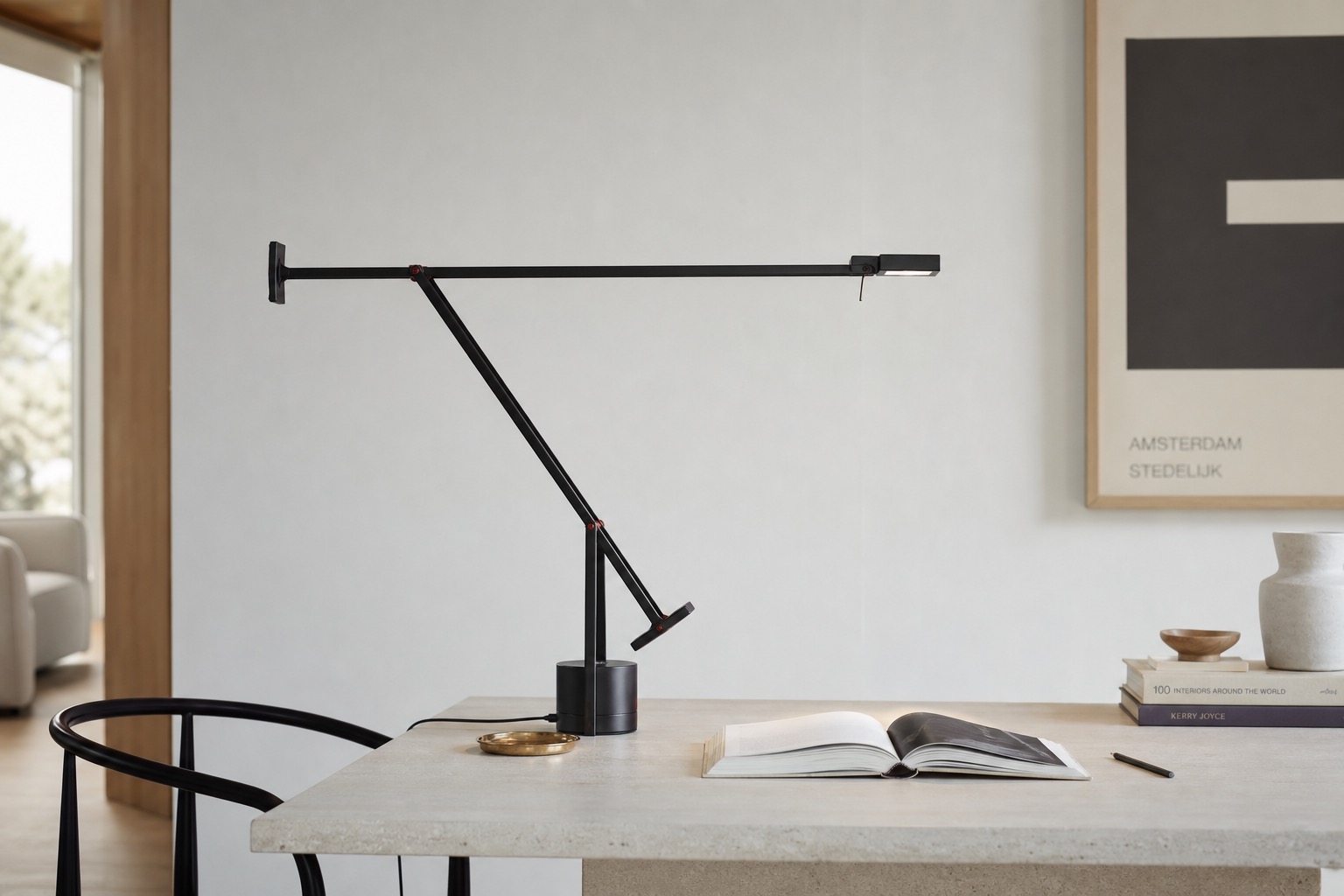
Tizio is less a decorative desk lamp than an exposed construction principle
Anyone searching for Tizio quickly meets a familiar image: black arms, small rectangular head, round base, almost no visible technology. That is also where many descriptions become too vague. The dependable sources show that the lamp does not hide its engineering; it translates engineering into form. The Met describes the 1972 object as a fully adjustable task light with a small precise light source, a counterweight system and arms that conduct electricity, so no extra wires disturb the balance. The V&A confirms the same logic and adds that a transformer is concealed in the base and feeds a 12-volt halogen lamp.
For readers of mid-century·designs, that is more useful than icon talk on its own. Anyone who already knows our pages on lamps mid-century, Artemide Eclisse or the wider shop can see in Tizio how strongly a later mid-century object can be defined by mechanics, current flow and positional control, not just by silhouette.
The real breakthrough is conductive arms instead of visible wires
The most important point comes from several sources that agree closely. Richard Sapper’s own product page states that Tizio has a transformer located in the base that powers a halogen lamp through rods and push-button joints carrying electrical current without cables. The Met makes the same point in museum language: the arms themselves conduct electricity to the bulb, eliminating extraneous wires and making the fine balance of the arm possible in the first place.
That matters for buyers and collectors because it clarifies what separates a Tizio from a merely similar-looking task lamp. The defining feature is not just the black angular profile, but the integrated current path as part of the structure. The V&A goes further and explicitly calls this solution, in 1972, an innovation seen in very few other lamp designs.
Its adjustability works only because weight, joints and light source were conceived together
The second major strength of Tizio lies in its counterweight system. The Met writes that Richard Sapper wanted to redesign the standard desk lamp and, through methodical experimentation, arrived at a form whose own balance lets it be positioned in almost any way. The V&A describes it as a table lamp movable in four directions, with its balance ensured by counterweights. The result is a work light that can place concentrated light exactly where it is needed.
A quotation preserved by the V&A makes the design brief especially concrete. Sapper said he wanted a lamp with a small head and long arms, one that did not need to be clamped to the desk and could be moved easily. That makes Tizio not a chance icon and not a mere style exercise, but a highly specific response to a practical use problem.
For the market, dating, materials and technology matter more than the word “icon”
The source base is unusually strong if you want concrete checkpoints. The V&A dates the design to 1971–1972 and the documented example to 1973, made by a Milan-based manufacturer. The Met lists its object as 1972 and specifies the materials precisely as polyamide (nylon), polycarbonate, aluminium and metal alloy. The V&A complements that with aluminium, acrylonitrile-butadiene-styrene plastic, steel and glass. Those details help with sober evaluation of historical examples far more than general design rhetoric does.
The official manufacturer page also supplies an important present-day context. It describes Tizio as a 50-year-old design that remains absolutely contemporary, and notes a current version with an integrated LED source. For historical understanding and for buying decisions, that means older halogen versions, later variants and current editions should not be collapsed into one vague category. It is more useful to look closely at dating, lighting technology, joint logic, materiality and manufacturer attribution.