CATEGORY · ARTEMIDE NESSO

Artemide Nesso – organic form, early plastic modernity and a collector object with unusually solid documentation

Artemide places Nesso within the plastic optimism of the 1960s, while the Met, MoDiP and Design Museum Brussels provide hard museum data for date, maker and dimensions

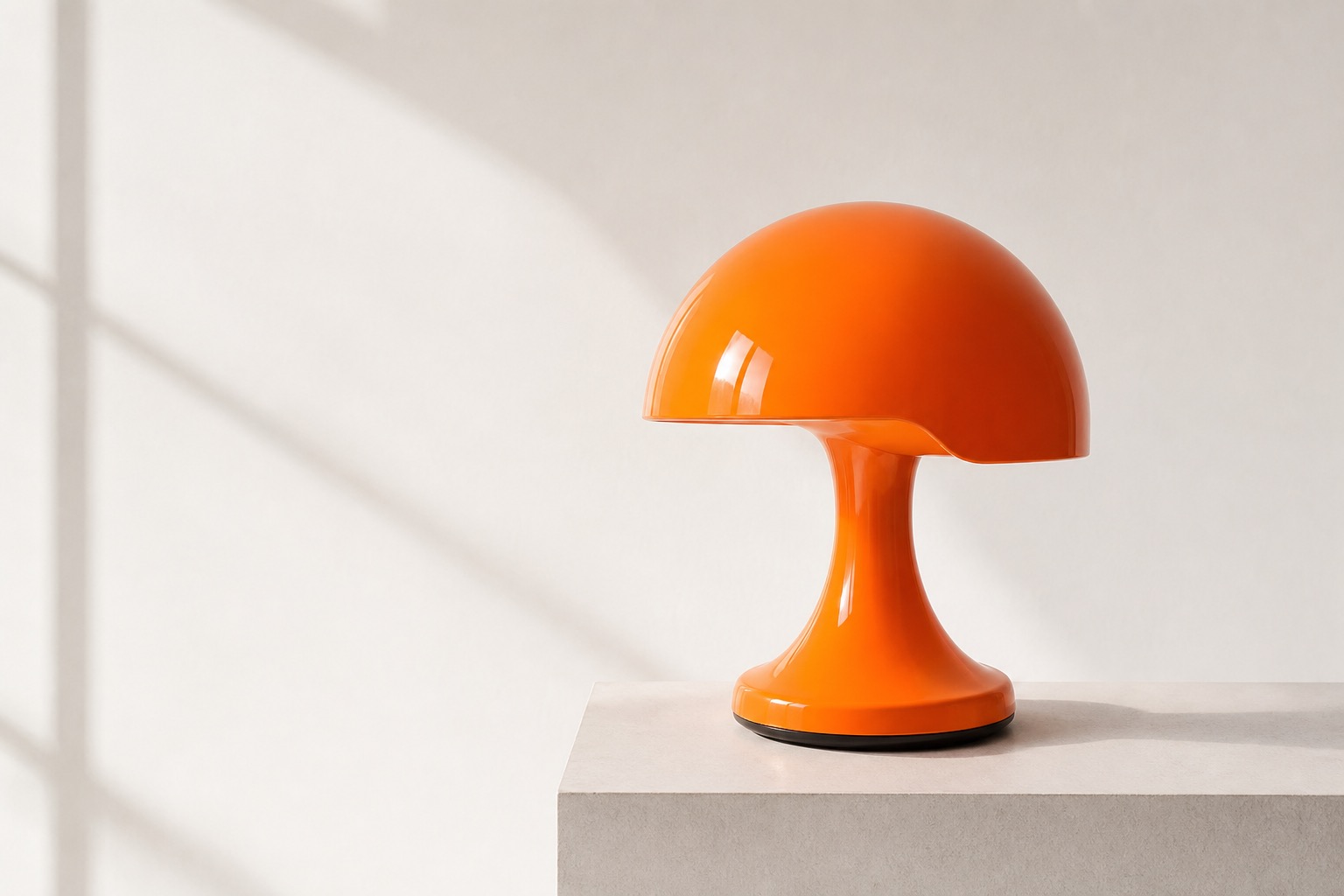
Artemide Nesso becomes much more useful once the sources are read together. Artemide presents it as an icon of 1960s international design shaped by the early use of plastics. The Metropolitan Museum documents a 1967 example in glass fiber–reinforced polyester and styrene acrylonitrile plastic, while the Museum of Design in Plastics describes its orange version as a mushroom-shaped 1967 lamp, continuously produced and made from ABS. That combination gives buyers a stronger factual basis than generic vintage language ever could.

mid-century·designs

Artemide Nesso

ESSAY · 01

Work & Context

mid-century·designs

Artemide Nesso matters most when form, material and museum evidence are read together

Many texts reduce Artemide Nesso to an appealing Italian space-age lamp. The primary sources support a more precise reading. Artemide presents Nesso as an icon of 1960s international design and explicitly ties it to a moment when domestic design was being redefined through the first uses of plastics. That means the nature-inspired shape is not just an atmospheric style cue; it belongs to a specific material turn in postwar design.

In a shop context, that distinction is genuinely useful. Anyone browsing mid-century·designs through lamps mid-century, Artemide Eclisse or the wider shop should read Nesso not as a vague “mushroom lamp” but as an object whose value depends on documented authorship, material reading and museum-level comparables.

The sources show that Nesso should be discussed materially, not only stylistically

The Metropolitan Museum of Art documents its “Nesso” Lamp from 1967, manufactured by Artemide S.p.A., and lists the materials as glass fiber–reinforced polyester and styrene acrylonitrile plastic. The Museum of Design in Plastics, by contrast, describes its orange version as a mushroom-shaped table lamp, originally designed in 1967 for Artemide, continuously produced since then, with a base and large domed shade made from ABS.

That difference is exactly what makes the object interesting for collectors. It does not mean one source cancels the other; it means older Nesso lamps should not be described with a single lazy material formula. When evaluating examples on the market, buyers should therefore look beyond silhouette and focus on plastic character, surface condition, colour tone, underside details and maker markings. With plastic objects, material literacy often matters more than with painted metal lamps because ageing and finish can vary substantially.

Attribution and dimensions are unusually well anchored for a lamp of this kind

The authorship is comparatively well documented. Artemide credits Giancarlo Mattioli together with Gruppo Architetti Urbanisti Città Nuova. The Museum of Design in Plastics attributes the original design to Giancarlo Mattioli, and Design Museum Brussels also names Giancarlo Mattioli, dates the lamp to 1967 and records Artemide (Italy) as editor/manufacturer context. The measurements also align closely: the Met gives 34 × 54 cm, while Design Museum Brussels lists 34 × 53 cm.

For buyers, that makes Nesso more legible than many anonymous period plastic lamps. The useful questions are not whether a seller calls it “iconic”, but whether the listing provides a credible account of date, material description, colour, scale and manufacturer identification. That is where a fact-based product page creates real value.

Sources

FAQ · 02

Frequently asked about Artemide Nesso

5 Answers

01
Who is credited as the designer of Artemide Nesso?
Artemide credits Giancarlo Mattioli together with Gruppo Architetti Urbanisti Città Nuova. The Museum of Design in Plastics attributes the original 1967 design to Giancarlo Mattioli, and Design Museum Brussels also names Giancarlo Mattioli.
02
Why is Nesso historically important?
Artemide places Nesso in the 1960s moment when design was redefining the domestic landscape through early uses of plastics. That makes the lamp important not only for its silhouette but for its role in a new material culture.
03
What materials are actually documented for Nesso?
The Metropolitan Museum of Art lists glass fiber–reinforced polyester and styrene acrylonitrile plastic for its object. The Museum of Design in Plastics describes its version instead as having a base and large dome made from ABS. For buyers, that difference matters because Nesso should not be flattened into a single generic material description.
04
Has Nesso remained in production?
Yes. The Museum of Design in Plastics states that Nesso was designed for Artemide in 1967 and has been in continuous production ever since.
05
Which dimensions can be cited from museums?
The Metropolitan Museum gives 34 × 54 cm, while Design Museum Brussels lists 34 × 53 cm. Those closely aligned measurements are helpful benchmarks when assessing scale and plausibility.

GLOSSARY · 03

Related Terms

6 Entries

Giancarlo Mattioli
Italian designer named by Artemide, the Museum of Design in Plastics and Design Museum Brussels in connection with Nesso.
Gruppo Architetti Urbanisti Città Nuova
Design group credited by Artemide and the Metropolitan Museum alongside Nesso.
Styrene acrylonitrile plastic
Material description used by the Metropolitan Museum for its 1967 Nesso object.
ABS
Acrylonitrile butadiene styrene. The Museum of Design in Plastics describes its orange Nesso version as being made from ABS.
Continuous production
Statement from the Museum of Design in Plastics that Nesso has remained in production since its 1967 design date.
Early plastic modernity
The 1960s design context described by Artemide, in which new plastics changed the appearance of domestic objects.