CATEGORY · WEST GERMAN POTTERY

West German Pottery – read the underside before you buy the glaze

Between Scheurich from 1954, Carstens since 1878 and marks such as Germany, W.-Germany or West Germany lies much of the real collector value

Reliable maker and marks sources show that West German pottery is more than a decorative keyword. If you want to assess postwar vases and ceramic objects seriously, you need to read production history, glaze type, base mark and export wording together—especially when an object is offered only as ‘West Germany’.

mid-century·designs

West German Pottery

ESSAY · 01

Work & Context

mid-century·designs

West German Pottery becomes much clearer once you stop looking only at the glaze

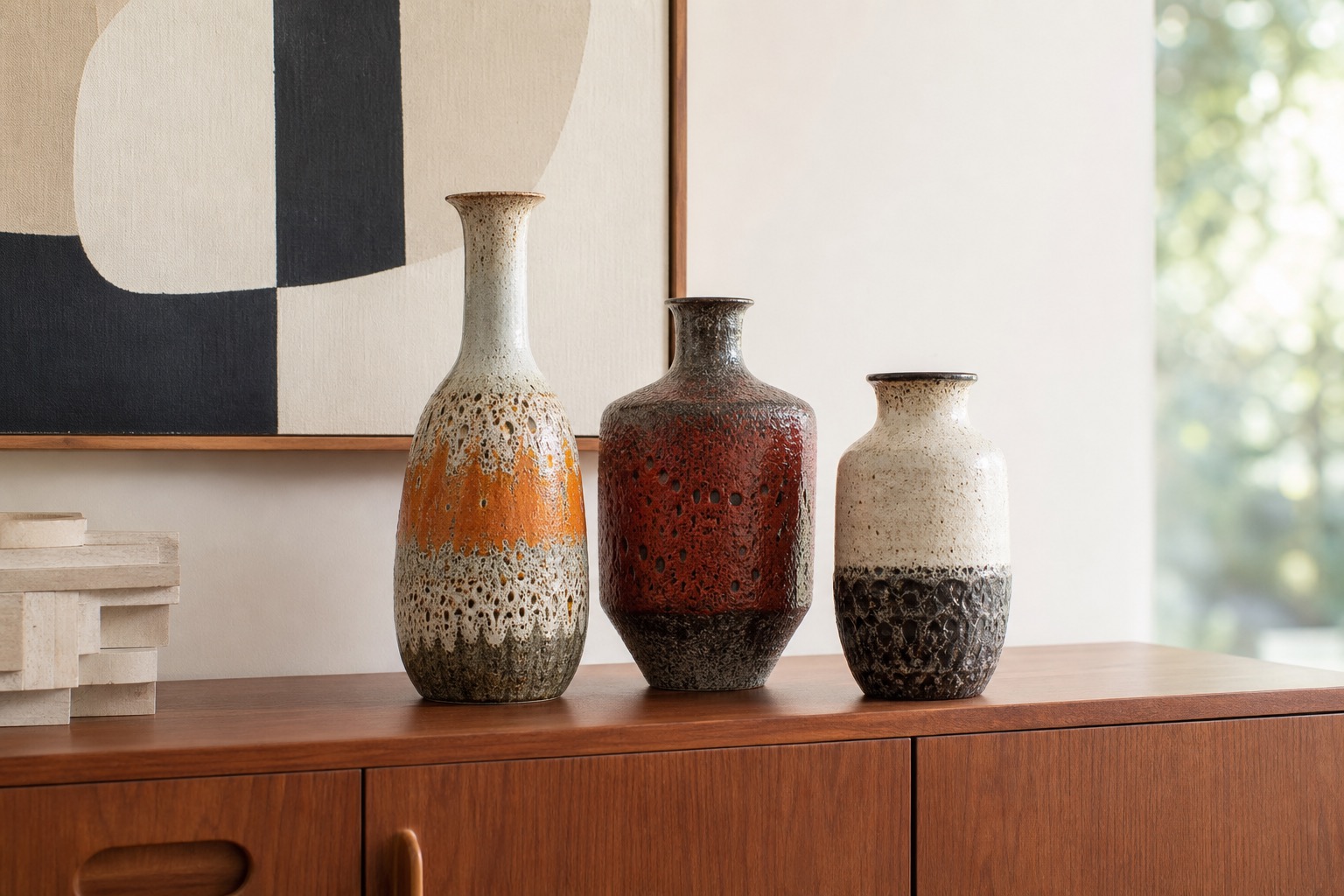
The collecting label West German Pottery is useful in the market, but it is imprecise. That is exactly why reliable maker and marks sources matter. On its own company history page, Scheurich states that the business was founded in 1928 as a wholesaler of glass and porcelain and that in 1954 it began ceramic production with its first electrical tunnel kiln. For collectors, one later detail is especially revealing: for the 1970s, Scheurich explicitly describes “strong colors and lava-type glazes” as typical. That matters because it confirms a familiar market look through a primary manufacturer source rather than through dealer shorthand alone.

This is useful because many listings still rely on broad labels such as “Fat Lava” or “West Germany vase”. Those terms may describe surface character or country of origin, but not necessarily the workshop. As on our page about stoneware crockery, the underside is often more informative than the front view. With West German vases, that is especially true.

Scheurich and Carstens show that production history can be checked, not guessed

With Scheurich, the move from wholesaling into ceramic manufacture is unusually easy to date. The company does not merely give a foundation year; it names 1954 as a concrete technical beginning for ceramic production. Its chronology also notes that in 1956 animal figures with built-in clocks were highly popular gift and decoration articles. Details like that keep West German pottery from collapsing into a single vase stereotype; they show a broader postwar field spanning decorative ceramics, giftware and serial production.

Carstens sharpens the picture from another angle. The current Carstens site explicitly trades on the phrase “Seit 1878 mit Bodenmarke”—since 1878 with a base mark—and describes the firm as a family company across generations. The reference database Porcelain Marks and More is even more concrete for the postwar works Carstens Tönnieshof: it gives the family’s founding in Elmshorn in 1878, describes the postwar restart in Moringen-Fredelsloh, and notes that by 1950 Carstens had returned to fourth place among German ceramics manufacturers. For collectors, that is a practical indicator of real industrial scale and market presence.

Why “Germany”, “W.-Germany” and “West Germany” are buying clues, not final answers

The most useful part of the Porcelain Marks and More entry is its documentation of concrete mark variants. For Carstens Tönnieshof it records forms using “Germany”, “W.-Germany”, “West Germany” and several paper labels. That explains why a vase is not fully identified simply because the base says “West Germany”: the origin is narrowed, but the workshop often still has to be refined through additional marks, form numbers and traces of original labels.

That is where the article becomes shop-relevant. In our Decoration category, vases and ceramic objects regularly appear that clearly belong to the West German postwar modern tradition. When judging them, it is more useful to compare base photographs, number strings, maker abbreviations, label residue and glaze quality than to rely on colour alone. That combination is what turns a generic vintage vase into a properly described collector’s object.

Sources

FAQ · 02

Frequently asked about West German Pottery

5 Answers

01
What does the collecting term West German Pottery actually mean?
In the trade it usually refers to decorative and domestic ceramics made in the Federal Republic of Germany after the Second World War. For buyers, however, the term is only a starting point; attribution becomes much stronger once the maker, base mark, form number and glaze can be narrowed down.
02
Why is Scheurich important in this field?
Scheurich’s own company history records 1928 as the founding date of the wholesale business and 1954 as the start of ceramic production with its first electrical tunnel kiln. For the 1970s the company explicitly notes strong colours and lava-type glazes as typical, which directly connects a familiar collector look to a primary manufacturer source.
03
What can be verified about Carstens?
Carstens presents itself as a family company with continuity since 1878 and explicitly foregrounds the base mark as part of its identity. Porcelain Marks and More adds that Carstens Tönnieshof used markings such as Germany, W.-Germany, West Germany and several paper labels after 1946.
04
Why is the base mark more useful than the style label “Fat Lava”?
Because similar silhouettes and textured glazes were used by more than one producer. A base mark, impressed number or surviving label gives you something verifiable to compare against reference sources.
05
How does that help when buying in the shop?
When assessing West German ceramics, always inspect the underside in photographs: marks, numbers, ceramic type and condition become much easier to judge. Relevant pieces appear in our [Decoration](/en/shop?category=dekoration) category.

GLOSSARY · 03

Related Terms

6 Entries

Base mark
An impressed, printed or paper-applied maker’s identification on the underside of a ceramic object. In attribution work it is often more important than the silhouette alone.
Electrical tunnel kiln
The production technology Scheurich cites for its 1954 start in ceramics. The detail matters because it dates the company’s move from wholesaling into industrial ceramic manufacture.
Lava-type glaze
A heavily textured glaze surface that Scheurich explicitly describes as typical of the 1970s. In the trade it is often absorbed into the broader but less precise label “Fat Lava”.
W.-Germany
An abbreviated country-of-origin marking found on West German ceramics. Porcelain Marks and More documents it among the Carstens Tönnieshof variants.
Paper label
A maker’s adhesive label used in addition to impressed marks. On West German ceramics, a surviving label can be a strong attribution clue.
Carstens Tönnieshof
The postwar Carstens works in Moringen-Fredelsloh, documented by Porcelain Marks and More for the years 1946 to 1977.