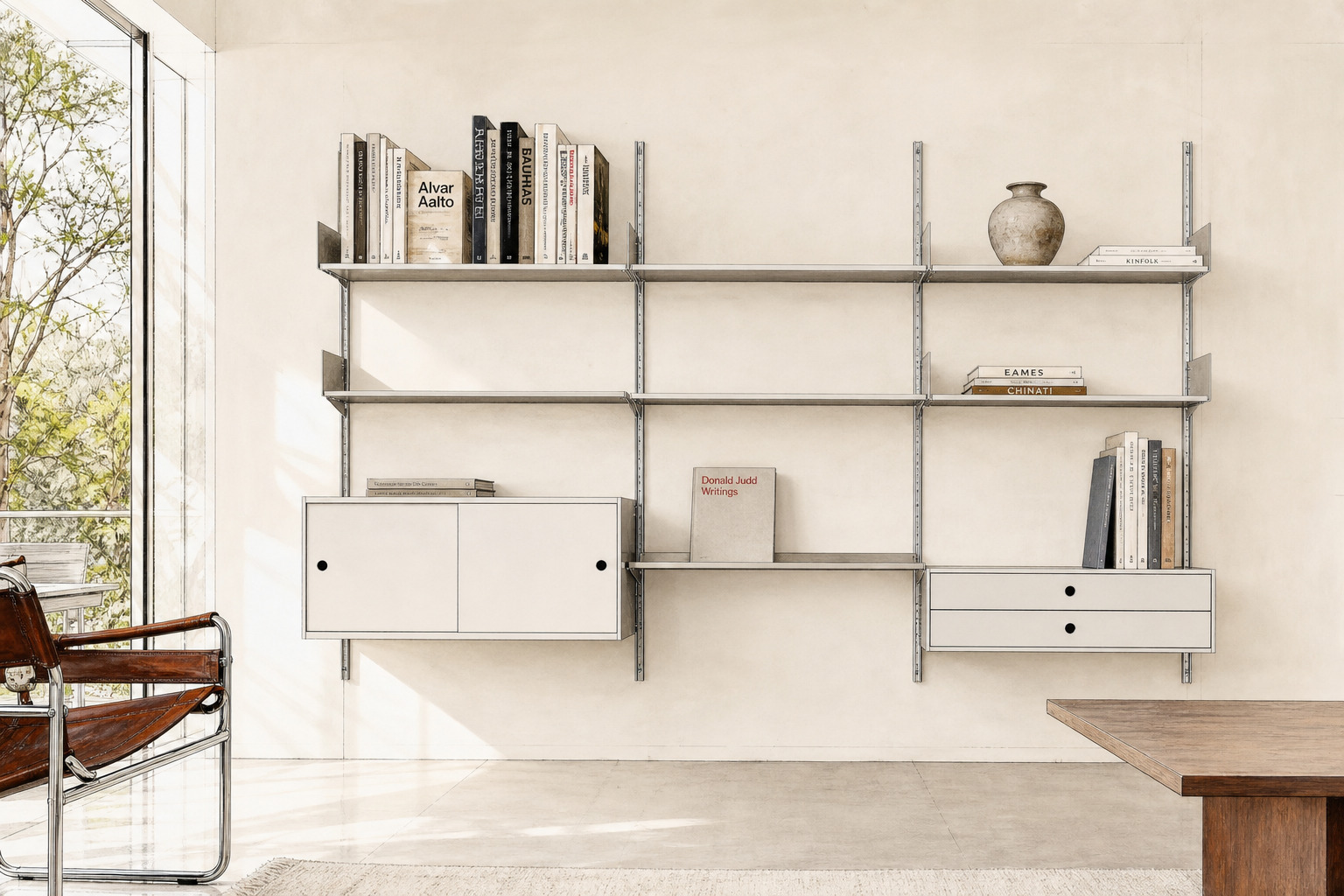
CATEGORY · VITSŒ 606 SHELVING SYSTEM

Vitsœ 606 shelving system — a reduced storage design built to survive moves, additions and decades of use

Dieter Rams began developing the idea in 1957, and the system reached the market in 1960 as a wall-mounted solution

Vitsœ, the Design Museum and Archive of Objects all describe the 606 as a modular shelving system by Dieter Rams. Because its construction, dating and material logic are unusually well documented, it is one of the clearest mid-century objects for separating real design substance from generic minimalism.

mid-century·designs

Vitsœ 606 shelving system

ESSAY · 01

Work & Context

mid-century·designs

The 606 is more useful to understand as a documented system than as a generic minimalist shelf

Anyone shopping for mid-century shelving quickly encounters many later systems that borrow a restrained look without sharing the same design logic. The Vitsœ 606 shelving system is easier to place historically. Vitsœ states on its product page that it was “Designed by Dieter Rams in 1960 and made by Vitsœ ever since.” The Design Museum adds that Rams began work in 1957 on a modular storage system and describes the 606 as one of his most successful designs. Archive of Objects further notes that the system was launched in 1960 as RZ 60 and renamed 606 in 1970.

That combination of manufacturer, museum and archive evidence matters for collectors. The object is not known only through reputation, but through dates, names and concrete construction features. Readers who have already seen our page on Dieter Rams can trace here how Rams’s broader idea of durable, low-noise design became furniture.

The real innovation lies in the wall-mounted construction

The Vitsœ history page gives the clearest account of the system’s beginnings. It says that in 1955, while rethinking Braun interiors, Rams already sketched the first notion of a track-based, wall-mounted storage system. Two years later, according to the same source, Otto Zapf asked him to design furniture for his father’s furniture company. In the Vitsœ chronology, 1960 then marks the launch of the originally RZ 60 as a wall-mounted storage solution.

On its product page, Vitsœ still explains the structure in unusually direct terms: at the core is the aluminium E-Track, from which shelves, cabinets and tables are hung by pins, without tools. That logic matters more than any decorative label because it shows exactly where the system’s value lies. It is not a fixed bookcase but a kit of parts that can change with a home, study or collection.

Material clarity and production continuity make it especially relevant in the market

The Design Museum describes the 606 as a system intended to offer maximum flexibility from the minimum number of components. It specifies shelves, cupboards and drawers made from 3 mm sheets of anodised aluminium, connected to an extruded aluminium E-Track by 7 mm aluminium pins. For buyers, those are not trivial technical notes. They provide concrete checks for distinguishing a genuinely thought-through system from later approximations.

Archive of Objects adds that, after the shift to the name 606, the system remained virtually unchanged in its essentials. That long continuity should always be considered together with condition and provenance, but it is still the practical takeaway: the 606 is one of the few mid-century furniture systems whose dating, structure, expandability and material language can be checked against solid public sources. For more rigorously designed domestic objects, browse mid-centurydesigns.com/en/shop.

Sources

FAQ · 02

Frequently asked about Vitsœ 606 shelving system

5 Answers

01
Who designed the Vitsœ 606 shelving system?
Vitsœ explicitly identifies the 606 as a design by Dieter Rams. The Design Museum likewise presents it as a modular storage system developed by Rams, and Archive of Objects attributes it to Dieter Rams for Vitsœ.
02
When did the idea for the 606 begin?
According to Vitsœ history, the first idea appeared in 1955 in a sketch for modernised Braun interiors. The Design Museum then lists 1957 as the point when Rams began work on the modular 606 storage system.
03
Since when has the system been produced?
Vitsœ describes itself as a company active since 1959 and states on the product page that the 606 was designed by Dieter Rams in 1960 and made by Vitsœ ever since. Archive of Objects adds that it launched in 1960 as RZ 60 and was renamed 606 in 1970.
04
What is distinctive about the 606 construction?
Vitsœ explains that the aluminium E-Track is the core of the system, with shelves, cabinets and tables hung from it by pins without tools. The Design Museum adds 3 mm anodised aluminium sheets and 7 mm aluminium pins.
05
Why is the 606 relevant to buyers and collectors?
Because its quality can be checked through concrete features rather than style claims alone: wall-mounted E-Tracks, modular expandability, long production continuity and a clearly documented aluminium construction.

GLOSSARY · 03

Related Terms

6 Entries

E-Track
The wall-mounted aluminium track that Vitsœ describes as the structural core of the 606 system. Shelves, cabinets and tables hang from it.
Dieter Rams
German designer identified by Vitsœ, the Design Museum and Archive of Objects as the author of the 606 shelving system.
RZ 60
The system's original name at its 1960 launch. Archive of Objects notes that it was renamed 606 in 1970.
Anodised aluminium
Material specified by the Design Museum for the 3 mm system elements, a more useful identifier than the vague phrase “metal shelving”.
Modularity
The principle that a system can be expanded and rearranged from compatible parts. Vitsœ and the Design Museum both present this openness as central to the 606.
Vitsœ
Furniture company that, according to its own history, has existed since 1959 and still manufactures the 606 as the original maker.