CATEGORY · TUBE RADIO

The Tube Radio as Design Object

Where acoustic engineering meets mid-century form.

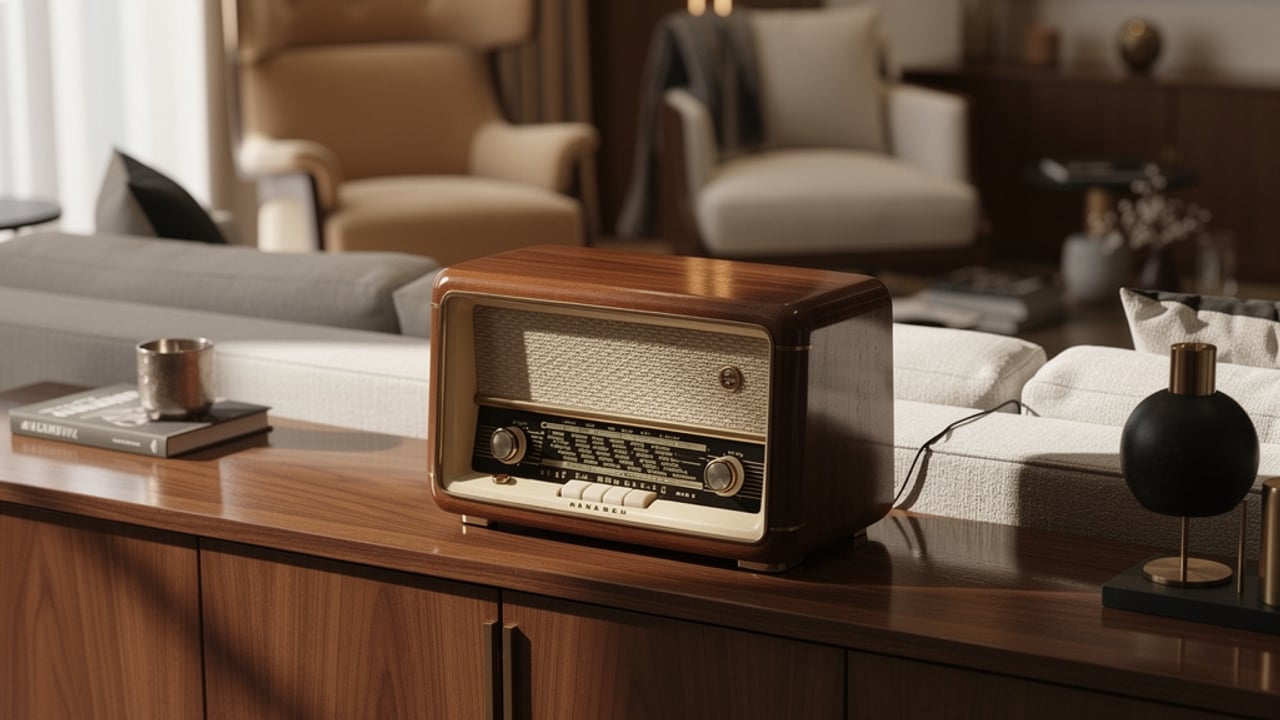
From Braun's functionalist cabinets to Grundig's sculptural consoles, the postwar decades produced radio receivers of extraordinary aesthetic ambition. Each piece in our collection is authenticated, condition-graded, and offered with full provenance documentation.

mid-century·designs

tube radio

ESSAY · 01

Work & Context

mid-century·designs

A Brief History of tube radio

The vacuum tube receiver emerged in the early twentieth century as a purely utilitarian instrument. By the 1950s, however, designers and manufacturers across Europe, the United States, and Japan recognised its commercial and cultural potential. The wooden console gave way to Bakelite, then to anodised aluminium and injection-moulded thermoplastics. Dials became graphic exercises; speaker grilles evolved into geometric statements; cabinets shrank from furniture-scale objects into handheld companions.

This transformation was not incidental. At firms such as Braun in Frankfurt and Bang & Olufsen in Struer, design departments were granted authority that rivalled that of the engineering teams. The result was a generation of objects that balanced acoustic performance with a rigorous, sometimes severe, visual language drawn equally from the Bauhaus tradition and from postwar optimism. Collecting these instruments today means engaging with that dual inheritance: the object as machine and as manifesto.

Production of the classic tube radio continued well into the 1970s, even as transistor technology displaced thermionic valves in mass-market goods. High-fidelity enthusiasts and certain prestige manufacturers sustained valve-based production precisely because the warmth of the sound — a function of the tube’s characteristic harmonic distortion — remained commercially and sonically desirable.

Notable tube radio Designs of the Era

Several manufacturers defined the canon. Braun’s SK series, conceived under the influence of Hochschule für Gestaltung Ulm, set a template for restrained, systematic design that subsequent decades have never fully superseded. Grundig’s Majestic console models pursued a different register: walnut veneers, illuminated dial scales, and a monumentality befitting a domestic centrepiece.

In Scandinavia, Bang & Olufsen produced receivers whose horizontality and material precision aligned them with the broader current of Danish furniture modernism. Jacob Jensen would later codify this approach, but the groundwork was laid by engineers and craftsmen working in the 1950s and early 1960s. Italian manufacturers, meanwhile, favoured expressive plastics and biomorphic silhouettes that reflected the influence of industrial designers working simultaneously on domestic appliances and automobile bodies.

Each of these lineages is represented in the mid-centurydesigns.com catalogue, with condition reports prepared by specialist conservators.

Where to Find Authentic tube radio on the Market

Authenticity is the central challenge of this collecting category. The market contains significant numbers of restored, resprayed, and partially substituted instruments offered without adequate disclosure. Provenance documentation — ideally including original receipts, manufacturer service records, or auction house certificates — materially reduces this risk.

Reputable specialist dealers and vetted auction platforms are the safest acquisition channels. Mid-century-designs.com subjects every instrument to a structured authentication review covering chassis markings, component dating, and cabinet finish consistency. Buyers receive a condition grade on a five-point scale together with a written conservation report. This standard of disclosure is, regrettably, uncommon in the broader vintage electronics market.

Estate sales and regional auctions occasionally surface unrecognised examples at accessible prices, but such opportunities require a degree of technical knowledge that most new collectors have not yet developed. Engaging an independent specialist for pre-purchase consultation is advisable before any significant acquisition outside established channels.

Caring for Your tube radio Collection

Storage and display conditions determine long-term preservation outcomes. Thermionic valve instruments are sensitive to sustained humidity above sixty percent, which promotes corrosion on chassis components and softens adhesive bonds in cabinet veneers. A stable environment of eighteen to twenty-two degrees Celsius with relative humidity between forty and fifty-five percent is the accepted conservation standard.

Periodic operation — running the set for thirty to sixty minutes monthly — maintains the condition of electrolytic capacitors and keeps tube filaments from seizing. Any instrument that has been in storage for more than two years should be recommissioned gradually using a variable transformer, allowing filter capacitors to reform before full mains voltage is applied. This procedure should be carried out by a qualified valve electronics technician rather than attempted without experience.

Cabinet surfaces in Bakelite or early thermoplastics should be cleaned only with a dry or very lightly dampened microfibre cloth. Solvent-based products will permanently alter surface gloss and can dissolve original silk-screened dial markings. Waxing wooden cabinets with a non-silicone furniture wax, applied sparingly, is appropriate and will not complicate future conservation treatments.

FAQ · 02

Frequently asked about tube radio

5 Answers

01
How do I verify that a vintage receiver is genuinely valve-based and not a later transistor model?
Open the chassis — carefully, with the set unplugged — and inspect the component population. Thermionic valves are glass envelopes, typically cylindrical, seated in ceramic or metal sockets. Transistors are small, often resin-encapsulated components soldered directly to a circuit board. Chassis stampings and original service documentation will corroborate the production date and specification.
02
What condition grades should I expect when purchasing from mid-centurydesigns.com?
We apply a five-point scale: Grade 1 denotes museum quality with no visible wear; Grade 2 indicates minor cosmetic imperfections consistent with careful ownership; Grade 3 represents honest display condition with visible patina; Grade 4 describes restoration candidates requiring conservation work; Grade 5 covers parts-only or heavily compromised examples. Full written reports accompany every listing.
03
Is it safe to operate a vintage valve receiver in a domestic setting?
Yes, provided the instrument has been inspected and recommissioned by a qualified technician. Key safety checks include replacing aged electrolytic capacitors, verifying mains transformer insulation integrity, and confirming that the chassis earth connection is sound. A recommissioned, properly fused receiver presents no greater risk than any other vintage electrical appliance used under normal domestic conditions.
04
Which manufacturers command the highest prices at auction today?
Braun, Bang & Olufsen, and certain Grundig models consistently achieve premium results. Rarity of model, originality of finish, and completeness of documentation are the primary value drivers. Instruments associated with named designers — Dieter Rams, Jacob Jensen — carry an additional premium reflecting their place in design history. Condition remains the single largest determinant of realised price.
05
Can replacement valves still be sourced for 1950s and 1960s receivers?
The global new-old-stock and new-production valve market remains surprisingly robust. Most common European and American types — EL84, ECC83, 6V6, and their equivalents — are available from specialist suppliers in Eastern Europe and Asia. Unusual proprietary types may require patient searching through specialist dealers or collector networks, but very few types are genuinely unobtainable at present.

GLOSSARY · 03

Related Terms

7 Entries

Bakelite
A phenol-formaldehyde resin, the first fully synthetic plastic, widely used for radio cabinets from the 1930s through the 1950s. Its characteristic colours — black, brown, ivory — and distinctive lustre are important period markers and are highly susceptible to solvent damage.
Hochschule für Gestaltung Ulm
A West German design school operational from 1953 to 1968, philosophically descended from the Bauhaus. Its systematic, functionalist methodology directly shaped the visual language of postwar European industrial design, most influentially through its collaboration with Braun AG.
Dieter Rams
German industrial designer, chief of design at Braun from 1961 to 1995. His ten principles of good design and his austere, systematic product language remain the primary reference for mid-century functionalist aesthetics and continue to command significant collector and institutional interest.
Jacob Jensen
Danish industrial designer responsible for Bang & Olufsen's product identity from the late 1960s through the 1990s. His work synthesised Scandinavian material sensibility with an extreme horizontal compositional discipline, producing objects now held in major design museum collections worldwide.
Thermionic Valve
An evacuated glass envelope containing electrodes that control the flow of electrons, used to amplify or rectify electrical signals. Known in North America as a vacuum tube, it defines the audio character and technical constitution of pre-transistor radio and high-fidelity amplification equipment.
Provenance
The documented ownership and exhibition history of an object, used to establish authenticity and, where relevant, cultural significance. In the vintage electronics market, provenance records include original receipts, service documentation, and auction catalogues that trace an instrument from manufacture to present ownership.
Electrolytic Capacitor
A polarised capacitor using an electrolyte to achieve high capacitance in compact form, critical in power supply filtering within valve equipment. These components degrade over decades and are typically replaced during professional recommissioning to ensure safe and accurate operation of vintage instruments.