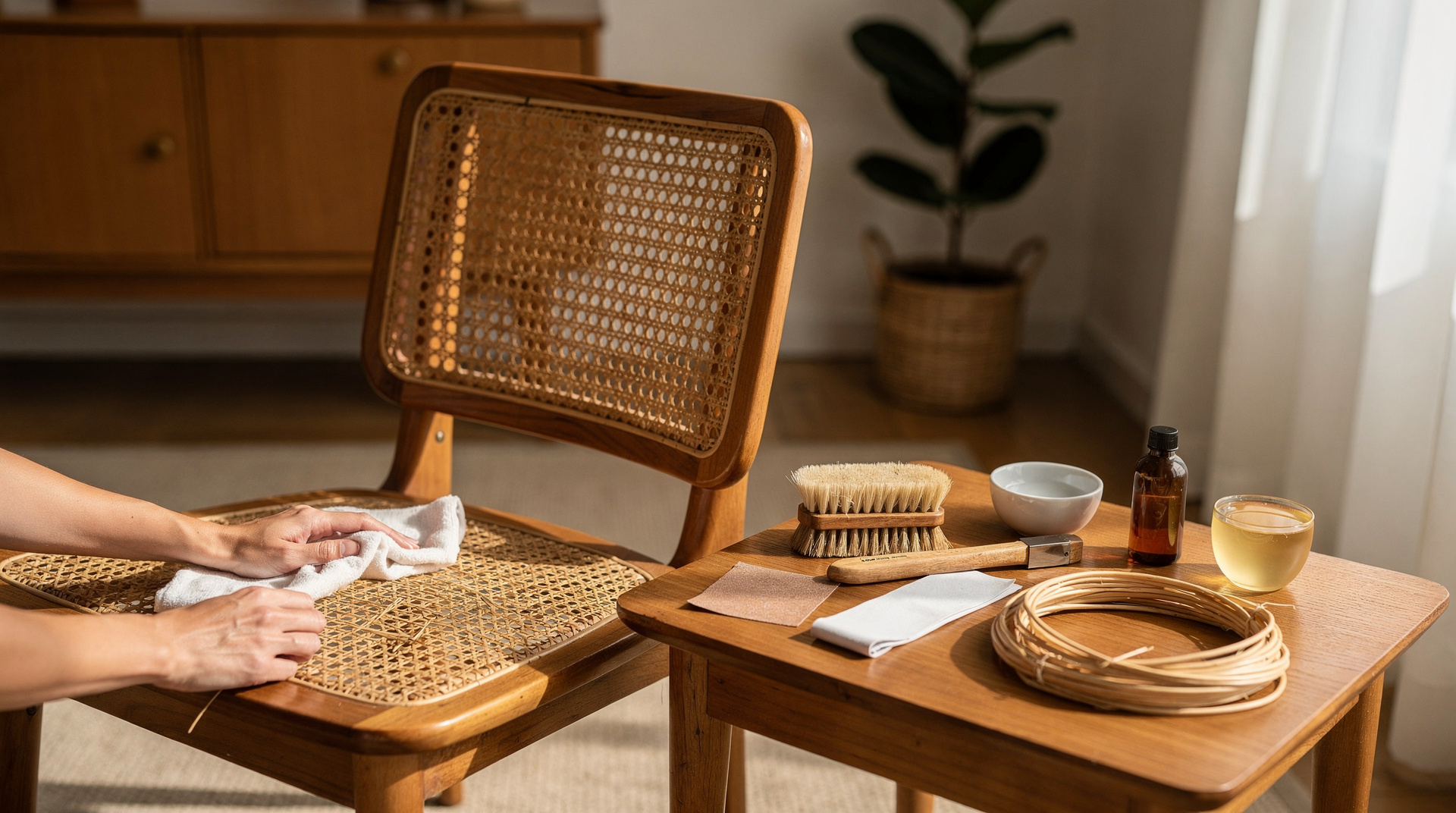
Caring for and Restoring Rattan and Viennese Cane
Woven seat surfaces, backrests, and body coverings are among the most delicate yet defining elements of Mid-Century furniture construction. Anyone who uses a chair by Hans J. Wegner, an armchair by Franco Albini, or a sideboard with rattan covering in their studio knows the ambivalence: the weave carries the aesthetic of the design, yet is simultaneously its most vulnerable component. It responds to humidity, dryness, UV radiation, and localised stress. Proper care is therefore less about cosmetics and more about a conservation practice that preserves the value of an original.
The following sections summarise what you should know about materials, historical contexts, and the assessment of condition and authenticity before cleaning yourself, commissioning repairs, or ordering a new weave. Guiding principle: every intervention should be reversible, carried out in a material-appropriate manner, and kept to a minimum in scope wherever possible.
1. Characteristic Materials and Their Properties
In Mid-Century furniture construction, you will encounter essentially three woven material qualities, which differ in origin, processing, and care requirements.
Viennese Cane (Hexagonal Weave): Pre-fabricated panels made from the split outer skin of the rattan palm (Calamus rotang), machine-woven into the characteristic octagonal pattern and set into a routed groove in the frame with a spline. It reacts strongly to humidity: rooms that are too dry make it brittle, while rooms that are too humid cause it to sag. The ideal range is 45 to 55 percent relative humidity. Cleaning should be done dry using a soft brush or vacuum cleaner on a low setting; for heavier soiling, use lukewarm water, a few drops of pure soap, and a barely damp cloth, then allow to dry flat. If Viennese cane has sagged, it can be moistened once with warm water from the underside; as it dries, it will pull taut again.
Hand-woven Cane (seven steps): Identifiable on high-quality frames by a surrounding row of holes. This technique was used on Scandinavian chairs of the post-war years, including several models by Wegner. Re-weaving by an experienced workshop is labour-intensive and is generally the only authentic replacement option.
Pedicle Reed and Rattan Core: Worked in full-round or half-round form, usually as a woven backrest, body covering, or wrapping on metal and wooden frames (Albini, Bonacina, Gebrüder Thonet, Lio Carminati). Pedicle reed is more robust than Viennese cane, but becomes locally brittle under stress. Regular dusting and a light annual application of a colourless, wax-based furniture conditioner keeps the fibres supple. Linseed oil-based products should be avoided as they yellow and clog the gaps.
For all woven materials: no direct sunlight, no placement above radiators, no seat cushions with non-slip rubber backing that can locally overheat and leach the material.
2. Regional Schools and Designers
Woven elements became defining features in several centres of Mid-Century modernism, each with its own formal language.
Denmark: Hans J. Wegner used paper cord and cane weave as load-bearing seat surfaces — for example on the CH24 (Wishbone Chair, 1949, Carl Hansen & Søn) with envelope-woven paper cord, or the PP512 with cane weave. Nanna Ditzel worked with pedicle reed and rattan for R. Wengler and later Sika-Design, visible in designs such as the Hanging Egg Chair (1957). Kaare Klint and Rud. Rasmussen also incorporated cane weave into classically modern frames.
Italy: Franco Albini defined a formal language with the Margherita chair and the Gala model (1951, Bonacina 1889 in Lurago d’Erba) in which rattan functions as both structural and ornamental element. Gio Ponti, Tito Agnoli, and later Afra and Tobia Scarpa also employed rattan and pedicle reed.
France: Audoux-Minet in Golfe-Juan combined cord and woven rope with reduced frames. Louis Sognot and Janine Abraham designed rattan furniture for Édition Rougier.
Germany and Austria: The tradition of Viennese cane extends from Thonet into Mid-Century production — for example in the model 214 and the bentwood re-editions of the 1950s and 1960s. In the Netherlands, Dirk van Sliedregt and Rohé Noordwolde used rattan for production chairs with a high degree of design precision.
These attributions help you to position a piece stylistically and in terms of production history, and to derive from this which repair technique is appropriate in the first place.
3. Authenticity and Condition from a Collector’s Perspective
When purchasing or deciding on restoration, three levels need to be examined: the integrity of the frame, the originality of the weave, and the quality of any previous work.
Frame Integrity: Check mortise-and-tenon joints, nut seatings, and frame grooves. A chair with loose joints should be re-glued before new cane is stretched. Otherwise the wood works against the weave, and the new covering tears prematurely.
Originality of the Weave: Not every original weave is worth preserving at any cost. A historically significant piece with intact, aged original weave is collectorially superior to a re-woven example, provided use remains gentle. A repeatedly patched, torn weave, on the other hand, is usually better replaced by a professionally executed re-weaving in the identical technique. Pay attention to the type of work (hexagonal weave machine-made versus seven-step hand-woven), to the diameter of the material, and to the depth of colour from ageing. Chemically bleached or artificially patinated new work can be identified by an even, surface-level colouring without depth.
Provenance and Documentation: Maker’s marks (burned-in stamps, metal plaques, sewn labels on seat cushions), invoices, and publication records increase certainty. For Italian rattan furniture, it is worth comparing with manufacturer catalogues from Bonacina, Vittorio Bonacina, and Pierantonio Bonacina; for Danish chairs, with the production records of Carl Hansen & Søn, PP Møbler, and Fredericia.
Assessing Restorations: A documented, cleanly executed re-weaving reduces value less than an imprecise repair. Ask who carried out the work, what material was used, and whether photographs of the previous condition exist.
At mid-centurydesigns.com, we examine every woven piece before inclusion in our inventory for frame integrity, originality of the weave, and the quality of any existing restorations. Where a new weave is necessary, we work with specialist workshops in Denmark, Italy, and Germany that are proficient in the original technique for each piece. For every object you will find details of the manufacturer, dating, condition of materials, and documented interventions, so that you can make your decision on a solid basis.