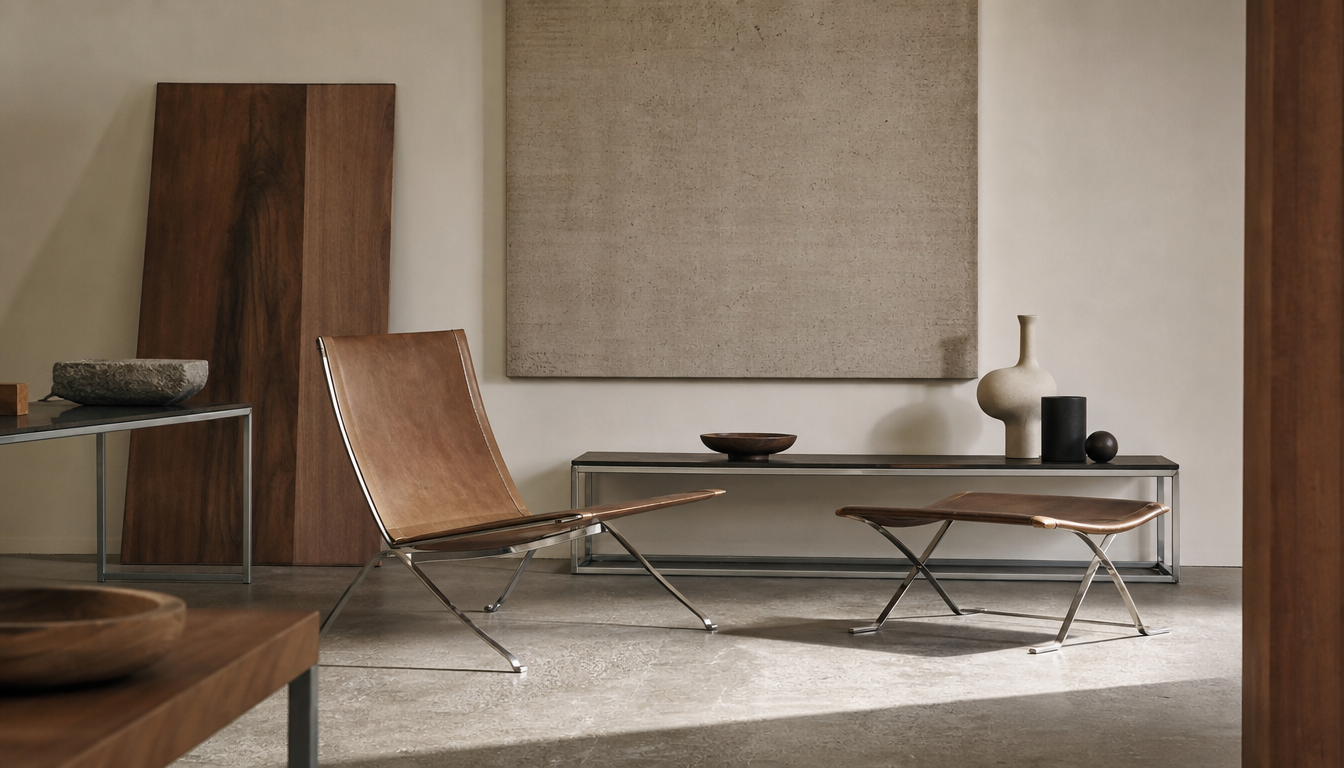
Poul Kjærholm – The Purist of Danish Modern
Anyone wishing to tell the story of Danish postwar furniture design cannot pass over Poul Kjærholm. And yet his name still lingers in the shadow of Hans J. Wegner or Arne Jacobsen in the public consciousness, even though his work in precision, conceptual consistency, and craft radicality is scarcely surpassed. Kjærholm, born in 1929 in the Jutland town of Østervrå, first completed a carpentry apprenticeship before studying at the Kunsthåndværkerskolen in Copenhagen under Ole Wanscher. This dual training – in woodcraft and in design theory – laid the foundation for an approach that set him apart from his contemporaries: Kjærholm was not interested in the warm and organic qualities that made Danish modernism so popular. He sought the absolute. His tool was steel, his standard was industrial production, his model was classical antiquity. The furniture that emerged between the early 1950s and his untimely death in 1980 are objects of thought as much as objects of use. For collectors and design connoisseurs who look beyond the obvious, they rank among the most significant testaments to twentieth-century European industrial design.
Characteristic Materials: Steel, Natural Hides, and the Honest Contradiction
Kjærholm’s decisive turning point was his choice of matte, brushed flat steel as the primary structural material, at a time when Danish design was almost synonymous with wood. He justified this choice not technically but aesthetically and culturally: steel was a natural material, an ore that came from the ground, no lesser than wood. This argument was no marketing manoeuvre; it reflected a genuine philosophical position. The steel frames of his furniture, initially produced by Fritz Hansen from 1955 and later by PP Møbler, were constructed with a standard of precision reminiscent of the smith’s craft. The welds are invisible, the angles mathematically exact, the connections between frame and seat surface appear to float. At the same time, Kjærholm consistently combined this coldness of steel with natural materials that generated a sensory tension: undyed cowhide on the PK22, woven sisal mats on the PK25, patinated leather on the PK80 Daybed. Marble, slate, and glass joined as tabletops. These pairings were not compromises; they were the actual programme. The friction between industrial precision and organic texture was, for Kjærholm, the essence of furniture design. For collectors, this means: the authenticity of materials in Kjærholm is non-negotiable. Retrofitted upholstery, replaced seat surfaces from non-contemporary leather batches, or modern sisal weaves alter the object fundamentally – not only visually.
Regional Schools and Key Figures: Kjærholm in the Network of Danish Modernism
Kjærholm was not a lone figure, even if his work appears so. He emerged from a specific milieu: the Copenhagen design school of the late 1940s and 1950s, which cultivated an unusual combination of Bauhaus rationalism, British Arts and Crafts heritage, and Nordic material tradition. His teacher Wanscher conveyed to him a respect for historical formal repertoires, above all the Egyptian folding stool and the Greek klismos chair – references clearly visible in Kjærholm’s PK91 folding stool and PK22 armchair. The influence of Ludwig Mies van der Rohe is documented and was named by Kjærholm himself, particularly the Barcelona chairs as a structural and ideological model. Nevertheless, Kjærholm’s approach is entirely his own: where Mies van der Rohe sought monumental representation, Kjærholm sought reductive stillness. The manufacturer Fritz Hansen played a decisive role in the early dissemination; after Kjærholm’s death, E. Kold Christensen took over the licences, and today Fritz Hansen once again produces authorised reissues under the brand name Republic of Fritz Hansen. For the collector market, the production history is central: pieces from the Kold Christensen era, particularly from the 1960s and 1970s, are today regarded as especially coveted vintage originals, as they were produced under the direct supervision of the designer or his immediate successors. Pieces without documentable manufacturer attribution should be regarded with caution.
Authenticity and Condition: What Collectors Must Examine in Kjærholm
Kjærholm originals are well documented on the international auction and gallery market, but also well forged and frequently misattributed. The most important checkpoints begin at the underside of the steel frame: legitimate vintage pieces from Fritz Hansen production of the 1950s through the early 1970s bear stamped or etched markings with model number, production year, and the Fritz Hansen logo. Kold Christensen pieces from 1982 onwards use their own stampings. Missing markings are not automatically grounds for exclusion, but may indicate reproductions or unauthorised individual production. On the flat steel itself, the condition of the surface is decisive: the characteristic matte brushing of the original changes irreversibly through polishing. High-gloss polished frames offered as vintage pieces are a warning sign. For the cowhide of the PK22, the rule is: the original displays an irregular, natural hide structure with visible pores. Industrially uniformly embossed covers are indicators of later restorations or reproductions. Patina in Kjærholm is not a flaw; it is evidence. An even ageing of the leather, slight traces of oxidation at weld seams, and the natural greying of untreated natural materials tell the story of the piece. Collectors acquiring a Kjærholm piece in apparently untouched new condition should ask for the restoration protocol. Transparency in provenance is not optional with these objects; it is an obligation.
At mid-centurydesigns.com, every Kjærholm piece is individually examined before being admitted to the inventory: manufacturer markings are documented, material findings are captured photographically, and the provenance history is traced as far as possible. Only objects whose authenticity and condition meet the criteria described here make their way into the curation. The goal is not completeness, but reliability – for collectors who do not wish to guess, but to know what they are acquiring.