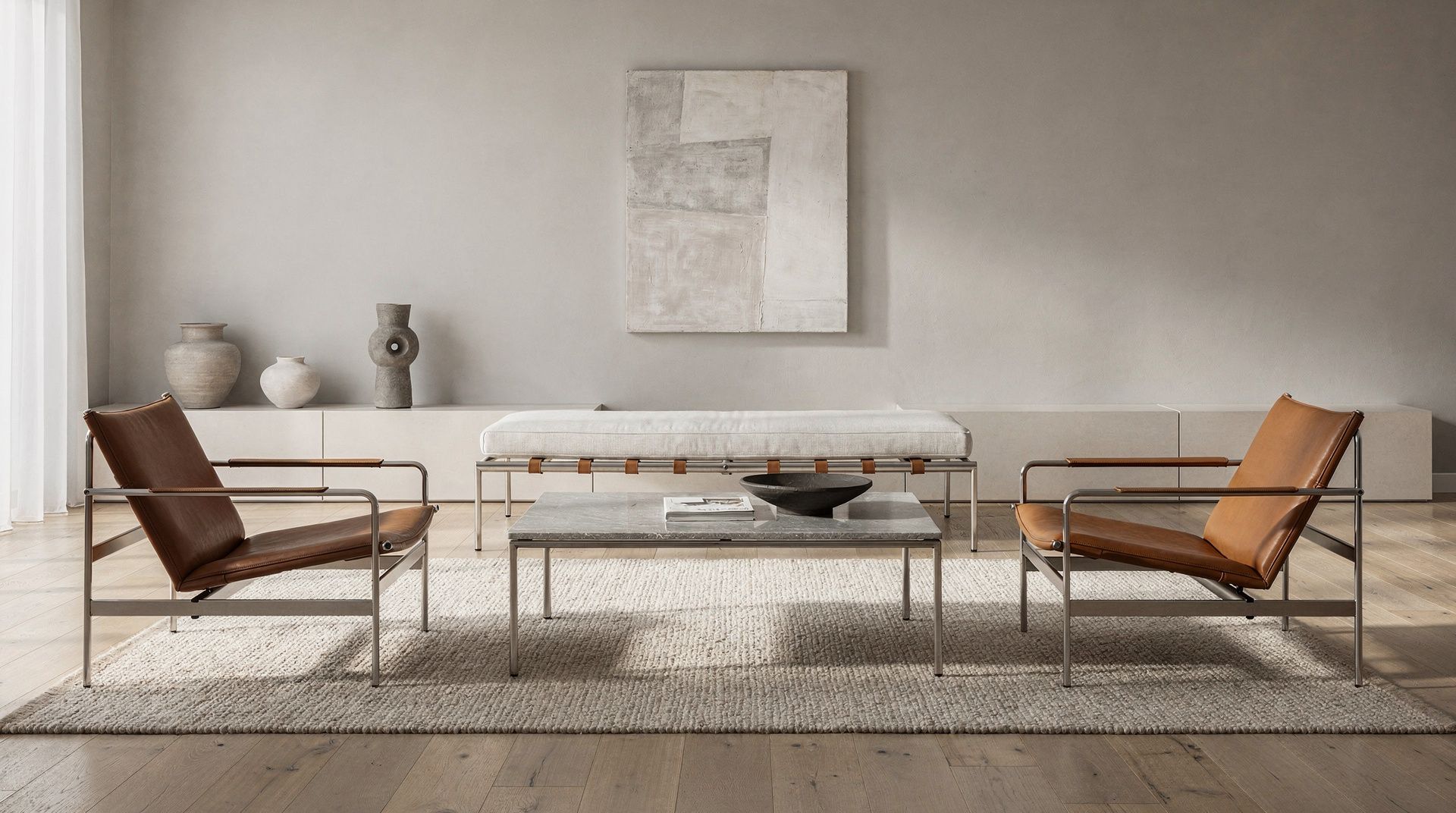
DESIGNER · POUL KJÆRHOLM

Poul Kjærholm: The Master of Reduced Steel Frames

Precision in Spring Steel, Leather and Natural Stone

Poul Kjærholm (1929 to 1980) occupies a special position within Danish Modernism: where Wegner and Juhl celebrated wood, he chose industrially manufactured spring steel as the load-bearing element. His PK series, produced from 1955 in collaboration with E. Kold Christensen and by Fritz Hansen since 1982, combines strict geometric order with sensual materials such as leather, wicker and marble. At mid-century designs you will find curated originals whose provenance and production details we carefully verify.

mid-century·designs

Poul Kjærholm

ESSAY · 01

Work & Context

mid-century·designs

Poul Kjærholm and the Precision of Steel

Poul Kjærholm (1929–1980) occupies a special position within Danish Mid-Century Modern. While contemporaries such as Hans J. Wegner or Finn Juhl made warm, crafted wood the foundation of their formal language, Kjærholm chose cool, industrially manufactured spring steel as the load-bearing element. Trained as a cabinetmaker and later a graduate and lecturer at the Copenhagen School of Arts and Crafts, he understood furniture not as sculpture but as a constructive task. His designs emerge from a precise relationship between structure, support and proportion – one that rarely surprises the viewer but convinces consistently.

The celebrated PK series, produced from 1955 initially by Ejvind Kold Christensen and since 1982 by Fritz Hansen, is today one of the most thoroughly documented œuvres in Scandinavian Modernism. Those interested in original editions enter a market where dating, manufacturer markings and the condition of the steel largely determine the value of a piece. The following sections offer guidance for collectors and designers who wish not only to own Kjærholm’s work, but to understand it.

Characteristic Materials: Spring Steel, Leather, Natural Stone

Kjærholm’s material canon is concise and consistent. Central to it is matte-brushed spring steel, which he had processed as cold-rolled strip material. In the PK22 (1956), the PK24 chaise longue (1965) or the PK20 armchair (1967), this frame carries the true design weight: it traces the silhouette, spans the surface and simultaneously references industrial production without concealing it.

For surfaces, Kjærholm preferred natural materials with a pronounced ageing aesthetic. Frequently encountered are:

  • Leather in natural, black or Elegance qualities, often saddle-coloured, developing a distinctive patina over the years.
  • Woven cane, as found on the PK22 in its classic cane version.
  • Canvas on the PK24, which works with a stainless steel counterweight neck roll.
  • Slate slabs, marble and Cipollino for the tabletops of the PK61, PK54 and PK71 series.
  • Solid wood such as maple, oak or ash, used sparingly, mostly for tabletops or secondary components.

The combination of these materials follows a clear principle: the steel remains visible, while the soft or mineral surfaces rest upon it without concealing it. This separation of bearing and borne is the true design idea of the PK series.

Regional Schools and Designers: Copenhagen between Mies and Wegner

Kjærholm worked in an environment defined by two poles. On one side stood the Danish cabinetmaking tradition, as presented annually at the Snedkerlaugets Møbeludstillinger at the Copenhagen Museum of Decorative Arts, which shaped designers such as Wegner, Mogens Koch and Ole Wanscher. On the other side was the international Modernism of Mies van der Rohe, Marcel Breuer and Charlotte Perriand, whose tubular steel furniture Kjærholm studied closely.

His contribution lay in interweaving both traditions. From the German Bauhaus he adopted the idea of industrial material; from Danish craftsmanship he took the precision of joinery, the care given to edges and transitions, and the closeness to the user. Within the Danish scene he formed, alongside Verner Panton, Arne Jacobsen and Grete Jalk, a group that consciously distanced itself from a purely wood-based Modernism. Jacobsen’s Series 3100 and 3300 for Fritz Hansen, Panton’s experimental plastic works and Kjærholm’s steel frames together defined a Danish Modernism that was internationally compatible.

The collaboration with Ejvind Kold Christensen, begun in 1955, secured Kjærholm a small but very consistently produced series. It was only after his early death in 1980 that Fritz Hansen acquired the rights in 1982 and has continued production to this day under the designation “Kjærholm Collection”.

Authenticity and Condition: What Collectors Look For

Several criteria are decisive when evaluating original Kjærholm pieces. First, the manufacturer’s marking: models from the Kold Christensen workshop frequently bear an embossed or stamped mark reading “E. Kold Christensen A/S” with the characteristic EKC logo, usually on the underside of the steel frame. Fritz Hansen editions from 1982 onwards are marked with the embossed Fritz Hansen stamp and year of production.

Second, the condition of the spring steel. Since Kjærholm dispensed with coatings and had the steel matte-brushed, the surface is sensitive to moisture. Surface rust, pitting or previous improper re-polishing significantly reduce value. A uniform, fine brushed line running lengthwise is the hallmark of an original finish.

Third, the upholstery. For leather models, the original hand-sewn cushions with their characteristic strap suspensions are value-defining. Reupholstery is acceptable on heavily used pieces but should be documented and executed true to the original in terms of material, colour and seam pattern. For wicker, a professionally re-woven seat is generally preferable to a damaged original, provided the frame remains untouched.

Fourth, dating. Early Kold Christensen editions from the 1950s and 1960s command significantly higher prices on the collector’s market than later Fritz Hansen production runs. Invoices, photographs from previous ownership or auction provenance records considerably increase certainty.


At mid-centurydesigns.com, works from the PK series are only listed after verification of the mark, frame condition and upholstery. Each piece is examined for manufacturer stamps, surface condition of the spring steel and originality of the covers, documented and described with all available provenance information. This means you will find Kjærholm designs whose attribution is reliable and whose condition can be transparently traced.


This article was generated automatically by an AI system. Disclosure pursuant to Article 50 of the EU AI Act.

FAQ · 02

Frequently asked about Poul Kjærholm

5 Answers

01
Who was Poul Kjærholm and what is his significance in Mid-Century Design?
Poul Kjærholm (1929–1980) was a Danish designer and one of the most influential figures in Scandinavian Minimalism. He revolutionised furniture design through the combination of steel and premium materials such as leather and marble. Kjærholm initially worked as a craftsman and blacksmith before turning to industrial design. His philosophy of reduction to the essentials shaped the PK series and established him as a pioneer of functional elegance, appreciated to this day in collections worldwide.
02
What makes the PK series so special and valuable for collectors?
The PK series comprises more than 30 pieces of furniture created between 1957 and 1987, all distinguished by their precisely steel-framed constructions. Each piece in the series embodies Kjærholm's understanding of form follows function: slender steel or chrome frames carry seating surfaces of leather, cord or natural stone. The series is valuable to collectors because it captures the essence of Danish Functionalism, preserves craft perfection and was produced in small quantities. Originals from the Kjærholm era are design classics with stable long-term value.
03
How do genuine Poul Kjærholm originals differ from later replications?
Original Kjærholm furniture is distinguished by its constructional precision, the quality of the steel used and the craftsmanship of its finish. Early pieces from the 1950s and 1960s often show subtle variations and patina that speak authentically to their period of production. The PK series is today produced under licence by E. Kold Christensen (later acquired by Fritz Hansen). When looking at originals, pay attention to provenance, year of production and manufacturer marking. High-quality replications are correct, but genuine 1950s–60s pieces are unmistakable in their craftsmanship and material patina.
04
What materials did Kjærholm use and how do they affect longevity?
Kjærholm favoured high-quality, durable materials: steel tube or polished steel for the frames, often chrome-plated or powder-coated; natural leather (frequently cognac or black tones) for seating surfaces; cord made from natural fibres; and stone (especially marble and slate) for shelf and table surfaces. This choice of materials resulted in exceptional durability. Kjærholm furniture is robust and can last for decades when properly maintained. The leather develops a fine patina over time, while steel frames remain stable. These combinations make the series particularly value-retaining.
05
Which iconic PK pieces should collectors know?
The PK22 (steel-framed chair with leather, 1956) and the PK24 (low lounge chair with leather cushion) rank among the best-known design icons. The PK33 is a minimalist steel-tube table with refined proportions, while the PK61 is a striking side table with a marble top. The PK9 rocking chair combines elegance and functionality. The PK series also includes coffee tables, benches and shelving systems. For collectors it is valuable to know the numbers and their years of origin, as this underlines the historical significance and authenticity of each piece. Originals produced up to 1980 are especially sought after.

GLOSSARY · 03

Related Terms

8 Entries

PK Series
Design line by Poul Kjærholm from the 1950s onwards, known for its steel-tube frames and minimalist formal language. The series comprises iconic furniture such as the PK22 chair and defines Scandinavian functional design through precise steel technology and purist aesthetics.
Reductive Minimalism
Design philosophy that reduces forms to their essential geometric elements. In the context of Kjærholm's work this means: clear lines, functional structure made visible, no decorative additions. Focus on material honesty and proportional elegance.
Steel-Tube Frame
Construction principle using cold-bent or welded steel tubes as the load-bearing structure. Kjærholm perfected this technique to combine extreme slenderness with high load capacity, making floating seating surfaces without bulky legs possible.
Scandinavian Functionalism
Design movement of the 20th century that derives beauty from purposeful form. Characterised by rational construction, high-quality materials, suitability for mass production and democratic design. Kjærholm is regarded as a representative of this tradition in furniture design.
Material Honesty
Design principle that deliberately highlights the natural properties of materials. In Kjærholm's work: visible steel welds, natural patina, unconcealed construction. Material is not hidden but used as a design element.
Floating Design
Design concept in which seating furniture appears to float visually, achieved through filigree frames that taper downwards. Kjærholm's steel constructions enabled this visual lightness while maintaining stability, thereby defining a formal language of post-war Modernism.
Provenance
The origin and ownership history of a piece of furniture or object. Essential for collectors of Mid-Century Design: the original manufacturer, year of production, previous owners and authentication details document the authenticity and historical value of a piece.
Design Classic
A piece of furniture or object that retains its relevance over decades through timeless form, innovative construction and cultural significance. Kjærholm's PK chairs are considered canonical examples: iconic since the 1950s, not dated by fashion, of museum standing.