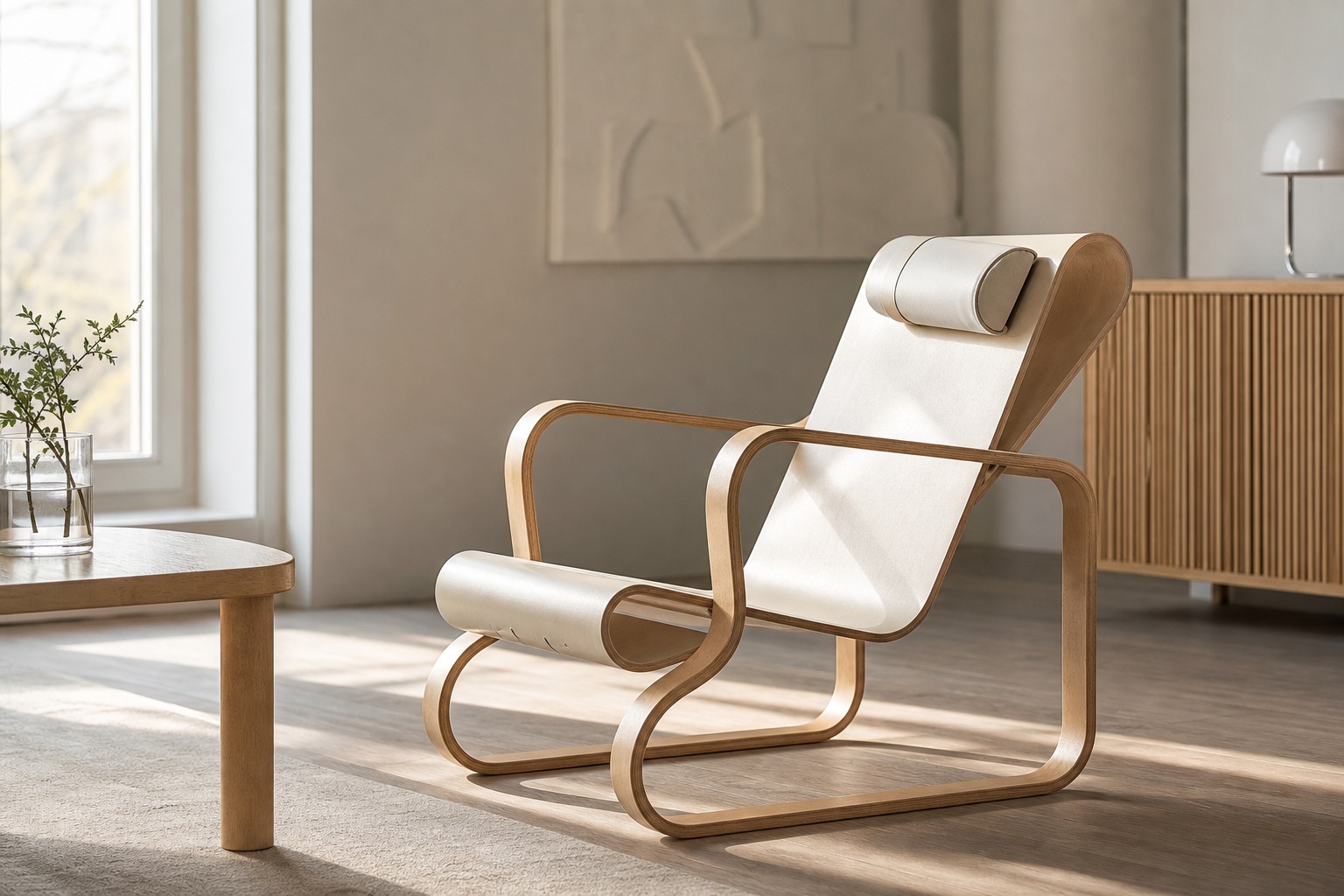
The Paimio Chair makes most sense when read as a specific sanatorium object, not just a modernist icon
The Paimio Chair becomes much clearer once the documented sources are read closely. On the official Artek page for Armchair 41 “Paimio”, the chair is dated to 1932 and described as having been created for the interior of a tuberculosis sanatorium in the Finnish city of Paimio. The V&A adds that Aalto deliberately rejected tubular steel in favour of an all-wood construction. The Met goes further and explains that Aalto sought a form that would be mentally and physically soothing to patients and support their recuperation.
That is highly useful in a buying context. Anyone moving between Bauhaus references and the broader shop should not treat the Paimio Chair as just another curved lounge chair. Its importance lies in the unusually well-documented link between architecture, healthcare and material invention.
The construction matters as much as the silhouette
Artek’s current product page specifies a frame in form-bent solid birch lamella and a seat shell in form-pressed birch plywood, made in Finland. The V&A becomes even more exact by recording a moulded 7-ply birch plywood seat and a 4-ply laminated birch frame with solid birch struts. For collectors, those details matter because they shift attention from style language toward actual build logic.
Artek also notes that the suspended seat is attached to the frame at only four points, which is why the chair appears to float and has such visible elasticity. When assessing older examples, buyers should therefore focus on delamination, later repainting, structural cracking, and the clarity of the laminated birch edges rather than on patina alone.
The therapeutic brief is what separates the Paimio Chair from generic organic seating
The Met’s wording is the key reason the chair still matters: Aalto wanted a form that would help patients feel calmer and support recovery. This makes the Paimio Chair more than a sculptural exercise in plywood. The V&A, meanwhile, frames it as one of Aalto’s most successful productions of the 1930s, while also noting that the chair remains in production by Artek.
That combination is what gives the object market weight today. A convincing Paimio Chair should be understood through its early-1930s dating, its medical-building context and its technically demanding birch construction — not merely through a general label such as “Scandinavian organic modernism”.