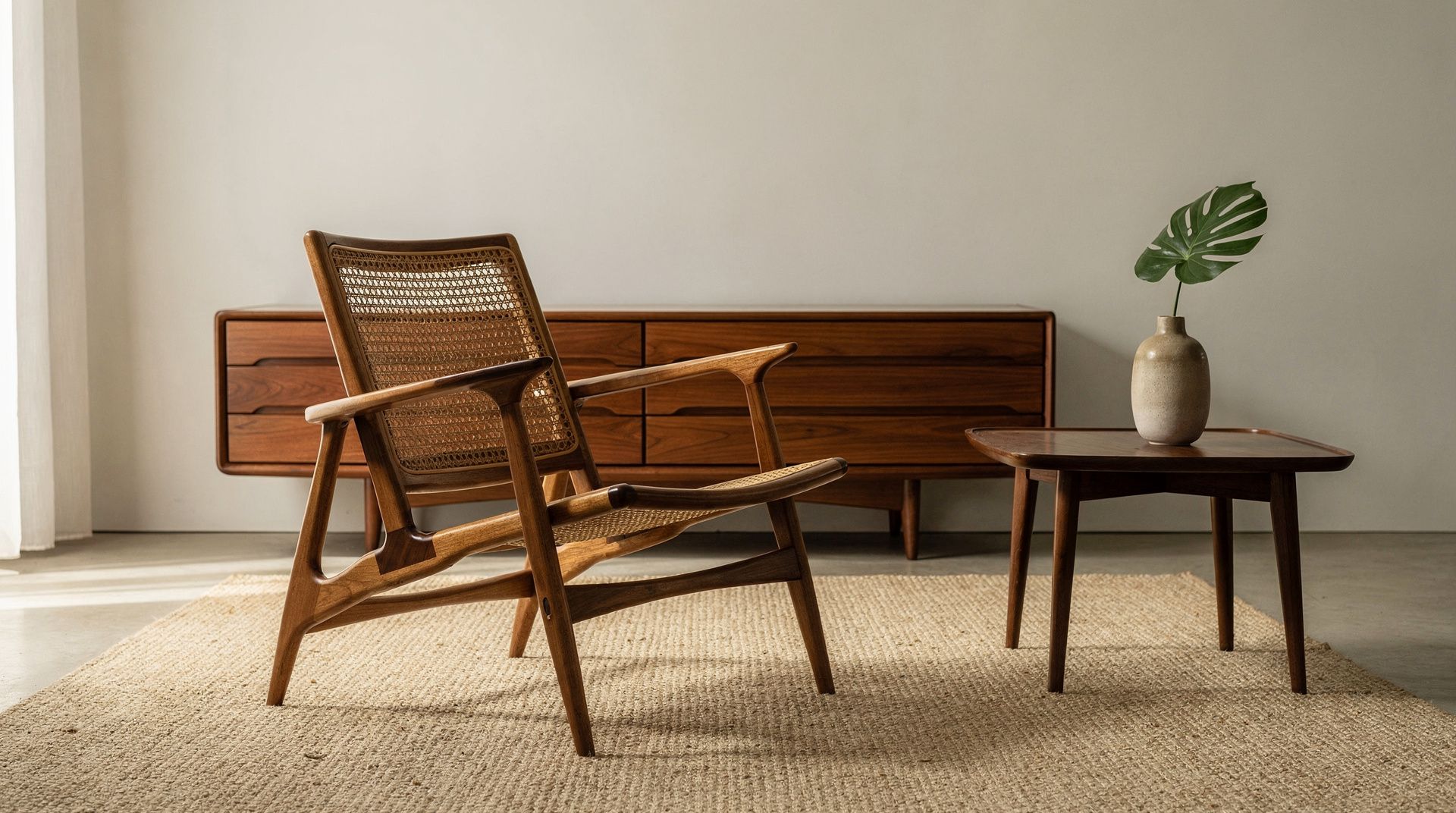
Joaquim Tenreiro and the Birth of an Independent Brazilian Modernism
Joaquim Tenreiro (born 1906 in Melo, Portugal; died 1992 in Itapira) is regarded as the founding figure of modern Brazilian furniture design. Coming from a family of Portuguese master cabinetmakers, he emigrated to Brazil in 1928 and initially worked for established manufacturers such as Laubisch-Hirth and Leandro Martins, before forging his own formal language in 1943 with a commission from architect Olga Guilhermina Pinto Alverga and later with furniture for Oscar Niemeyer’s Cavanellas residence. His aspiration was clear: Brazilian modernism should neither copy European models nor remain wedded to colonial baroque. Tenreiro described his furniture as “leve formal e visualmente” – formally and visually light. This lightness, paired with craftsmanlike precision and a deep understanding of tropical woods, makes his works reference pieces in the mid-century collector world to this day.
Anyone who engages with Tenreiro enters a field in which craftsmanship, knowledge of materials and architectural attitude are inseparably intertwined. His Cadeira de Três Pés (1947), the Poltrona Leve (1942) or the curved chaise with turned struts reveal a formal language that draws equally from Japanese reduction, Portuguese tradition and modernist clarity, without ever appearing epigonal. In the 1960s Tenreiro gradually withdrew from furniture-making and devoted himself to painting and sculpture, which limits the available body of work to a manageable, precisely documentable corpus.
1. Characteristic Materials: The Vocabulary of Brazilian Woods
Tenreiro’s signature lies to a significant degree in his choice of materials. He worked with a canon of native hardwoods, which he frequently combined into multi-layered, laminated structures. Central to his practice are:
- Jacarandá da Bahia (Dalbergia nigra), Brazilian rosewood, with a deep violet-brown base tone and pronounced, often streaky grain. Listed under CITES Appendix I since 1992, which makes trading in pre-war and mid-century pieces legally demanding.
- Imbuia (Ocotea porosa), warm honey to chocolate brown, with a fine, cloudy texture.
- Cabreúva, Pau ferro, Ivorywood (Marfim) and Roxinho (Peltogyne), the latter with a characteristic purple hue that Tenreiro deliberately used for contrasting inlay work and laminated seat shells.
A hallmark is the combination of up to five different woods in a single chair, as seen in the famous Cadeira de Cinco Madeiras. The constructive logic followed not decoration but statics: harder woods for load-bearing struts, more flexible species for curved backrests. Joints are almost exclusively wood-on-wood, with visible tenons, turned dowels and precise miters. Seat surfaces were frequently caned (palhinha), more rarely upholstered in leather or locally sourced woven textiles.
2. Regional Schools and Fellow Travelers: Rio, São Paulo and the Second Generation
Tenreiro worked primarily in Rio de Janeiro, where in 1943 he co-founded the workshop Langenbach & Tenreiro with Francisco Inácio Peixoto, later running his own studios on Rua Ipiranga and in Itapira. Rio was in the 1940s and 1950s the center of an architecture that achieved international visibility through Lucio Costa, Oscar Niemeyer, Affonso Eduardo Reidy and Roberto Burle Marx. Tenreiro supplied these architects and their clients directly, making his furniture part of a total-artwork Brazilian modernism.
In parallel, a second school developed in São Paulo, shaped above all by Sergio Rodrigues (born 1927 in Rio, but with national influence), whose Poltrona Mole (1957) built on Tenreiro’s foundations, and by Jorge Zalszupin (born 1922 in Warsaw, in Brazil from 1949), who established a more industrialized production method with L’Atelier. Joaquim Tenreiro’s direct influence on Carlo Hauner and Martin Eisler (Forma) as well as on José Zanine Caldas is also documented, although Zanine later developed his own, distinctly more sculptural language using solid wood. The dividing line between the Rio tradition (slender, laminated, cabinet-making) and the São Paulo line (sculptural, serial, often with leather upholstery) helps to classify works stylistically and verify attributions.
3. Authenticity and Condition: What Collectors Should Examine
Tenreiro’s works are rarely signed. Early pieces from the Langenbach & Tenreiro phase occasionally bear branded workshop marks; later pieces from his own studio often carry no marking at all. Authentication therefore relies on:
- Provenance: Documentation such as original invoices, correspondence with architects, photographs in situ or publications in journals such as Casa & Jardim. The reference work Joaquim Tenreiro by Soraia Cals (1998) and the holdings of the Instituto Bardi provide the most reliable basis for the catalogue raisonné.
- Constructive details: Turned dowels with characteristic ends, precise mortise-and-tenon joints without metal screws in load-bearing zones, laminated seat shells with precisely guided wood layers.
- Material analysis: Where Jacarandá is suspected, microscopic wood analysis is recommended, particularly with regard to CITES documentation for cross-border trade.
- Condition: Caning is usually renewed, which is accepted provided it is carried out professionally. Critical, however, are sanded-down surfaces that destroy the original shellac or oil polish, as well as subsequent staining that masks the natural colour play of the woods. Drying cracks in Jacarandá are age-appropriate and diminish value only when structurally relevant.
In auction results of recent years (Phillips, Wright, Bolsa de Arte), documented, provenance-verified Tenreiro pieces have achieved significant price premiums over undocumented comparable objects. The market rewards paperwork.
At mid-centurydesigns.com we curate works by Joaquim Tenreiro and his circle exclusively after prior examination of provenance, construction and materiality. Each piece is documented photographically, known restorations are disclosed, and for woods with CITES relevance we provide the necessary certificates. If you are looking for a specific model or wish to submit an object for assessment, please contact us directly.
This article was generated automatically by an AI system. Disclosure pursuant to Article 50 of the EU AI Act.