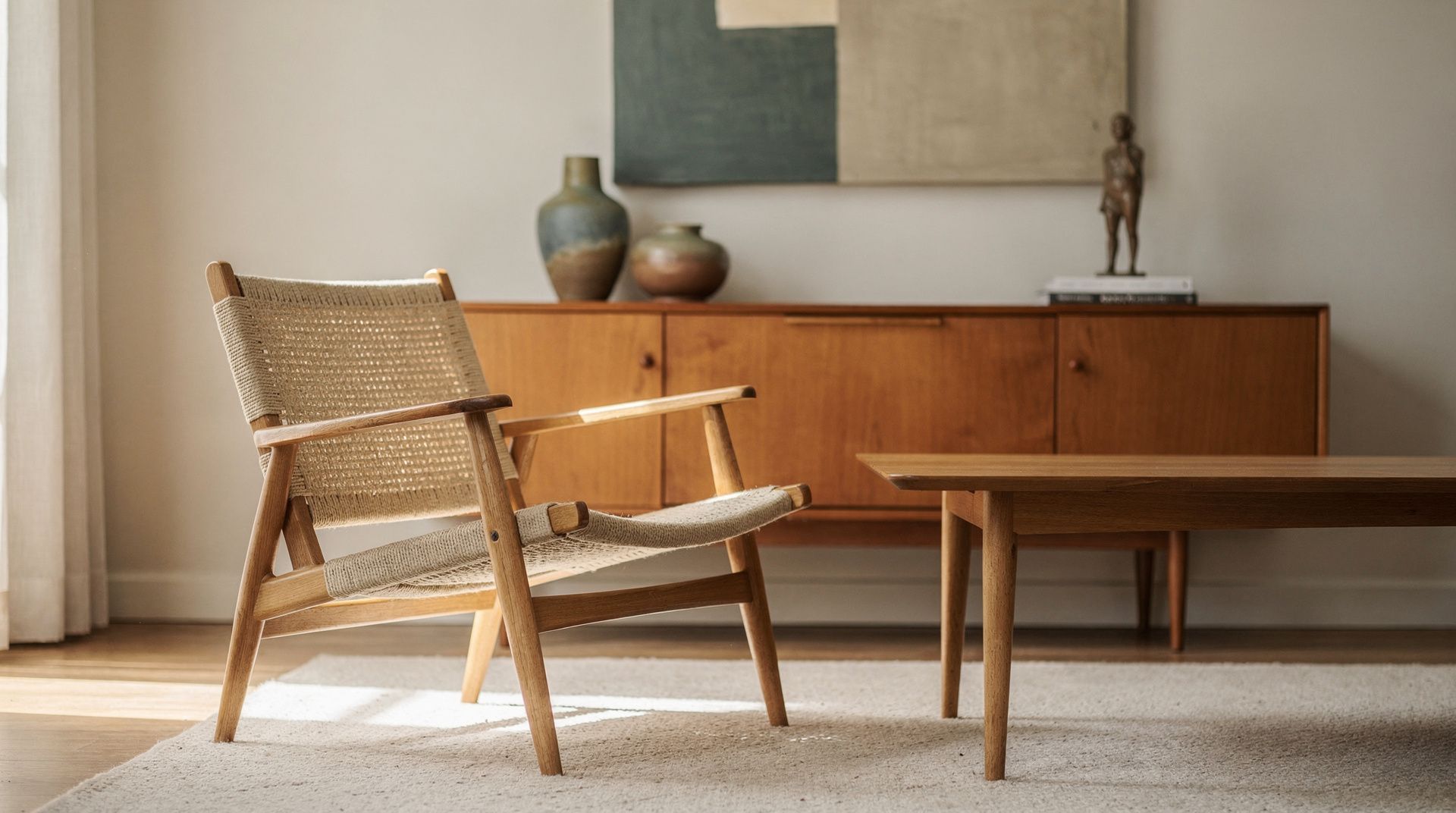
Jens Risom – The Scandinavian-American Pioneer
If you delve into the roots of American Mid-Century Modern, there is no getting around Jens Risom. Born in Copenhagen in 1916 and trained at the Krebs Skole and the Skolen for Boghaandværk, he brought a distinctly Danish understanding of craftsmanship to the United States from 1939 onwards. His early collaboration with Hans Knoll from 1941 is now regarded as a founding moment of the Knoll catalogue: the legendary “600 Line” of 1943, created under the material restrictions of the Second World War, used discarded parachute straps as seat webbing and maple or birch from non-war-essential stocks. Out of this necessity, Risom forged an aesthetic that remains defining to this day: light wooden frames, clear geometry, honest joinery, not a single superfluous decorative gesture.
In 1946 Risom left Knoll and founded Jens Risom Design Inc. in New York, which he ran until 1970 before selling the company to Dictaphone. Over those 24 years he created a body of work that united the Scandinavian idea of the democratic piece of furniture with American manufacturing culture. For you as a collector or design practice, Risom is compelling because his œuvre documents the translation between two design cultures without ever lapsing into quotation or mannerism. The serenity of his designs is a stance, not an affectation.
Characteristic Materials and Construction Principles
Risom’s material language is concentrated. Solid maple, frequently also American walnut and birch, form the basis of his frames. The woods are typically treated only with oil or a matte clear coat, so that the grain remains legible as an active design element. Mortise-and-tenon joints, dowelled round rods and exposed construction define the underframes. The legendary Webbing Lounge Chair (model 654W) exemplifies this principle: a skeleton of maple strung with cotton or jute straps in a plain cross-weave, without upholstery, without cladding.
The seating of the 1950s and 1960s introduces covers in wool, natural leather and, in later editions, vinyl, frequently in muted tones. Tables often feature thin-walled tops with a continuous chamfer, supported by conically tapering round legs. Notably, the cross-sections are pared back: Risom calculated his frames as slender as the statics would allow, lending the furniture a visual lightness that imitators rarely achieve. He used metal sparingly, mostly as a connecting element or in the form of brass hardware on sideboards and desks.
Regional Schools, Contemporaries and Context
Risom does not stand in isolation. He is part of a group of Scandinavian and Scandinavian-influenced designers who decisively shaped American Mid-Century Modern. Within the Knoll genealogy he ranks alongside Florence Knoll, Eero Saarinen and, later, Harry Bertoia among the defining voices of the first hour. Within the broader Danish-American movement, parallels to Peter Hvidt, Finn Juhl (whose US collection for Baker from 1951 pursued a different, more sculptural path) and Jens Quistgaard are clearly visible. All share a recourse to craftsmanship but differ in formal language: where Juhl compresses sculpturally, Risom remains constructive and tectonic.
For orientation, a look at the educational lineages is helpful. Risom studied in Copenhagen in an environment shaped by Kaare Klint’s furniture school at the Royal Danish Academy of Fine Arts: dimensional systems, historical studies, furniture as a utilitarian object. This Klint tradition explains the typological clarity of Risom’s work. In the United States this sensibility encountered the industrial serial production of the East Coast and a market that, after the war, was hungry for new ways of living. Herman Miller with George Nelson and the Eameses in the West, Knoll and Risom in the East – that, in simplified terms, is how the geographical axis of American Mid-Century might be described.
Authenticity, Condition and Assessment for Collectors
With Risom, close examination pays off. Early Knoll productions of the 1940s typically carry a glued paper label reading “Knoll Associates” or “Hans G. Knoll Furniture”. Pieces from his own firm, Jens Risom Design Inc., made between 1946 and 1970, bear a burned-in or stamped trademark, usually on the underside of seat surfaces, inside drawer carcasses or on the back of backrests. The absence of a label is not automatically grounds for exclusion, but it does require secondary evidence: construction details, wood species, hardware, provenance.
On condition: originally oiled or lacquered surfaces are value-defining. Subsequent staining, thickly applied refinishes or sanded-down edges significantly reduce collector value. On webbing models, a replaced strap webbing is acceptable provided the material and weave correspond to the original. On upholstered pieces, professional re-upholstery using period-appropriate fabrics is standard and value-neutral as long as the frame is left untouched. Pay attention to original joinery: glued mortise-and-tenon joints may have been re-glued but should not have been replaced with screws or metal brackets. On tabletops, check the edge treatment and the underside for period machining marks.
The market draws a clear distinction between the early Knoll editions of 1941 to 1946, the productions of Jens Risom Design Inc. up to 1970, and the later re-editions that Knoll and Rocket have issued from the 1990s onwards. All three are legitimate but are valued differently. For one’s own collection, the ability to distinguish between them is crucial, both for documentary and financial reasons.
At mid-centurydesigns.com we examine every piece for label presence, structural integrity, surface condition and documentable provenance before it is admitted to the curated selection. For each Risom object offered you receive a transparent assignment to the respective production phase, an honest description of any restoration steps taken and, wherever possible, details of prior ownership history. This allows you to make your collecting decisions on a solid foundation.
This article was generated automatically by an AI system. Disclosure pursuant to Article 50 of the EU AI Act.