DESIGNER · EGON EIERMANN

Egon Eiermann: Rationalist of Postwar Modernism

Steel tube, trestle systems and an attitude that makes construction visible.

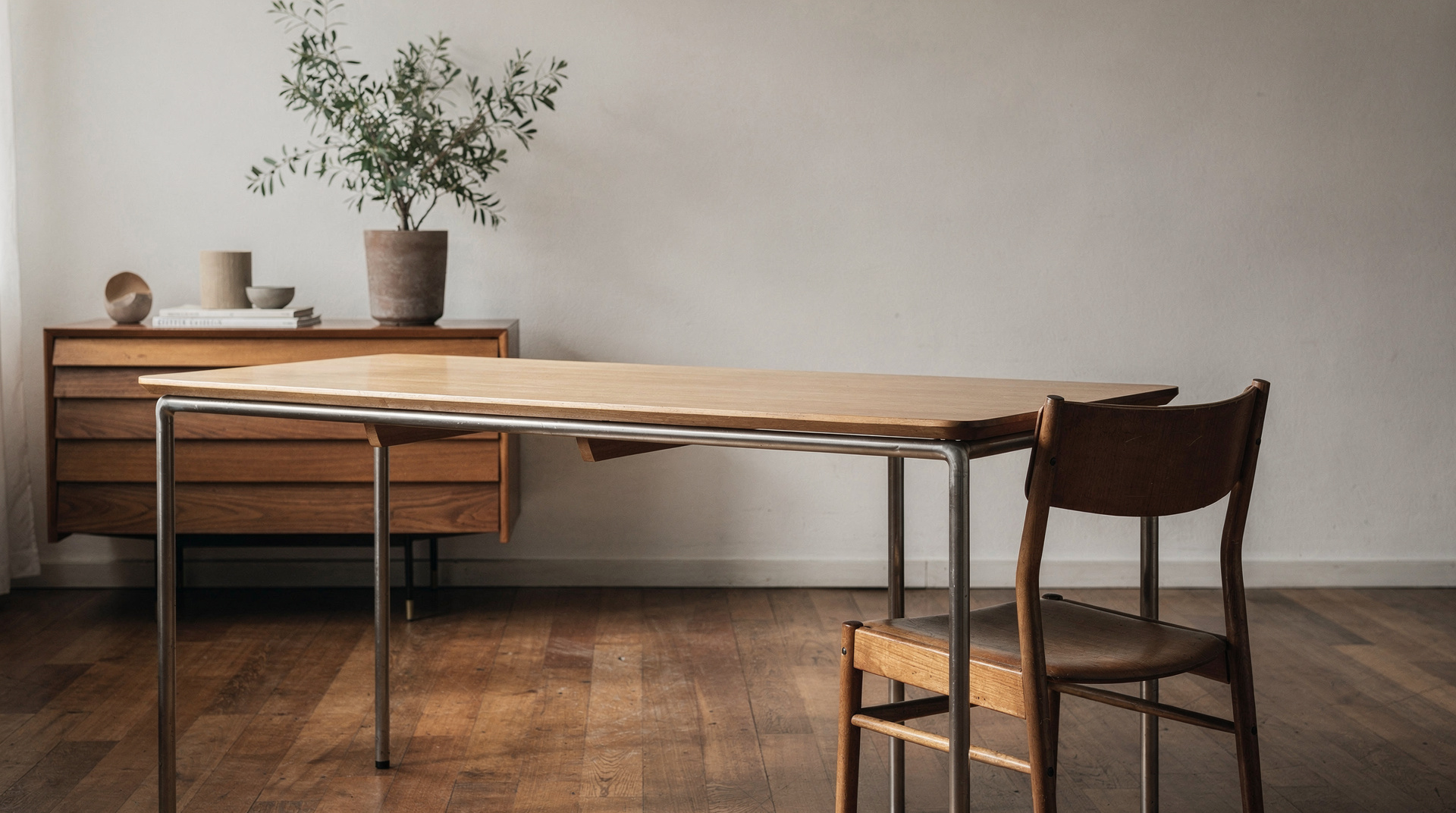
Egon Eiermann (1904–1970) is one of the defining architects and furniture designers of the Federal Republic of Germany. His work combines rigorous constructional logic with craft precision: slender steel tube frames, clearly legible joints and trestle table systems whose sawhorse base remains present in studios and collections to this day. In his teaching at Karlsruhe, Eiermann understood design as a collective workshop process in which material, joinery and use are inseparably linked.

mid-century·designs

Egon Eiermann

ESSAY · 01

Work & Context

mid-century·designs

Egon Eiermann – The Rationalist of Postwar Modernism

Egon Eiermann (1904–1970) ranks among the defining figures of German postwar modernism. Trained at the Technische Hochschule Berlin-Charlottenburg under Hans Poelzig, he combined a deeply rooted craft tradition with an uncompromisingly rational approach to construction. His furniture did not emerge as isolated objects but in dialogue with his architecture – from the Kaiser Wilhelm Memorial Church in Berlin to the German Embassy in Washington and the parliamentary high-rise „Langer Eugen” in Bonn. Those who approach Eiermann’s designs encounter an attitude that treats function, material honesty and industrial production as cultural values.

Central to his furniture work is the trestle table developed from the 1950s onwards, which later entered design history as the “Eiermann table.” The cross-braced steel tube trestle, produced since the 1960s by Richard Lampert in various configurations, follows a logic of reduction: visible bolted connections, clear force transfer, no decorative additions. In parallel, Eiermann developed a series of chairs for the furniture manufacturer Wilde+Spieth in Esslingen – including the SE 68 and SE 42 – combining moulded plywood seat shells with steel tube frames. The workshop philosophy that Eiermann championed at his Karlsruhe professorship understood design as a process between the drawing board and the workbench, in which prototype, material sample and serial production intermesh.

Characteristic Materials and Constructions

Eiermann’s material repertoire is concise and consistent. At its centre stands the lacquered steel tube – typically in black, white or chrome finish – which defines the furniture as its load-bearing structure. In the classic Eiermann trestle table, two sawhorse sides are stabilised by a diagonal cross-brace whose tension rods absorb the shear forces. This construction allows for large tabletops in linoleum, veneered plywood, solid wood or, later, coated materials, without requiring any additional apron frame.

The chairs for Wilde+Spieth employ moulded laminated plywood shells, frequently in beech, sometimes with teak or rosewood veneer in the early series. The connection between shell and frame is made via visible bolted joints, whose technical precision Eiermann regarded as an aesthetic value. For wicker furniture he collaborated with Heinrich Murmann in the 1950s, designing woven armchairs whose organic forms offer a deliberate counterpoint to the industrial steel tube. This breadth – from hand-woven rattan to serial metal fabrication – reveals Eiermann’s understanding of the workshop as a place where different production logics coexist on equal terms.

Eiermann taught at the Technische Hochschule Karlsruhe from 1947 to 1970, shaping an entire generation of architects and designers. His school stands for a South German rationalism that distinguishes itself from the more expressive tendency around Hans Scharoun as much as from the purely systematic approach of the Hochschule für Gestaltung in Ulm. Among his fellow travellers and intellectual neighbours are Hans Gugelot and Otl Aicher from Ulm, whose work for Braun and Deutsche Lufthansa pursued a similar commitment to design discipline.

In the furniture field, Eiermann’s designs can be placed in context with Herbert Hirche, who as a former Bauhaus student likewise produced clear, industrially conceived furniture, as well as with Hans Bellmann and Paul Schneider-Esleben. The collaboration with manufacturers such as Wilde+Spieth in Esslingen and later Richard Lampert in Stuttgart locates a significant portion of this production in the south-western German region, while in parallel, manufacturers in North Rhine-Westphalia such as Wilkhahn pursued similar paths. This regional density of producers committed to serial modernism formed the fertile ground on which Eiermann’s work could flourish.

Authenticity and Condition for Collectors

Anyone acquiring original Eiermann designs should carefully examine provenance and period of manufacture. The Wilde+Spieth chairs typically carry maker’s marks that vary by era: embossed metal plaques, paper labels or stamped signatures on the underside of the seat shell. Early examples from the 1950s and 1960s differ in details such as glides, screw heads and veneer thickness from later re-editions. With the trestle tables, the transition between historical production and the manufacturing still ongoing today is fluid, making the condition of the lacquer finish, the execution of the cross-bracing and the precision of the threaded connections important indicators.

Assessing condition is best done by examining typical weak points: rust spots on the steel tubes, particularly at the floor contact areas; chipping along plywood edges; worn-out bolted connections; and overpainting that conceals the original surface. On linoleum tabletops, edge flaking and discolouration are common and, to a certain degree, an expression of honest wear. A carefully maintained original with visible patina is generally preferable to an aggressively restored example, provided structural integrity is preserved. Provenance documentation such as invoices, catalogues or links to institutional interiors enhances not only the historical significance but also the collector’s value.

At mid-centurydesigns.com, every piece by Egon Eiermann is individually examined, documented and contextualised within its constructional and historical references. We verify maker’s marks, original surfaces and the coherence of all components before an object enters our curated selection. Here you will find exclusively designs whose authenticity is reliably substantiated and whose condition is described transparently.

FAQ · 02

Frequently asked about Egon Eiermann

5 Answers

01
Who was Egon Eiermann and why is he relevant to mid-century design?
Egon Eiermann (1904–1970) was one of the most influential German architects and designers of postwar modernism. After the Second World War, he redefined West German design language through radical functionality and rational construction. His furniture embodies the philosophy of the Bauhaus and the workshop movement, combined with steel-framed structures that continue to set standards for minimalist design today. Eiermann's work is closely linked to the economic and cultural redefinition of Germany in the 1950s and 1960s.
02
What makes the Eiermann tables so special, and what should I look out for when buying?
The Eiermann tables are distinguished by their characteristic steel frame construction and the clear separation between load-bearing structure and surface. The most striking feature is the cantilevered support provided by curved or offset steel tubes, which allow for maximum legroom. When examining originals from the 1950s–60s, you should check for: manufacturer markings (Wilde & Spieth, USM Haller), authentic steel patina, original surface finish (walnut, Formica, ash) and structural integrity. Modern replicas are common, so provenance is decisive.
03
Which manufacturers produced Eiermann furniture, and are there differences between the series?
Eiermann's designs were produced primarily by Wilde & Spieth (Tuttlingen) and later by USM Haller. The Wilde & Spieth pieces from the 1950s often show visible weld seams and more robust detailing, while USM Haller (from the 1960s onwards) introduced greater modular precision. In addition, there were licensed productions and adaptations by other German manufacturers. The early Wilde & Spieth series are considered particularly valuable for collectors, as they document the experimental phase of the design.
04
How does Eiermann's steel tube philosophy differ from that of other modernists?
While contemporaries such as Mart Stam or Marcel Breuer shaped the steel tube as a continuous line, Eiermann used it as a structural problem: his tubes are discontinuous, offset and tensioned like engineering components. This reflects his background in architecture and structural engineering. Eiermann's approach is more rational and less expressive than, say, Italian steel furniture. The aesthetic emerges from the logic of statics, not the other way around. This makes his pieces particularly appealing to buyers who value technical brilliance.
05
How do I properly care for and preserve an original Eiermann piece?
Steel frames should be regularly treated with a light oil (e.g. linseed oil) to maintain natural oxidation and patina – do not polish unless you wish to restore a gloss finish. Wood surfaces (walnut, ash) benefit from occasional treatment with a neutral wood oil. Avoid water and aggressive cleaning agents. Original finishes such as Formica should not be worked on, as any restoration diminishes value. Store pieces in dry conditions; steel tube is susceptible to surface rust in humid environments. Professional restoration should only be carried out by specialists who understand Eiermann's constructional logic.

GLOSSARY · 03

Related Terms

10 Entries

Steel Tube Construction
A structural design principle in which furniture is made from bent or welded steel tube. Eiermann used this technique to create light, load-bearing structures that combine spatial efficiency with visual lightness. It enables serial and mass production without loss of quality.
Eiermann Table
Iconic table by designer Egon Eiermann from the 1950s, characterised by minimal, frame-like steel tube legs and interchangeable tabletops in various materials. It embodies the rationalist principle of postwar modernism: function before form, reusability, disassembly.
Postwar Modernism
A design movement of the 1945–1960s in Germany that emphasised rational use of materials, demountability and functional suitability. It emerged under conditions of economic scarcity and shaped the functional aesthetic of the reconstruction period. A forerunner of modern industrial design standards.
Workshop Philosophy
A design methodology that combines craft and industrial serial production. Eiermann developed prototypes through hands-on craft experimentation, then transferred them into standardisable production processes. Quality control remains central at every stage – not mass production at any cost.
Rationalism (Design)
A design philosophy that derives form from function, material and production rather than from decorative impulses. In Eiermann's work: every line, every angle serves structure or use. Rejection of ornament and historical references in favour of contemporary, logical solutions.
Demountable Construction
Production on a modular principle in which furniture can be disassembled and reassembled without tools or with minimal tooling, and reused. Eiermann applied this to simplify transport, enable repairs and conserve materials. A hallmark of his steel tube system furniture.
Deutscher Werkbund
An association of artists, craftspeople and industrialists (founded 1907) that promotes quality, objectivity and the collaboration of design and production. Eiermann was a lifelong adherent of this philosophy and continued to shape it after 1945 through his own teaching.
Systems Thinking (Furniture Design)
An approach in which individual furniture objects are not designed in isolation but as parts of a combinable, expandable system. Eiermann developed modular principles for tables, shelving and chairs that can be configured according to space and need, representing long-term investments.
Lightness (Weight and Appearance)
A design intention to make furniture appear and feel weightless both visually and physically. Eiermann's slender steel tube structures reduce material mass, while the floor clearance of the furniture bodies creates a sense of spatial openness. A counterpoint to the closed, massive furniture of the postwar period.
Provenance (Furniture Trade)
The documented history of origin and ownership of a piece of furniture. For original Eiermann designs, this is essential for value assessment and authenticity. Evidenced by factory marks, catalogues, photographs or expert opinions from established museums and specialist collections.