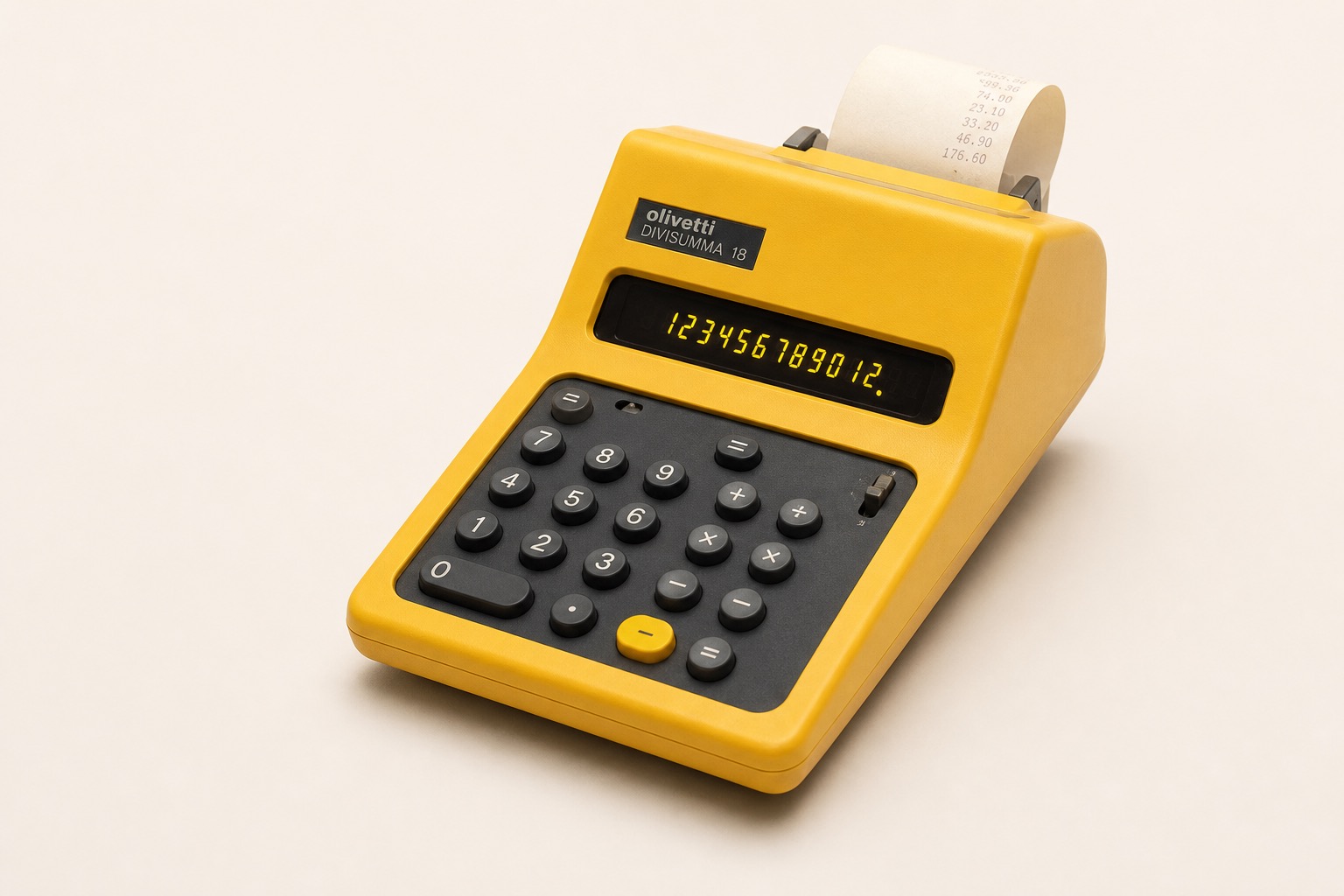
CATEGORY · DIVISUMMA 18

Divisumma 18 – Olivetti, Mario Bellini and a calculator that makes calculation visible

In 1972 Mario Bellini designed a printing calculator for Olivetti with a yellow ABS body and a rubberised membrane

The documentation around the Divisumma 18 is unusually concrete: Mario Bellini’s archive describes it as a battery-operated electronic printing calculator with a rubberised membrane, Nationalmuseum Sweden dates the design to 1972, and the Museum of Design in Plastics adds material and functional details such as yellow ABS, the absence of a display and thermal print-out. That makes the object much easier to assess seriously than the vague 'space age' labels common in the market.

mid-century·designs

Divisumma 18

ESSAY · 01

Work & Context

mid-century·designs

The Divisumma 18 matters most when it is read as a documented working object, not just a bright design trophy

With the Divisumma 18, the most useful step is to read the documented sources before repeating market adjectives. On the official Mario Bellini project page, the object is described as a battery-operated electronic printing calculator using a rubberised membrane technology that covers the surface and incorporates the keypad. Nationalmuseum Sweden catalogues it directly as Calculator Divisumma 18 and dates the design to 1972. The Museum of Design in Plastics adds that the yellow case is made of ABS and that the calculator has no display, relying instead on thermal print-out.

That combination matters more to buyers than the familiar “pop design” shorthand. The object’s value does not rest only on colour; it rests on the unusually coherent relationship between material, operating logic and industrial form. Anyone collecting serious vintage office objects should therefore approach the Divisumma 18 as a well-documented Olivetti design of the early 1970s rather than as a decorative novelty.

The membrane is not just styling – it is the defining functional idea of the design

Bellini’s archive identifies the rubberised membrane as the core technology of the calculator. That matters in collecting terms because the Divisumma 18 ages differently from machines with raised hard-plastic keys. Cracks, hardening, depressions or later repairs affect not only appearance but the integrity of the design itself.

The museum sources also sharpen the material reading. Nationalmuseum lists synthetic rubber, electronic components and plastic, while the Museum of Design in Plastics specifies a yellow ABS body. In a shop context, this means buyers should look beyond silhouette and concentrate on the survival of the membrane, case colour, paper output path and underside markings.

Its lack of a display is precisely what makes the Divisumma 18 feel so distinctive today

The Museum of Design in Plastics describes the Divisumma 18 as a calculator without a display that presents calculations through thermal printing. That feature gives the object its peculiar historical position: it belongs to a moment when electronic calculation was still experienced as a physical event in everyday life. The Divisumma 18 is therefore neither a traditional adding machine nor a later LCD calculator, but a transitional object with its own material and technological identity.

For buyers at mid-century·designs, that is the real value. If you are browsing Olivetti pieces, office design or high-colour technology objects, it makes more sense to compare complete paper handling, healthy membrane condition, stable case edges and credible maker markings than to rely on broad labels such as “space age”. Related context appears on our Olivetti Valentine page, on Vintage typewriter and in the main shop.

Sources

FAQ · 02

Frequently asked about Divisumma 18

5 Answers

01
When was the Divisumma 18 designed?
Nationalmuseum Sweden and the Museum of Design in Plastics both date the Divisumma 18 to 1972. Mario Bellini’s own project page places it within the same Olivetti design phase.
02
Who designed the Divisumma 18?
Reliable sources identify Mario Bellini as the designer for Olivetti. Nationalmuseum Sweden lists Bellini together with Olivetti, and the Museum of Design in Plastics explicitly names the object as designed by Mario Bellini for Olivetti.
03
What makes the Divisumma 18 different from many other vintage calculators?
Bellini’s archive describes it as a battery-operated electronic printing calculator with a rubberised membrane covering the surface and integrating the keypad. The Museum of Design in Plastics adds that it has no display and shows calculations via thermal print-out.
04
Which materials are documented?
Nationalmuseum Sweden lists synthetic rubber, electronic components and plastic, while the Museum of Design in Plastics specifies a yellow ABS case. That combination is important when assessing authenticity and condition.
05
What should buyers inspect on surviving examples?
Useful evidence includes close views of the membrane, paper compartment, case edges, underside markings and, where present, the charging unit. With the Divisumma 18, material condition and completeness often matter more than colour alone in seller photography.

GLOSSARY · 03

Related Terms

6 Entries

Electronic printing calculator
The description used by Mario Bellini’s archive for the Divisumma 18, emphasising that the object prints results rather than merely displaying them.
Rubberised membrane
Surface technology described on Bellini’s project page as covering the calculator and incorporating the keypad. It is one of the defining features of the design.
ABS
Case material specified by the Museum of Design in Plastics for the yellow Divisumma 18. It helps explain the object’s precise form and durable colour.
Thermal print-out
Output method noted by the Museum of Design in Plastics. Instead of a visual display, the Divisumma 18 records calculations on paper.
Nationalmuseum Sweden
Museum source that catalogues the Divisumma 18 as a calculator and dates the design to 1972.
Olivetti
Italian manufacturer that repeatedly linked office technology with advanced industrial design. The Divisumma 18 is one of its clearest examples.