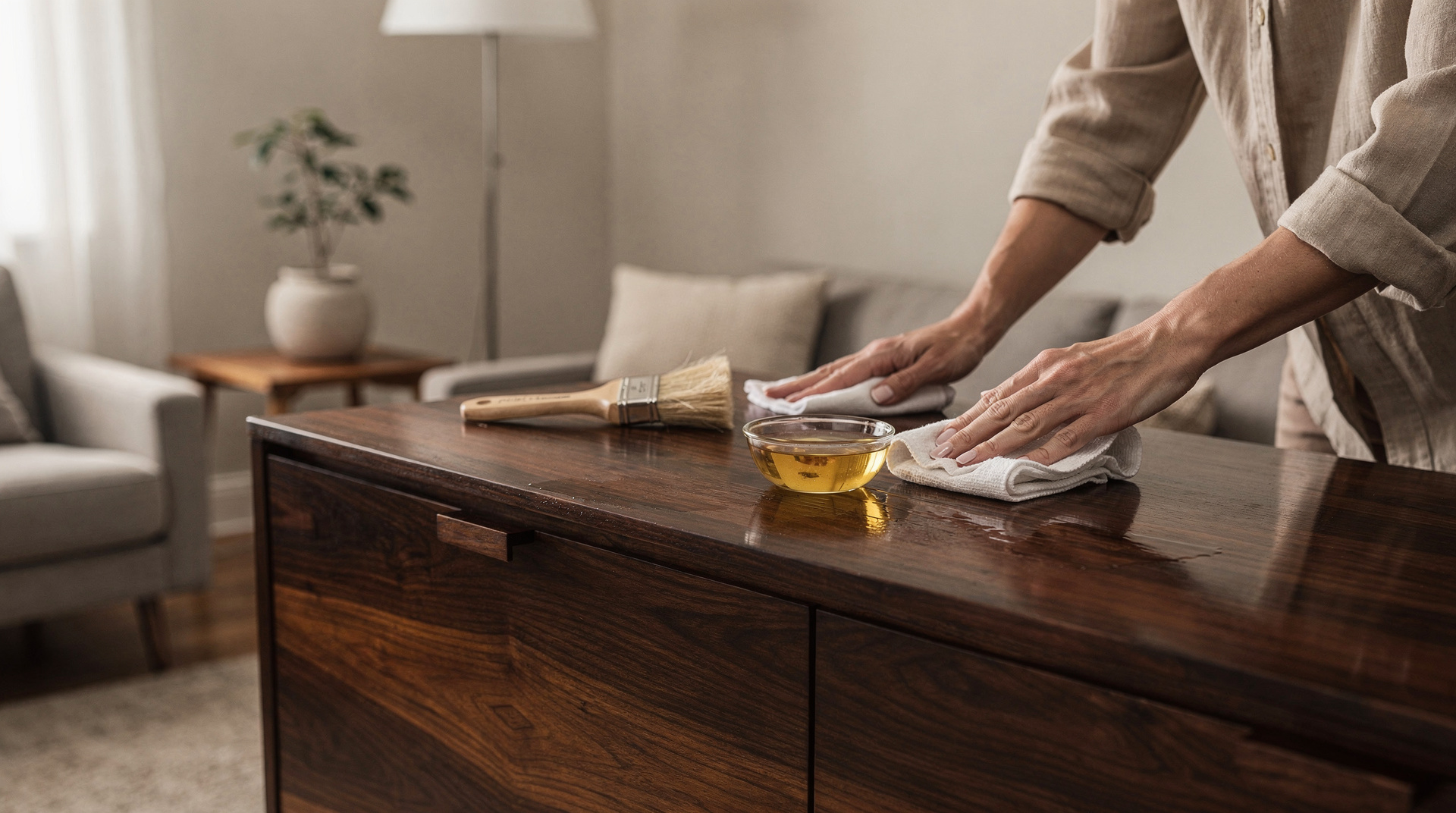
Caring for and refreshing rosewood: treatment of dark exotic wood furniture
Rosewood is one of the defining woods of Mid-Century Modern. The dense, oily tropical timbers of the genus Dalbergia were used from the 1950s onwards in Scandinavia, the USA, and Italy for sideboards, dining tables, armchairs, and writing furniture. Their depth of colour ranges from warm reddish-brown to deep violet-black, with grain patterns alternating between calm lines and dramatic clouds. Owning such a piece means being the custodian of a piece of cultural and trade history: since 2017, all Dalbergia species have been listed under Appendix II of the Convention on International Trade in Endangered Species (CITES), with Rio rosewood (Dalbergia nigra) listed under Appendix I as far back as 1992. New material is therefore heavily regulated, and historic furniture is valued accordingly.
Caring for these woods requires restraint. Rosewood naturally contains oils and resins that protect the wood from within. Aggressive cleaners, silicone-based sprays, or thick layers of wax upset this balance more than they preserve it. What makes sense is dry cleaning with a soft cotton cloth — occasionally slightly misted with water — and, depending on the surface, a sparing application of pure furniture oil or a polish suited to the existing finish type. Before any treatment, the key question is: how was the piece originally finished — oiled, soap-treated, shellacked, or nitro-lacquered? This distinction determines everything that follows.
Characteristic materials and their care logic
Three rosewood species were predominantly used in Mid-Century Modern workshops: Rio rosewood (Dalbergia nigra) from Brazil, dominant until the late 1960s, with deep dark, often violet grain; Indian rosewood (Dalbergia latifolia), increasingly used from the 1970s onwards, calmer in figure and slightly cooler in tone; and Santos or Bolivian rosewood (Machaerium scleroxylon), botanically not belonging to the Dalbergia genus but visually related.
Surface treatment varies by origin and workshop. Danish manufacturers such as Poul Cadovius or Arne Vodder frequently worked with a thin oil or oil-wax coating that allows the wood to breathe. German and Italian productions more often used nitrocellulose or polyester lacquers, producing a closed, glossier surface. For oiled surfaces, a sparing re-treatment with pure rosewood or teak oil is appropriate — applied along the grain, left for twenty minutes, then thoroughly wiped off. Lacquered surfaces need no oil, only occasional cleaning and, if necessary, a refresh of the polish by a restorer. Furniture polishes based on silicone should be avoided: they leave a film that makes future restoration considerably more difficult.
Regional schools and their furniture
The Danish school shaped the iconography of rosewood furniture like no other. Finn Juhl used Rio rosewood sculpturally as early as the 1940s, most notably in the Chieftain Chair (1949). Arne Vodder designed a whole range of sideboards for Sibast featuring characteristic coloured drawer fronts and deeply figured rosewood surfaces. Kai Kristiansen, Ib Kofod-Larsen, and Johannes Andersen contributed complementary grammar: reduced, constructive, with visible dovetail joints and open grip recesses. Poul Kjærholm frequently used rosewood in his PK series for E. Kold Christensen as a contrast to steel and leather.
In Sweden, Nils Jonsson designed sideboards for Troeds with similar clarity; in Norway, Torbjørn Afdal and Bruksbo defined the local handwriting. Italy took a different approach: Ico Parisi, Osvaldo Borsani, and Gio Ponti combined rosewood with brass, marble, and lacquered surfaces. In the USA, George Nakashima used rosewood sparingly, mostly in combination with American walnut, while Vladimir Kagan employed it for sculptural frames. Knowledge of these schools aids in caring for the pieces: a Sibast sideboard calls for a different approach than a Borsani writing desk.
Authenticity and condition for collectors
For collectors, substance matters as much as signature. Points to examine include manufacturer’s marks (branded stamps, metal plaques, adhesive labels such as the round Dansk Møbelkontrol badge), construction (solid rails, cleanly executed dovetail joints, veneered surfaces on solid substrates), and veneer thickness. Early Danish productions work with veneer thicknesses of around 1.5 millimetres; later industrial productions often use considerably thinner layers. A veneer that has been sanded too heavily is irreversible: it can be re-oiled, but not restored.
Typical condition issues include sun bleaching, water rings, heat marks, and greying through UV exposure. Rio rosewood changes with light, sometimes darkening, sometimes losing its violet tone and becoming more brownish. This patina is part of the history and should not be eliminated through aggressive brightening or re-staining. Substantial restorations (new veneers, complete sanding, modern lacquer build-ups) reduce collector value. For CITES-relevant sales within the EU, an EC certificate is required for Dalbergia nigra, and proof of origin for other Dalbergia species. Buyers should ask to see this documentation.
At mid-centurydesigns.com, every rosewood piece is examined for provenance, condition, and originality before being added to the inventory. Veneer thickness, surface build-up, manufacturer’s marks, and, where required, CITES documentation are all recorded. Restorations are carried out with restraint and in consultation with experienced workshops, in order to preserve the patina. This keeps intact what makes rosewood a collector’s wood: the unadulterated story of a piece, its workshop, and its material.