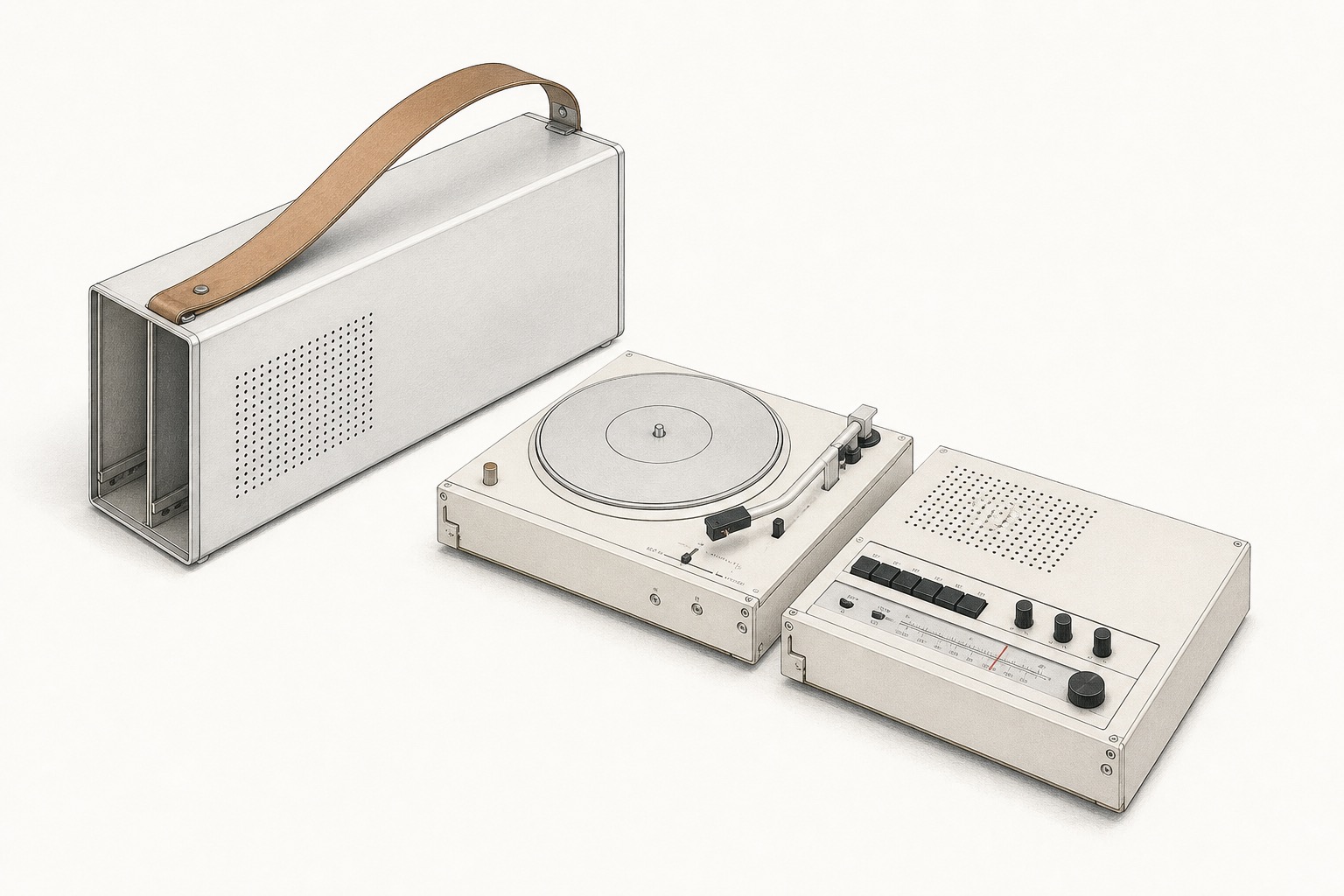
The Braun TP 1 matters because its portability is structural, not rhetorical
Many historic audio objects are now sold as decorative vintage technology. The Braun TP 1 rewards a more exact, source-based reading. The Victoria and Albert Museum describes it as a portable record player and radio designed by Dieter Rams, manufactured by Braun in Germany, and dated to 1959. The Met records the same object as Portable Record Player/Radio Combination (Model TP1) from 1959, while LACMA lists it as the TP1 phonograph and transistor radio, also designed 1959. That institutional overlap is valuable for buyers, because date, authorship, and object type are not just dealer language here.
In the context of mid-century·designs, that matters immediately. Readers moving between our pages on Dieter Rams, Braun SK 4, or the main shop will notice how often historic audio is described only through broad style terms. With the TP 1, the design can be described much more precisely.
The V&A explains most clearly why the TP 1 should be read as a system object
The V&A is especially useful because it defines the object in parts. It describes the TP 1 as consisting of three components: record player, radio, and case. Even more important is the functional description: the radio and record player can be used independently, but are inserted into a slim aluminum carrying case for transport. Portability is therefore not a later marketing claim; it is built into the architecture of the object.
The museum’s account of playback is equally specific. According to the V&A, the record is played from the underside, not the top, and the position of the lever and stylus means that the machine is limited to 7-inch singles at 45 rpm. In a shop context, that is real value. The TP 1 is not just a small turntable with a radio; it is a carefully bounded device tied to the single as a format and to mobile listening as a use case.
The Met and LACMA make the material logic easier to assess
The material descriptions are also unusually helpful. The Met lists polystyrene, poly(methyl methacrylate), metal, and leather. LACMA describes the object as plastic, aluminum, and leather. The V&A adds aluminum, leather, polystyrene, and electronic components. For buyers, that means the TP 1 should not be treated as a generic grey Rams object, but as a deliberate material composition of metal case, plastic housings, and leather detail.
That leads directly to a practical checklist. When assessing an example today, it makes sense to inspect the completeness of all three parts, the condition of the aluminum case, the coherence of the plastic surfaces, the fit between radio and record player, and the credibility of Braun markings. With modular objects, incompleteness is often the moment when a visually attractive piece loses much of its historical clarity.
The TP 1 is documented not only as a beautiful form, but as mass-produced pop audio
The V&A explicitly labels the TP 1 mass produced and notes that the design won an Interplas award in London in 1961. That matters because it positions the object not as a rare prototype but as an industrial product that was recognized in its own moment. In the same V&A summary, the TP 1 is presented as a meeting point between postwar German functionalism and the energy of new pop culture. That is exactly what makes it so strong in a shop context: it stands both for rigorous West German product design and for the culture of portable 45 rpm listening.
So if you are looking for a Braun object that can be described through more than generic Rams iconography, the TP 1 is one of the clearest cases available. For related context on mid-century·designs, see also Bakelite Radio and Vintage Alarm Radio.