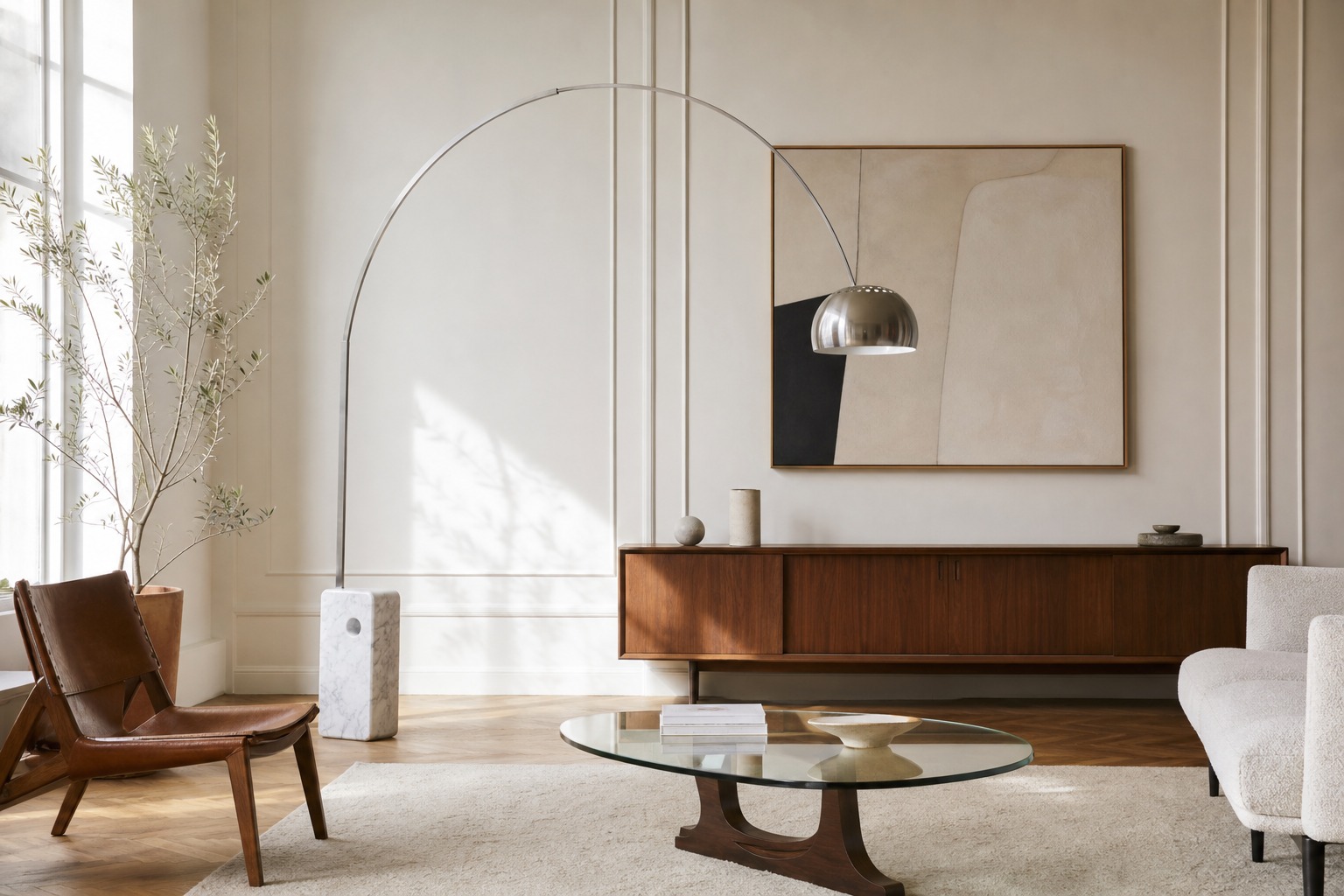
Arco is more convincing as a domestic tool than as a design icon
Anyone who reads the Arco lamp only as a dramatic arc misses its real achievement. Flos describes the 1962 design by Achille and Pier Giacomo Castiglioni in highly technical terms: a white Carrara marble base as counterweight, a telescopic stainless-steel stem, and a swivelling, height-adjustable reflector made from pressed, polished and zapon-varnished aluminium. Even that material list already suggests that Arco was not born from a free sculptural gesture, but from construction-led precision.
That matters in a shop context because Arco is a good example of how a famous lamp can be both sculptural and genuinely useful. Readers of mid-century·designs who already browse lamps mid-century, metal lamp or the wider shop do not need another myth of greatness here. They need concrete criteria for why the design remains historically and practically relevant when assessing older or later examples.
MoMA makes the core idea unusually clear: Arco recreates a ceiling light from the floor
The sharpest short definition comes from MoMA. The museum says Arco solves a practical problem: an overhead lamp that does not require drilling a hole in the ceiling. According to MoMA, the Castiglioni brothers achieved that by inserting a steel arch into a heavy Carrara marble pedestal. The result was a lamp able to place light eight feet from its base—far enough to illuminate the middle of a dining table.
That point is highly relevant for buyers. Arco is not simply a large floor lamp; it is a side-positioned construction that creates a ceiling-like light position in a domestic interior. MoMA even adds that the brothers studied the span of the arch so that a person carrying a tray could pass behind someone seated at the table. That is an unusually concrete sign that the design was shaped by use rather than by symbolism.
Material and transport details are part of the design logic, not decorative trivia
Flos offers the clearest technical reading of the object. The manufacturer lists the perforated aluminium diffuser, the stainless-steel arc, the swivelling reflector, and above all the white Carrara marble base used as counterbalance. One detail is especially telling: Flos explicitly states that the hole in the marble base allows the lamp to be moved with a wooden pole. MoMA phrases the same idea in practical terms, noting that the heavy lamp can therefore be moved by two people.
For collectors and buyers, this matters because Arco’s credibility often rests on material quality, proportions, weight logic and constructional clarity. If an example copies only the silhouette while weakening the base, the arc or the reflector, it loses exactly what makes the design historically persuasive. Arco works because reach, counterweight and light direction are inseparable.
ADI explains why Arco is not merely famous, but securely grounded in design history
The fact that Arco is still produced and still discussed is not just market folklore. In 2020, ADI honoured the lamp at the XXVI Compasso d’Oro with the Compasso d’Oro alla Carriera del Prodotto. In the jury statement, Arco is described as an “innovazione tipologica nel settore illuminotecnico”—a typological innovation in the lighting sector—that over time became an icon of Italian design worldwide.
That is more useful in a shop context than almost any vague “timeless classic” language. It shows that Arco matters not only because it is recognisable, but because it solved a domestic lighting task in a new and durable way. When evaluating historical or later examples, it therefore makes sense to focus less on aura and more on material honesty, the reach of the arc, the execution of the marble base, reflector mechanics and credible manufacturer attribution.