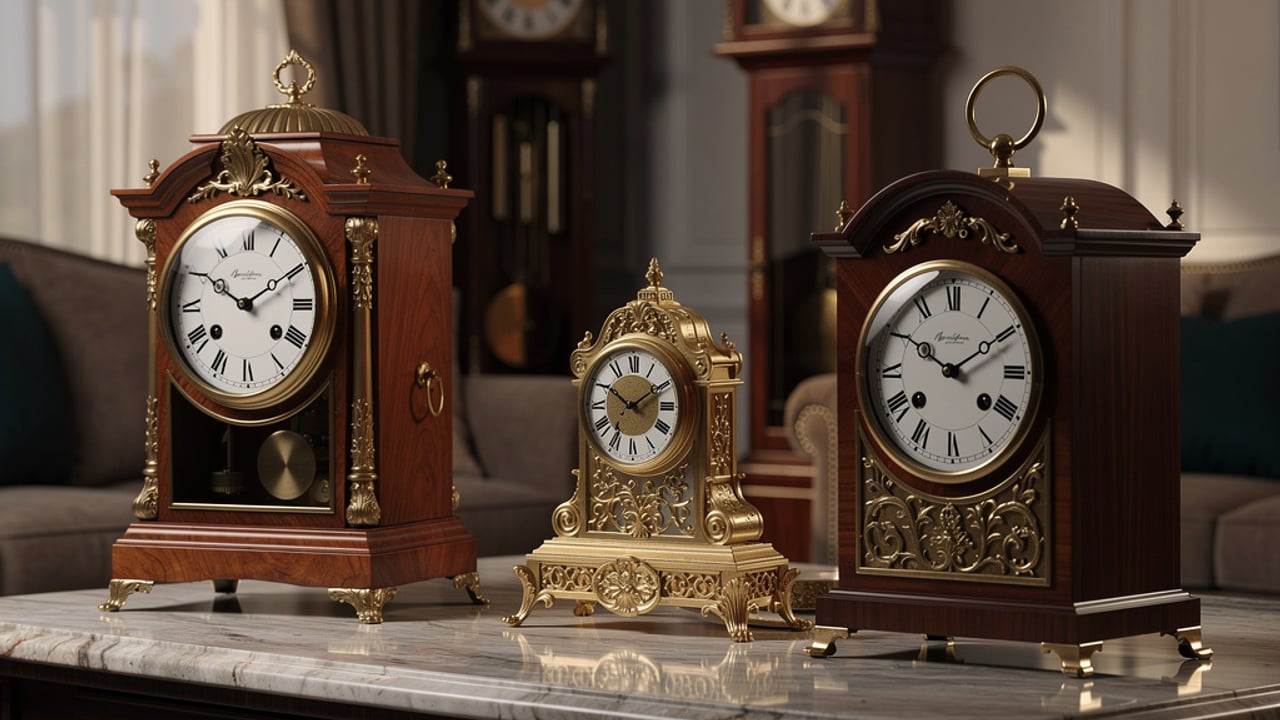
CATEGORY · ANTIQUE CLOCKS

Time as Object: antique clocks

Where mechanical precision meets mid-century design philosophy.

Each piece in our collection represents the intersection of industrial craft and aesthetic intention. These are not mere instruments of timekeeping — they are objects that crystallised a moment in design history, made permanent through brass, enamel, and movement.

mid-century·designs

antique clocks

ESSAY · 01

Work & Context

mid-century·designs

A Brief History of antique clocks

The decades between 1950 and 1980 produced some of the most formally inventive timekeeping objects ever manufactured. As post-war optimism reshaped domestic interiors, designers turned the clock face into a canvas. Scandinavian functionalism, Italian rationalism, and American corporate modernism each left distinct impressions on the discipline. The wall clock moved from peripheral ornament to compositional anchor; the mantel clock shed its Victorian ornament for geometric restraint. To collect antique clocks from this period is to trace the broader argument between utility and beauty that defined an entire generation of industrial design.

Notable antique clocks of the Mid-Century Era

Certain objects define the category entirely. George Nelson’s Ball Clock of 1948, produced by Howard Miller, remains the period’s most reproduced form — a radiating armature of enamelled spheres that reads simultaneously as sculpture and instrument. Arne Jacobsen’s Series 7 wall clock, with its clean typographic numerals, exemplifies the Danish conviction that legibility is itself an aesthetic virtue. In Germany, Junghans collaborated with Max Bill to produce wall and table clocks of extraordinary formal economy. These are the benchmarks against which all antique clocks from the era are measured.

Where to Find Authentic antique clocks

Authenticity in this collecting field requires methodical verification. Production stamps, original movements, and period-correct hardware are the primary indicators of provenance. At mid-centurydesigns.com, each listed piece undergoes condition assessment and attribution review before publication. Estate sales, specialist auctions, and mid-century dealers in Scandinavia, Germany, and the northeastern United States remain the principal sourcing territories. When acquiring antique clocks through private channels, request documentation of prior ownership and, where possible, cross-reference against manufacturer catalogues held in design museum archives.

Caring for Your antique clocks

Mechanical movements require periodic servicing — typically every seven to ten years for weight-driven or spring-driven examples. A qualified horological conservator should be engaged rather than a general watchmaker; the scale and mechanism of mid-century wall and mantel pieces are distinct from wristwatches. Dial surfaces, particularly those finished in original lacquer or enamel, are irreversible once damaged. Store in stable humidity and avoid direct sunlight, which degrades both case materials and printed numerals. Proper maintenance preserves not only function but the legibility of form that distinguishes these objects from later reproductions.

The market for authenticated mid-century timepieces has matured considerably since the early 2000s. Institutional interest — through acquisitions by design museums in Copenhagen, Stuttgart, and New York — has established floor prices for major works and brought scholarly rigour to attribution. Collectors entering the field now benefit from this documentation, even as it has raised acquisition costs for the finest examples.

FAQ · 02

Frequently asked about antique clocks

5 Answers

01
How do I verify that a piece is genuinely from the mid-century period?
Examine the movement for manufacturer marks and patent dates, inspect case materials for period-correct alloys and finishes, and cross-reference the design against dated catalogue photography. Original boxes, warranty cards, and retailer labels substantially strengthen provenance. Third-party assessment by a specialist in decorative arts or horology is advisable for significant purchases.
02
What distinguishes a collectible mid-century clock from a period reproduction?
Reproductions typically use contemporary movements, modern fixings, and digitally printed dials. Originals show consistent ageing across all components — oxidation patterns on brass, patina on lacquered wood, and wear consistent with the object's stated age. Discrepancies between case age and movement date are a reliable indicator that components have been replaced or combined from different sources.
03
Which designers command the highest prices in this category?
George Nelson, Arne Jacobsen, Max Bill, and Tapio Wirkkala represent the upper tier. Nelson pieces produced by Howard Miller with original labels and intact enamel spheres regularly exceed four figures at specialist auction. Max Bill's Junghans examples are particularly sought in Continental European markets, where institutional collecting has sustained strong demand.
04
Is it advisable to restore a clock to working condition before purchase?
Restoration should be undertaken only by accredited conservators using period-sympathetic materials. Amateur servicing frequently damages original movements and diminishes value. A non-functioning clock in original, unrestored condition is generally preferable to one with replaced components. Disclose any prior intervention to prospective buyers; undisclosed restoration constitutes misrepresentation in most auction jurisdictions.
05
How should antique clocks be displayed to minimise long-term deterioration?
Mount wall examples away from exterior walls where temperature fluctuates. Avoid proximity to heating vents, which cause wood cases to crack and enamel to craze. UV-filtering glazing protects painted and printed surfaces. Mantel and shelf pieces benefit from climate-stable interiors maintained between 45 and 55 percent relative humidity. Annual visual inspection for case movement or dial discolouration is recommended.

GLOSSARY · 03

Related Terms

7 Entries

Enamel Dial
A clock face finished by fusing powdered glass onto a metal substrate at high temperature. Enamel dials are valued for their colour stability and resistance to fading, and appear on premium mid-century examples by Junghans and Kienzle. Chips are irreparable without full re-enamelling, which diminishes collector value.
Howard Miller Clock Company
An American manufacturer founded in 1926 that produced George Nelson's most celebrated designs from the late 1940s onward. Howard Miller pieces bearing original foil labels and pre-1970 production stamps are the primary reference objects for mid-century American clock collecting.
Junghans
A German clockmaker established in 1861, whose mid-century collaboration with Max Bill produced wall and table clocks of Bauhaus-inflected rigour. Junghans pieces designed by Bill remain among the most institutionally collected German design objects of the postwar period.
Scandinavian Functionalism
A design philosophy prevalent in Denmark, Sweden, and Finland from the 1930s through the 1970s, prioritising legibility, material honesty, and the integration of craft with industrial production. It shapes the visual logic of most collectible Nordic clocks and domestic objects of the era.
Movement
The internal mechanical or electromechanical assembly that drives a clock's hands. In collectible mid-century examples, original movements — whether spring-wound, weight-driven, or battery-powered — are a primary determinant of authenticity and value. Replaced movements significantly reduce auction estimates.
Patina
The surface transformation of metals and finishes through oxidation and use over time. In brass cases and hardware, patina is evidence of age and authenticity. Artificial patination, applied to reproduction pieces, is typically distinguishable under magnification by its uniformity and lack of wear-consistent variation.
Max Bill
Swiss architect, artist, and designer (1908–1994) trained at the Bauhaus. His clock designs for Junghans, characterised by minimal typographic numerals and geometric discipline, are canonical works of mid-century industrial design and among the most sought objects in the German postwar decorative arts market.