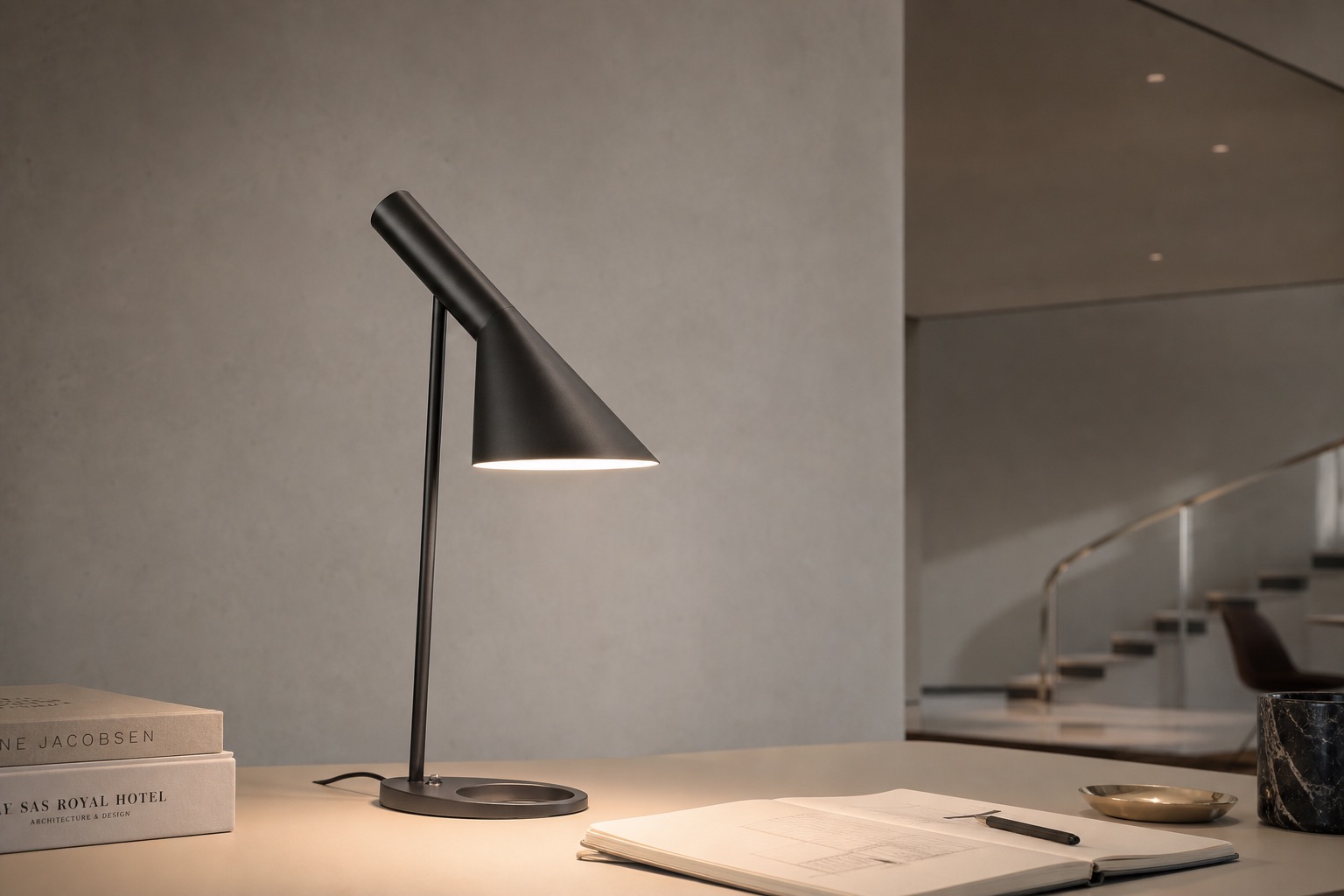
CATEGORY · AJ TABLE LAMP

AJ Table Lamp – designed in 1957 for the SAS Royal Hotel, visible in the 1960 interior, and still unusually clear as a directional lighting object

The official Arne Jacobsen site dates the design to 1957; Louis Poulsen explains the tilting shade and downward light; the Philadelphia Museum of Art records an AJ Lamp designed in 1957

The AJ Table Lamp is often reduced to an elegant angled metal silhouette. The strongest sources are more exact. Arne Jacobsen’s official work page dates the AJ Lamp to 1957 and explains that it later formed part of his total design for the SAS Royal Hotel. Louis Poulsen sharpens the product reading: the table lamp directs light downward through its white-painted inner shade, and the shade can be tilted to adjust distribution. The Philadelphia Museum of Art also records the AJ Lamp as a 1957 design and explicitly places it inside Jacobsen’s functionalist practice. That overlap of architecture, light control, and sustained production is what makes the AJ Table Lamp especially useful in a shop context.

mid-century·designs

AJ Table Lamp

ESSAY · 01

Work & Context

mid-century·designs

The AJ Table Lamp becomes most useful when it is read not as a generic icon but as a specific lighting instrument

The AJ Table Lamp deserves a more exact reading than the usual “classic Danish lamp” shorthand. The official page Arne Jacobsen: AJ Lamp dates the design to 1957 and explains that the lamp later formed part of the SAS Royal Hotel. The same page also states that Jacobsen designed three versionsfloor, table, and wall — and that all three have remained in production by Louis Poulsen ever since the late 1950s.

For buyers at mid-century·designs, that is practical because it anchors the object beyond mood or style language. Anyone moving between Arne Jacobsen, Lamp Mid Century, and the main shop benefits from that precision: the AJ Table Lamp is not a vague Scandinavian signal but a dated, architectural lamp type with a documented production history.

Louis Poulsen makes clear that the form follows a very specific lighting task

The official Louis Poulsen page for the AJ Table Lamp provides the strongest product-level value. It states that Arne Jacobsen designed the lamp in 1957 for the SAS Royal Hotel in Copenhagen. It also gives a concrete functional description: the lamp produces pleasant downward-directed light through its white-painted inner shade, and the shade can be tilted to adjust the distribution.

That matters in a shop context. The AJ Table Lamp is not compelling only because of its slanted profile; it works because the profile serves a clear light logic. When assessing an older example, buyers should therefore inspect more than colour or patina: shade angle, joint, stem, and base all need to support the lamp’s controlled directional use.

Its architectural origin explains why it feels stricter than many other mid-century lamps

Louis Poulsen also adds that the AJ lamp family was found throughout the hotel after the 1960 inauguration of the SAS Royal Hotel, and that the clean light effect appeared there in copper and stainless steel. The Arne Jacobsen site reinforces that reading by saying the design was reduced to straight lines and straight and oblique angles. That is what separates the AJ Table Lamp from softer or more sculptural mid-century lighting: it is tightly derived from an architectural grid.

The Philadelphia Museum of Art confirms that interpretation. The museum lists the “AJ” Lamp as Designed 1957 and says the object is typical of the functionalist principles that informed much of Jacobsen’s work. In buying terms, this is more than theory. It helps distinguish the AJ Table Lamp from any loosely similar angled vintage lamp and refocus attention on its specific discipline of light control, proportion, and architectural clarity.

That is why buyers should prioritise precision over resemblance

Read together, the sources create a clear profile: designed in 1957, made for the SAS Royal Hotel, visible in the hotel by 1960, with directed light and a tilting shade. Anyone looking for an AJ Table Lamp today should therefore check for credible angles, a clean shade edge, believable maker information, coherent finishes, and a functioning adjustment mechanism. In this design, value sits not only in recognisable form but in the precision with which form and lighting function coincide.

Sources

FAQ · 02

Frequently asked about AJ Table Lamp

5 Answers

01
What is the clearest date for the AJ Table Lamp?
The official Arne Jacobsen site dates the AJ Lamp to 1957. The Philadelphia Museum of Art also labels its object as an “AJ” Lamp designed in 1957.
02
What project was the lamp originally designed for?
Louis Poulsen says Arne Jacobsen designed it in 1957 for the SAS Royal Hotel in Copenhagen. The Philadelphia Museum of Art likewise describes it as a lamp originally designed for the Scandinavian Airlines Air Terminal and Royal Hotel in Copenhagen.
03
What do the sources say about the light itself?
Louis Poulsen states that the AJ Table Lamp gives pleasant downward-directed light through its white-painted inner shade. The same source adds that the shade can be tilted to adjust light distribution.
04
Why is the form more than a style cue?
The Arne Jacobsen site explains that the design was reduced to straight lines and straight and oblique angles. The Philadelphia Museum of Art correspondingly reads the AJ Lamp as typical of the functionalist principles that informed much of Jacobsen’s work.
05
What should buyers inspect on an older AJ Table Lamp?
Ask for detailed photos of the shade, joint, stem, base, and inner surface. Because the best sources frame the lamp as a precise light tool in an architectural setting, shade proportions, clean tilt mechanics, coherent finishes, and credible maker attribution matter more than a roughly similar silhouette.

GLOSSARY · 03

Related Terms

6 Entries

SAS Royal Hotel
Copenhagen hotel project in which the AJ Lamp was embedded, according to both the Arne Jacobsen work page and Louis Poulsen.
Louis Poulsen
Danish manufacturer named on the Arne Jacobsen page and the source that provides the clearest product-level details about light direction, tilting shade, and hotel context.
Downward-directed light
Functional description used by Louis Poulsen for the AJ Table Lamp. It explains why the object remains relevant as a purposeful reading and task light, not just as décor.
White-painted inner shade
Detail from the Louis Poulsen product description. The pale inner surface supports controlled reflection and helps the lamp send light downward.
Functionalist principles
Phrase used by the Philadelphia Museum of Art to characterise the AJ Lamp within Jacobsen’s broader body of work.
Total design
Useful term for Jacobsen’s SAS Royal Hotel project, where architecture, furniture, and lighting were conceived as one coordinated system.