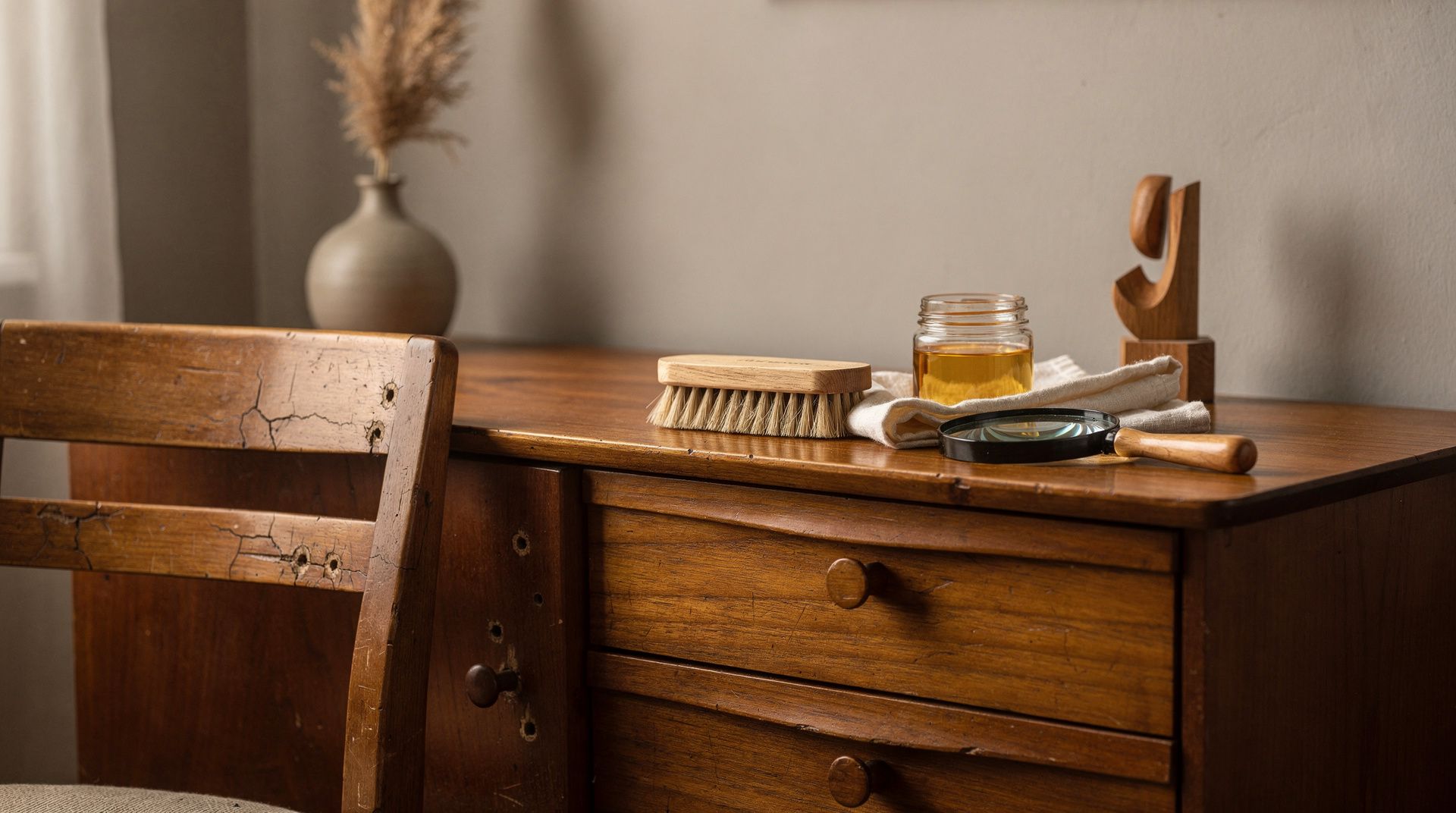
Identifying, Preventing and Combating Woodworm and Pest Infestation
Anyone who collects original Mid-Century furniture also takes on a responsibility: pieces from the 1950s and 1960s are now sixty to seventy years old and bear the traces of their materiality. Solid wood frames, veneers, leather upholstery, cane webbing and textile straps are organic substances that, under certain climatic conditions, can become habitat for insects. The Common Furniture Beetle (Anobium punctatum), colloquially known as woodworm, is the most frequent cause of visible damage to European walnut, pine and beech woods. Occasionally, the House Longhorn Beetle, Lyctus beetles and textile pests such as clothes moths or carpet beetles also appear, particularly in wool upholstery and lambskin covers of Scandinavian origin.
Prevention begins before acquisition. An expert condition assessment identifies fresh bore dust, circular exit holes with sharp edges, and crackling frass sounds in quiet rooms. After purchase: maintain a stable relative humidity between 45 and 55 percent, room temperatures below 22 degrees, and carry out regular visual inspections of undersides, frames and drawer bottoms. Vintage objects should never be placed alongside existing collection pieces without prior examination. A quarantine period of several weeks in a separate room is just as advisable for organic materials as it is for textiles.
1. Characteristic Materials and Their Susceptibility
The range of materials used in Mid-Century Modernism determines the conservation strategy. Teak from Southeast Asia, dominant in Danish productions by workshops such as Johannes Hansen, Fredericia or France & Søn, contains natural oils and silicates that largely repel Anobium beetles. Teak is therefore considered comparatively resistant, even though sapwood portions and glued lamellae can be attacked. Rosewood, particularly Rio rosewood (Dalbergia nigra, protected under CITES since 1992), shows similar resistance but is sensitive to direct sunlight and dry heating air, which leads to cracking in veneers.
Considerably more susceptible are domestic timbers such as pine, spruce and beech, which were used in back panels, drawer runners and frame constructions of many German and Austrian productions. American black walnut, characteristic of works by George Nakashima or early Herman Miller series, can also be affected. Cane webbing, paper cord and jute webbing, as used by Hans J. Wegner or Finn Juhl, are less at risk from beetles than from moisture fluctuations and mechanical stress. Aniline or semi-aniline leather upholstery, such as on chairs by Illums Bolighus or Arne Vodder, requires regular care with pH-neutral products to prevent drying out and cracking, which encourages microorganisms.
2. Regional Schools and Workshop-Specific Characteristics
The Danish school around Kaare Klint, Hans J. Wegner, Finn Juhl and Børge Mogensen relied on mortise-and-tenon joints, solid teak or oak frames and carefully seasoned timber. Workshops such as PP Møbler, Rud. Rasmussen or Fredericia Stolefabrik documented drying grades and provenance, which keeps material quality stable to this day. Nevertheless, beechwood dowels and glued frames are classic entry points for Anobium beetles, especially when pieces have been stored in basements or attics for decades.
American production, shaped by Charles and Ray Eames, Eero Saarinen, George Nelson and the manufacturing axis of Herman Miller and Knoll, combined moulded plywood, fibreglass-reinforced polyester and chrome-plated steel. Here, the conservation focus shifts to delamination, hairline cracks in fibreglass and corrosion of metal frames. Italian designs by Gio Ponti, Osvaldo Borsani or Ico Parisi, often executed in walnut and brass, present a different set of issues: brass fittings can oxidise, and the nitrocellulose lacquers used sometimes age with cracking. The German Werkbund tradition and manufacturers such as Wilhelm Knoll, Walter Knoll or WK Möbel frequently worked with domestic timbers, which justifies more careful inspection for woodworm infestation.
3. Authenticity, Condition and Collector Assessment
For collectors, the pest question is inseparably linked to questions of originality and depth of intervention. A historic, inactive flight hole pattern from the 1960s diminishes collector value far less than an aggressive, large-scale retreatment with modern wood protection lacquers that destroys patina and surface character. The conservation gold standard today is nitrogen fumigation in anoxic chambers or controlled heat treatment at 55 to 60 degrees over several hours. Both methods reliably kill larvae and eggs without leaving residues in the wood or damaging surfaces. Chemical injections and large-scale impregnations are problematic for signed or documented pieces, as they are considered irreversible interventions and can compromise provenance chains.
Documentation is crucial: a treatment record including date, method, workshop and photographs taken before and after the intervention is part of responsible collecting practice. For pieces bearing workshop marks, model numbers or attributions to notable designers, treatment should be carried out exclusively by experienced restorers, ideally with expertise in Mid-Century surfaces such as shellac, oil-wax finishes or original nitro lacquers. When acquiring a piece, do not only examine the visible appearance — request access to undersides, back panels and concealed structural areas.
At mid-centurydesigns.com, every object undergoes a multi-stage assessment: visual and tactile condition analysis, inspection for active or historic insect infestation, documentation of repairs and surface treatments, and, where necessary, preventive anoxic or heat treatment by specialist workshops. Provenance is researched, and workshop attributions are verified on the basis of marks, catalogues and published literature. This way, with every piece you acquire not only an object of design history, but a verifiably assessed substance that, under appropriate climatic conditions, can endure for generations.
This article was generated automatically by an AI system. Disclosure pursuant to Article 50 of the EU AI Act.