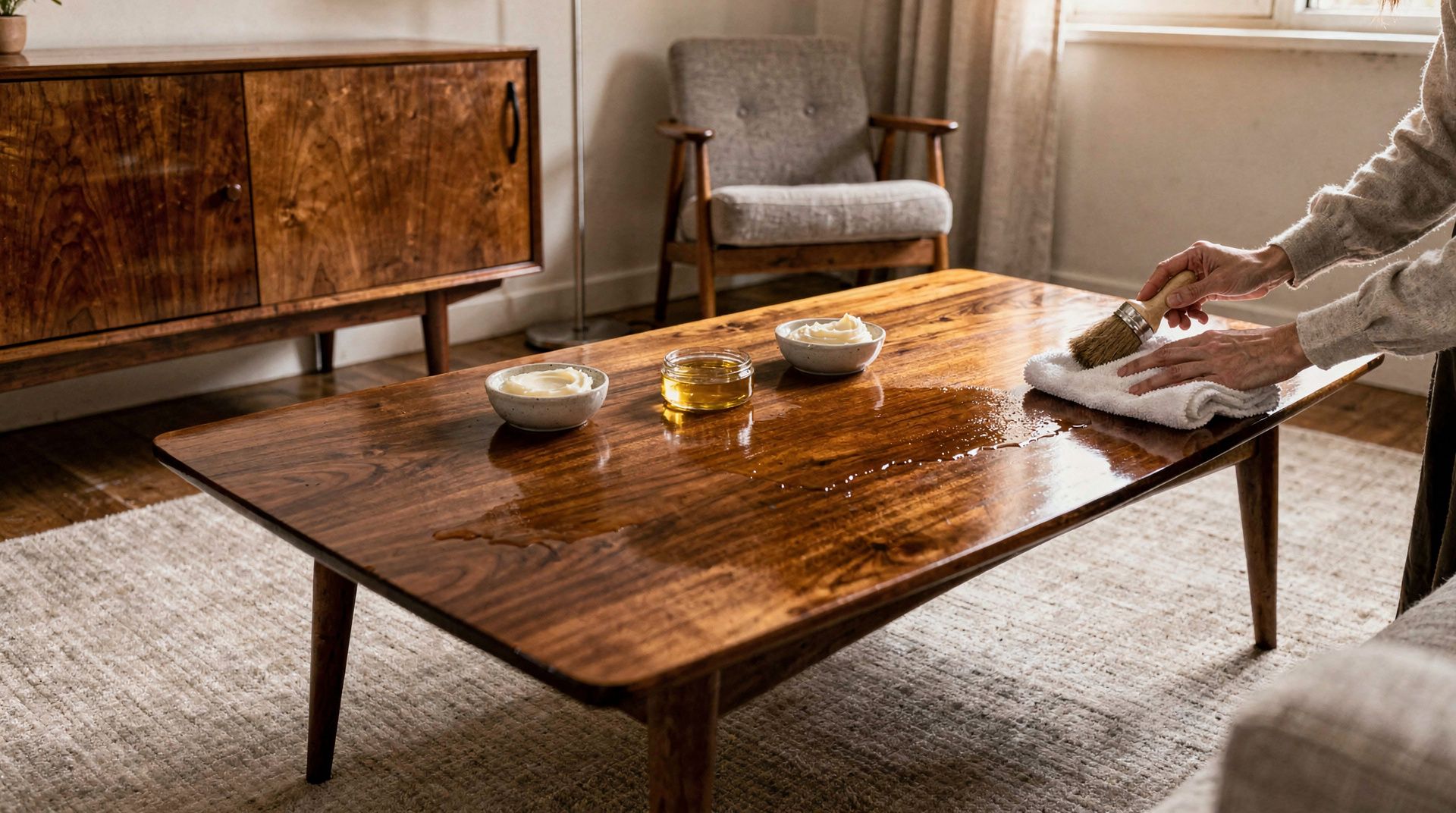
Oiling walnut and mahogany correctly: care that respects the substance
Vintage woods from the Mid-Century era are living materials. A sideboard in American walnut, a Danish dining table in Rio rosewood, or a British cabinet in Cuban mahogany have decades of room climate, changing light and daily life behind them. Those who collect such pieces are not merely caring for a surface, but for a patina that is part of their value. Before any treatment it is therefore worth taking a sober look: which wood is it, what finish layer does it carry, and how far has the drying-out or greying actually progressed?
The guiding principle of conservation practice is: as little as possible and as much as necessary. Excessive oiling can be just as harmful on already lacquered or soap-treated surfaces as aggressive cleaners or sandpaper that attacks veneers often only a few tenths of a millimetre thick. The aim is to stabilise moisture, nourish the cell structure and make the original depth of the grain visible again, without destroying historic layers.
1. Characteristic materials: walnut, mahogany and their care logic
Walnut (Juglans regia, Juglans nigra) is the signature wood of many American and European designs from the 1950s and 1960s. It is medium-hard, open-grained and sensitive to UV light, though unlike many other woods it becomes lighter and warmer over time. Drying out shows as a matt grey haze, fine cracks along the grain and a dull feel. Pure, hardening oils are suitable, such as boiled linseed oil or specialist hard-wax oil blends based on linseed oil, tung oil and carnauba or beeswax. They penetrate the pores, polymerise and form a breathable protective layer. Silicone-based furniture polishes are unsuitable as they complicate later restoration work.
Mahogany is the umbrella term for several species; in Mid-Century practice primarily Swietenia macrophylla (Honduras mahogany) and the now-protected Swietenia mahagoni (Cuban mahogany), and later African relatives such as Khaya. Mahogany is finer-grained than walnut, denser and tends toward a reddish-brown colour. In Mid-Century Modernism it was frequently finished with shellac, nitrocellulose lacquer or polish rather than oil. On such surfaces an oil treatment is not appropriate; microcrystalline wax or a high-quality furniture wax will give better results. Only when mahogany has demonstrably been given an open-pore finish is a restrained application of pure conditioning oils advisable.
In practice: Clean the surface with a soft cloth and distilled water plus a drop of pH-neutral soap, allow to dry, work oil thinly into the wood in the direction of the grain using a lint-free cotton cloth, then remove completely after twenty to thirty minutes. Always soak oil-saturated cloths in water and lay them out flat to dry, as they are at risk of spontaneous combustion. Greyed areas can often be reactivated simply by cleaning with a one-to-one mixture of white spirit substitute and linseed oil before any re-oiling is attempted. For deeper greying, a fine rub with 0000 steel wool in the direction of the grain can help, though never on thin veneers without testing first in a concealed spot.
2. Regional schools and their surface traditions
Care is always also a history of craft practice. The Danish school around Hans J. Wegner, Finn Juhl, Arne Vodder and Kai Kristiansen worked predominantly with teak, rosewood and European walnut, often soap-treated or finished with linseed oil. Manufacturers such as Johannes Hansen, France & Søn and Søborg Møbler delivered surfaces designed for regular re-oiling. Here, oil is the authentic answer.
American Modernism with George Nakashima, Vladimir Kagan, Edward Wormley for Dunbar, or the walnut series by George Nelson and Charles Eames for Herman Miller relied heavily on Black Walnut. Nakashima himself worked with tung oil, while many Dunbar pieces show sprayed lacquer surfaces that will not absorb oil. The distinction is crucial.
Italian Modernism by Ico Parisi, Osvaldo Borsani, Gio Ponti and Paolo Buffa frequently used mahogany, walnut and rosewood in polished, sometimes shellacked finishes. French designs by Jean Royère or Jacques Adnet, British work from the circle of Archie Shine, G Plan or Robert Heritage for Archie Shine display a range from open-pore teak to the finest mahogany polish. German and Swiss manufacturers such as Wilhelm Knoll, Walter Knoll or the early post-war designs from the circle of the Ulm School preferred pragmatic, often lacquered surfaces. Each of these traditions calls for a different care strategy.
3. Authenticity and condition: what collectors should check
On an original Mid-Century piece the surface is part of its documentation. A complete sanding-back and re-oiling may look fresh in the short term, but it reduces veneer thickness, destroys original finishes and diminishes the object’s value from a collector’s perspective. Before any intervention, therefore, check the following points:
- Veneer thickness and condition: Mid-Century veneers from the 1950s are often still saw-cut and thicker than later knife-cut veneers. They remain sensitive nonetheless, particularly at edges.
- Finish type: A drop of alcohol on a concealed spot will reveal shellac (it dissolves); a drop of nitro thinner indicates lacquer. If neither reacts, an oil or wax finish is likely.
- Maker and workshop marks: Branded stamps, metal plaques, paper labels or signatures on the undersides of drawers and on back panels are not only provenance evidence but also give clues about the original surface treatment.
- Historic repairs: Old additions may be part of the object’s biography and should be documented rather than necessarily removed.
Patina is not a flaw but a quality marker, as long as the substance remains intact. The care decision is therefore always a balance between preserving the current state and moderate refreshing.
At mid-centurydesigns.com, pieces offered for sale are examined for their materials before entering the inventory, assessed for provenance, maker’s marks and veneer condition, and where necessary carefully conserved in collaboration with experienced restorers. Surfaces are kept as close to the original as possible, so that you as a collector or designer receive an object whose history remains legible and whose care you can continue yourself using the methods outlined here.
This article was generated automatically by an AI system. Disclosure pursuant to Article 50 of the EU AI Act.