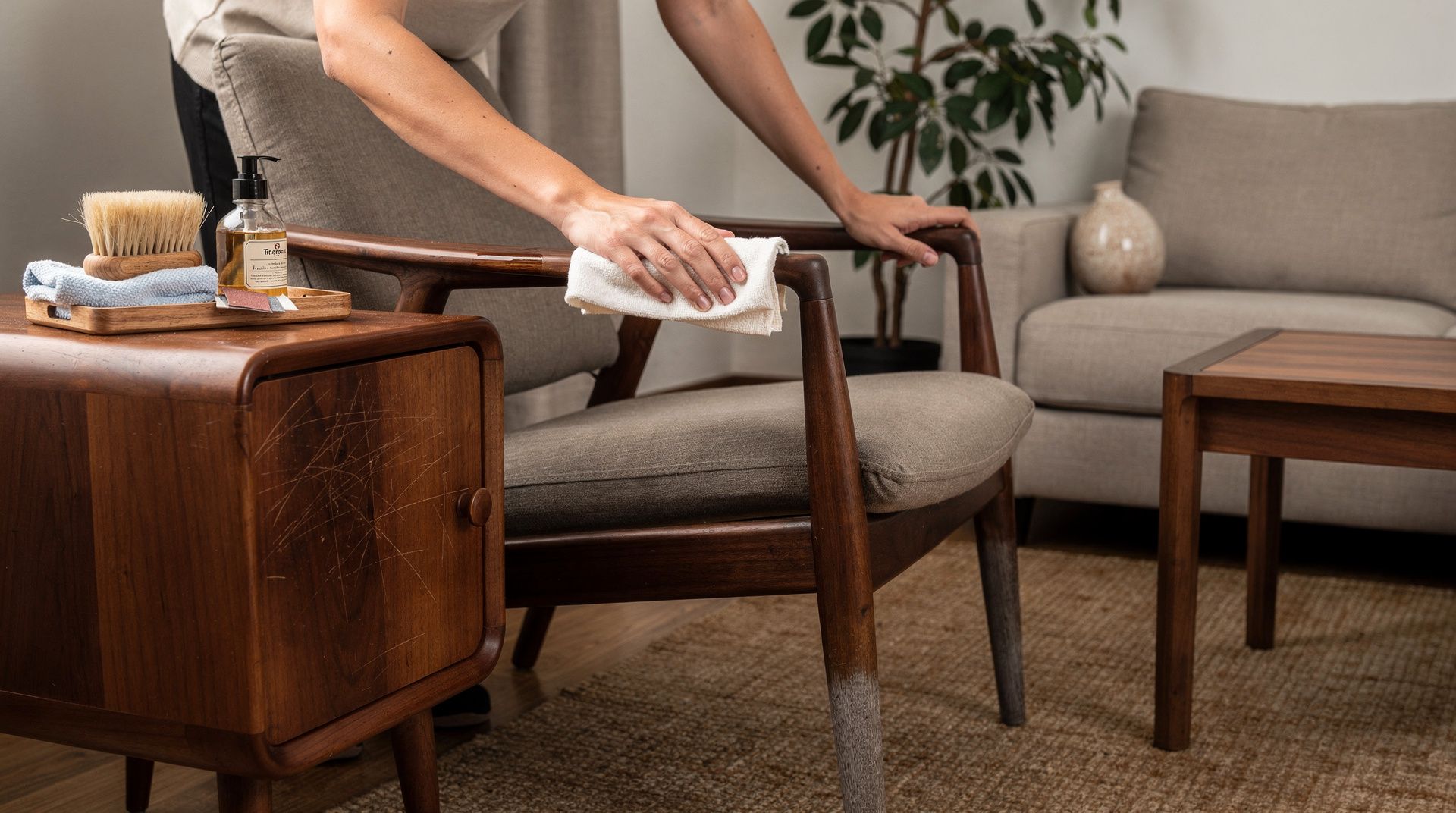
Understanding Walnut and Mahogany Before You Care for Them
Dark hardwoods from the Mid-Century era have their own logic. Anyone working on a sideboard by Ib Kofod-Larsen, a dining table in Brazilian rosewood, or a chest of drawers in American Black Walnut is not working on a piece of furniture in the contemporary sense, but on a historical surface. The craftsmen of the 1950s and 1960s worked with veneers, open-pored oils, or thin shellac and nitrocellulose finishes. These layers are now sixty to seventy years old, often thinner than a sheet of paper, and they react sensitively to improper care.
The most common mistake begins at the hardware store. Silicone-based furniture sprays, polishes with wax components of unknown origin, thick hard oils for decking: all of these deposit a film on the wood that cannot be removed without residue and blocks the pores. A walnut veneer that has been able to breathe for decades loses its depth as a result. The second trap is impatience. Graying, dull watermarks, or pale sun-bleached areas cannot be remedied in an afternoon — they require multiple thin applications, drying times, and a tool you have mastered: a soft cotton cloth, fine 0000 steel wool, and when in doubt, less oil rather than more.
What follows is not a restoration manual, but a guide for collectors who want to understand what they are dealing with before they even reach for the cloth.
1. Characteristic Materials: Walnut, Mahogany, Rosewood and Their Surfaces
American walnut (Juglans nigra) dominates the Californian and Danish Modernism of the late 1950s. It is medium-hard, with a warm brown tone, fine grain, and a tendency to lighten significantly under UV light. This very photobleaching is the main cause of graying and uneven discoloration: what stood beneath a vase is darker than the rest. Before oiling, the surface must therefore be even — otherwise the oil application will lock in the contrasts.
Mahogany, especially Cuban and Honduran from pre-war stocks, is denser, oilier in character, and reacts differently. It darkens over time, becoming a deeper reddish-brown to mahogany-brown in the strict sense, and does not tolerate aggressive degreasers. Scandinavian rosewood (Dalbergia nigra, now CITES-protected), in turn, contains its own essential oils that initially repel fresh oil applications. Here, pure, refined linseed oil in a very thin layer, cut with turpentine balsam, is historically the most compatible option. Modern hard wax oils should be used with caution on rosewood, as they tend to be too film-forming.
For scratches in the veneer: superficial scratches that only graze the finish can be evened out with 0000 steel wool along the grain and retouched with a drop of oil. Once a scratch penetrates into the veneer, retouching wax in a matching color tone marks the limit of self-help. Anything deeper belongs in the hands of a professional restorer.
2. Regional Schools and Designers: Where the Pieces Come From
Anyone caring for dark Mid-Century furniture should know which workshop it came from. The Danish school around Finn Juhl, Hans J. Wegner, Arne Vodder, and Kai Kristiansen worked predominantly with oiled surfaces, executed by cabinetmakers such as Niels Vodder, Johannes Hansen, or Sibast. These pieces are designed for re-oiling and benefit from regular, sparing treatment — typically once or twice a year.
The American studio line, above all George Nakashima, Phillip Lloyd Powell, or Wharton Esherick, relied on walnut with linseed-tung oil blends and sometimes wax sealing. Nakashima pieces are deliberately open-pored and carry their signs of use as part of the aesthetic. Sanding too perfectly here destroys value.
German and West German post-war modernism — furniture from the workshop of Wilhelm Renz, Behr, WK Möbel, or Georg Leowald — frequently used nitrocellulose lacquers on mahogany and walnut veneer. These surfaces cannot simply be re-oiled, because the oil does not penetrate through the lacquer film. Here, cleaning and polishing with high-quality furniture wax is the appropriate response, not oil. The Italian school around Ico Parisi, Osvaldo Borsani, or Gio Ponti, in turn, often worked with shellac polish, which is refreshed in the traditional manner using a rubber.
3. Authenticity and Condition: What Collectors Should Check
The condition of a surface in dark hardwoods is always also a question of authenticity. A Wegner sideboard that looks too flawless is suspicious: it was probably sanded down and re-oiled, which reduces the patina, maker’s stamps, and sometimes the veneer thickness. Original condition with visible but well-maintained signs of use now commands higher auction prices than a cosmetically perfect restoration.
Check three things: first, the veneer thickness at edges and notches. Pre-war and early post-war veneers are significantly thicker at one to two millimeters than modern reproductions. Second, maker’s marks, brand stamps, paper labels, and screws. Original Phillips screws, Danish furniture stamps such as “Made in Denmark, Danish Furnituremakers Control,” or American manufacturer labels from Herman Miller, Knoll, or Dunbar are evidence, not incidentals. Third, the consistency of the patina. If the back and front have aged to noticeably different degrees, pieces were likely swapped or supplemented.
Graying in itself, incidentally, is not a reduction in value — it is reversible. Discoloration from water damage, heat, or cleaning agents, on the other hand, is often irreversible and should be reflected in the purchase price. Ask about restoration history, the oils and waxes used, and photographs from previous ownership.
At mid-centurydesigns.com, only pieces whose provenance, surface condition, and degree of restoration are documented are offered for sale. Each piece of furniture is examined before inclusion in the inventory for veneer integrity, original hardware, maker’s marks, and the compatibility of historical surfaces. Where restoration has taken place, we identify the oil or wax used, the workshop that carried out the work, and the scope of the work. That is the foundation on which you not only purchase a walnut or mahogany piece of furniture, but care for it correctly over decades.
This article was generated automatically by an AI system. Disclosure pursuant to Article 50 of the EU AI Act.