Walnut in Mid-Century: Care as a Continuation of Material History
Walnut is the defining wood of postwar Modernism. From the Scandinavian workshops of the 1950s to the California Studio Craft movement and the Italian cabinetmakers of the 1960s, no other fine wood was so consistently used as the vehicle for a new formal language. Its warm, shifting figure, fine pore structure and ability to accept open-pore oil and wax finishes made it the material of choice for a generation that placed material honesty above concealing lacquers.
Anyone who owns an original walnut piece today is the custodian of a developed surface structure. The patina is not dirt but a layer of time: oxidized oils, micro-fine traces of use, a tone deepened or lightened by UV exposure. In this context, care does not mean restoration in the sense of returning to an as-new condition, but careful conservation. We advocate restraint: fewer products, applied less frequently, with the right understanding of the original finish. European walnut (Juglans regia) responds differently from American Black Walnut (Juglans nigra); an oiled sideboard by Kai Kristiansen calls for a different touch than a shellac-finished corpus from an Italian ébéniste workshop.
Characteristic Materials and Their Care Logic
Three walnut qualities dominated Mid-Century production: European walnut with its calm, often grey-brown base color; American Black Walnut with its darker, chocolate tone and more lively figure; and veneers from root or burl formations, used as representative facings on secretaires, commodes and tabletops. The vast majority of furniture from this era was treated open-pore, typically with linseed oil, tung oil or early oil-wax blends. Only a few manufacturers — mainly in the high-end Italian segment — worked with shellac or matte nitro lacquers.
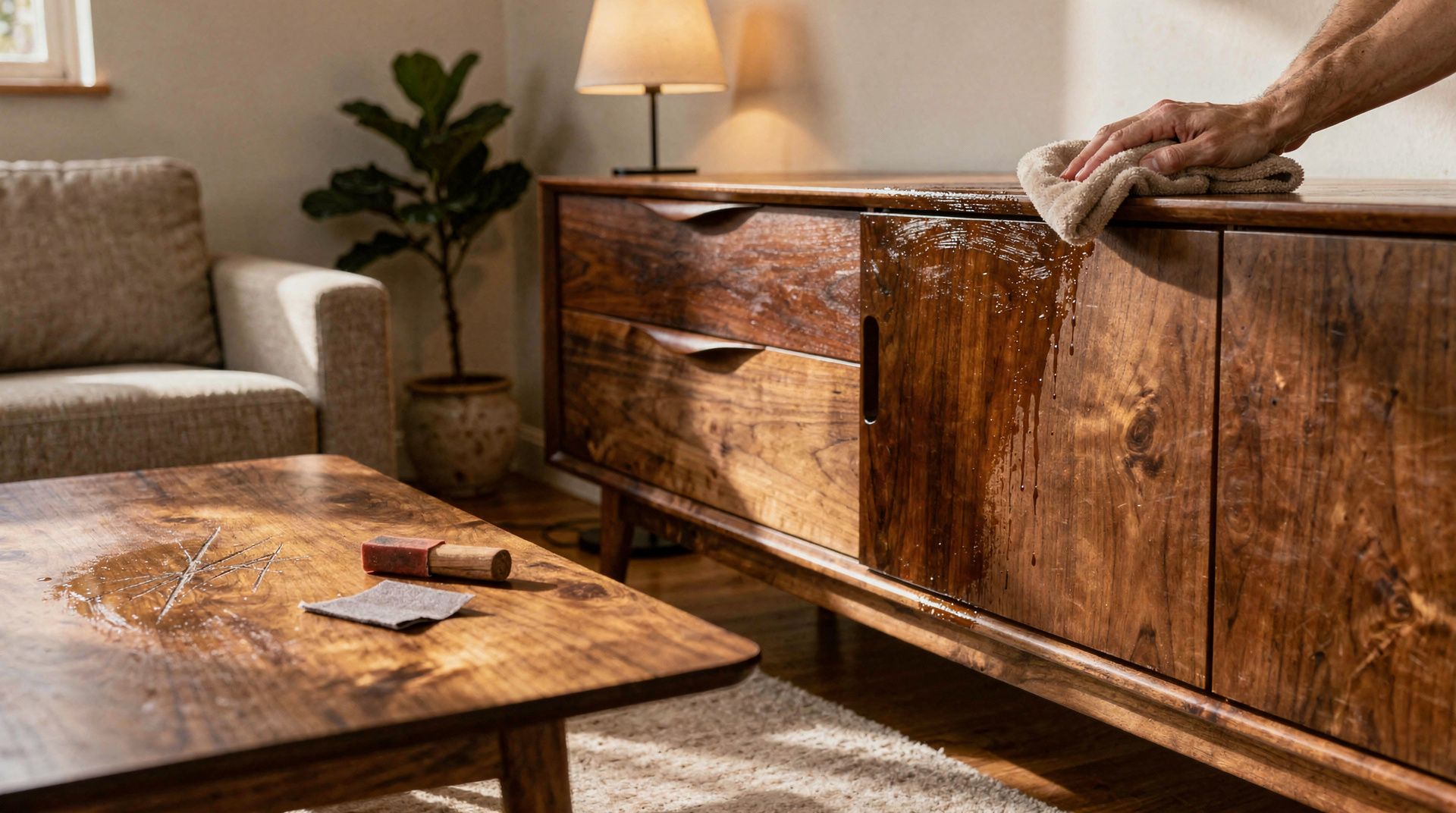
For the routine care of an oiled walnut piece, dry dusting with a soft cotton or microfiber cloth is generally sufficient. Re-oiling is only worthwhile when the wood visibly dulls, the grain looks flat and matte, or individual areas no longer bead water. In that case, apply a pure, low-resin furniture oil (such as refined linseed oil or a neutral hardwax oil without color pigments) sparingly with a lint-free cotton pad in the direction of the grain, allow it to penetrate for ten to fifteen minutes, then polish off the excess completely. No film should remain. Oil-soaked rags must be placed immediately after use in a sealed metal container or submerged in water, as they can self-ignite through oxidation.
Scratches must be assessed individually. Fine surface scratches in the oil often disappear after a localized re-oiling, as the wood is re-saturated at that point and darkens optically. Deeper gouges in the veneer require a reversible touch-up with retouching wax or shellac sticks in a matching tone, applied by a practiced hand. Water stains — so-called white rings — on oiled surfaces can often be resolved by carefully working over them with very fine steel wool (0000) in the direction of the grain and then oiling. On shellacked or lacquered surfaces, DIY intervention is not recommended.
The most common mistakes include: silicone-based furniture polishes that penetrate permanently into the pores and complicate future restoration; aggressive all-purpose cleaners; over-oiling (resulting in a sticky film build-up); direct sunlight, which bleaches European walnut and darkens American Black Walnut; and dry heating air below 40 percent relative humidity, which encourages veneer cracks.
Regional Schools and Their Walnut Signatures
The Danish school around Finn Juhl, Hans J. Wegner, Kai Kristiansen and Arne Vodder worked walnut mostly as solid wood or thick knife-cut veneer on robust carcass joinery. A characteristic restrained oil finish brings out the grain without gloss. These pieces respond well to regular, sparing oil care.
In the USA, George Nakashima, Phillip Lloyd Powell and Paul Evans shaped an independent Studio Craft tradition in which American Black Walnut was often showcased with visible natural edges, butterfly joints and hand-planed surfaces. Nakashima’s workshop in New Hope, Pennsylvania, used a specific oil finish that emphasizes the lively grain. In the industrial segment, Herman Miller (under George Nelson and Charles and Ray Eames) and Knoll used walnut veneers on plywood substrates whose thin veneer thickness demands particular restraint in care.
The Italian cabinetmaking tradition, represented by Ico Parisi, Osvaldo Borsani, Paolo Buffa and Frigerio, often combined walnut with brass details and more frequently worked with filled, satin-polished surfaces. Here, correctly diagnosing the original finish is critical before any care product is applied. The German and Swiss postwar modern tradition — for example furniture from the circle of Wohnbedarf or by Wilhelm Renz — favored European walnut in sober, constructively clear execution, usually matte-oiled or waxed.
Authenticity and Condition: What Collectors Look For
An original walnut piece of the era shows characteristics that cannot be simulated. Veneer thickness in pre-war and early postwar pieces is often 1.5 to 2.5 millimeters, later falling to 0.6 to 0.9 millimeters. Very thin, uniformly bright veneers point to later reproductions or replacement parts. The internal construction (dovetails, mortise-and-tenon joints, maker’s stamps, model numbers, retailer labels) is the most reliable proof of provenance. Danish furniture frequently carries brand stamps from both the cabinetmaker’s workshop and the furniture factory; American Studio pieces sometimes feature handwritten signatures and workshop drawings.
You should critically examine: surfaces that have been sanded down afterwards, reducing veneer thickness and rounding edges; heavy re-lacquering with synthetic resin that alters the original character irreversibly; replaced hardware and handles; and so-called “refreshes” with pigmented oils that distort the original tone. An honestly patinated, minimally maintained piece is almost always preferable to an excessively restored one — both art-historically and in terms of resale value.
At mid-centurydesigns.com we inspect and document every walnut piece before it enters the collection: origin, workshop, dating, condition of the original surface, and the nature and extent of any interventions. Where restoration has taken place, we name the scope and method. Where patina has been preserved, we record it. This means you receive not just a piece of furniture, but the accompanying history and a reliable basis for its ongoing care.
This article was generated automatically by an AI system. Disclosure pursuant to Article 50 of the EU AI Act.