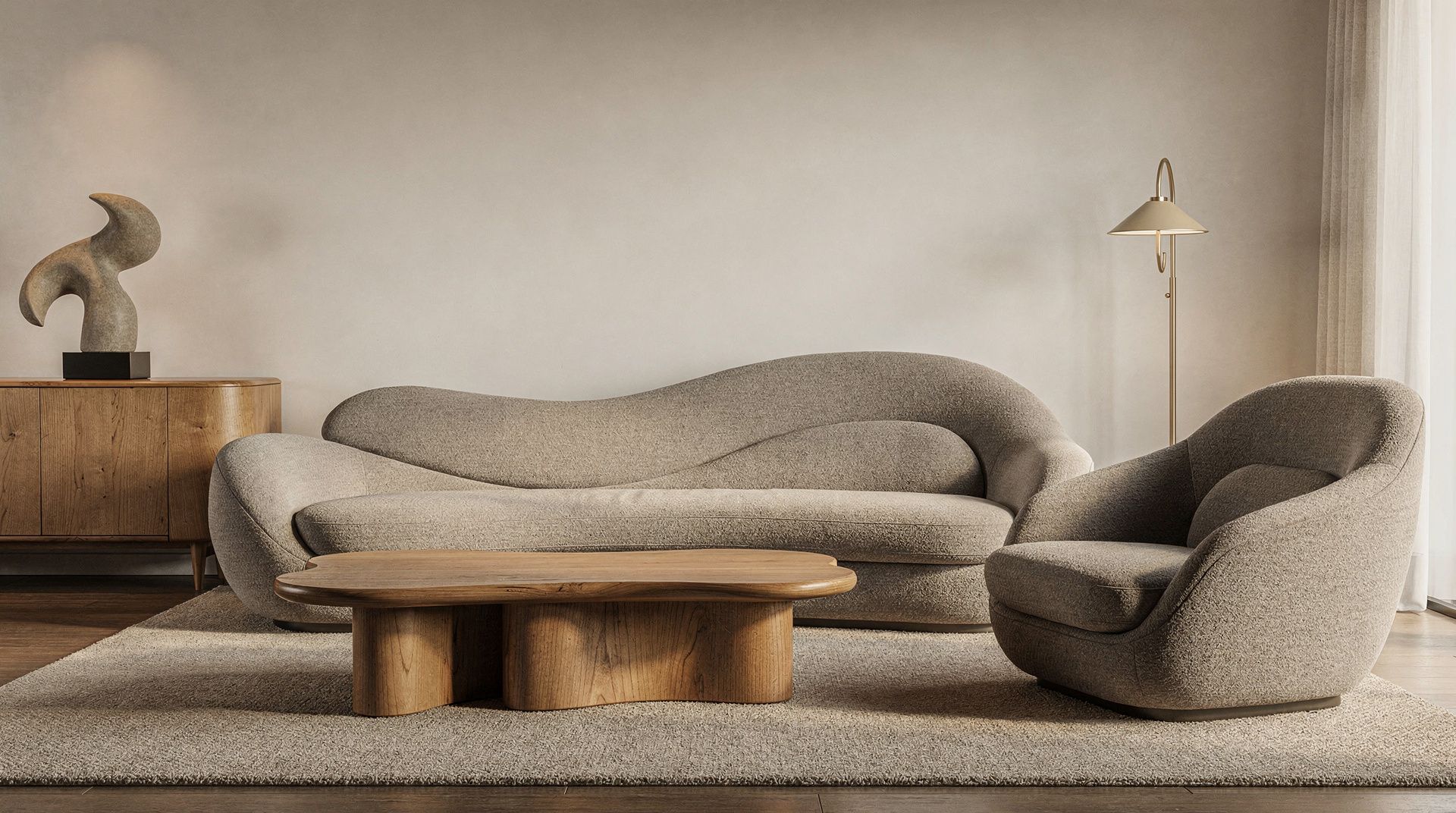
Vladimir Kagan and the Birth of Organic Modernism
If you are exploring American Mid-Century design, there is no way around Vladimir Kagan (1927 to 2016). Born in Worms on the Rhine, he emigrated with his family to the United States in 1938, where his father Illi Kagan, a master cabinetmaker, passed the craft on to him. In 1947 Vladimir opened his first retail shop in New York; in 1950 Kagan-Dreyfuss Inc. followed at 57th Street in Manhattan, founded together with textile designer Hugo Dreyfuss. From here, over seven decades, he shaped a design language that emancipated itself from the right angle and instead took the human body as its measure.
Kagan’s designs stand for a distinctly American strain of modernism: sculptural, sensuous, luxuriously crafted yet grounded in handcraft. While European contemporaries frequently aimed for industrial mass production, Kagan remained loyal to the small edition and the atelier principle. Clients such as Marilyn Monroe, Gary Cooper, Xavier Cugat and the General Motors Executive Office ensured that his furniture became an early cipher of urban sophistication. For collectors and designers today, a Kagan piece means more than a formal reference. It is a study in line, volume and material discipline.
Characteristic Materials and Construction Methods
Kagan’s formal language lives from the interplay between fluidly upholstered volumes and precisely cut solid-wood supports. For the frames he preferred American walnut, occasionally maple or rosewood, always in robust solid sections that he shaped further into curved runners, saber legs or sculptural supports. The Serpentine Sofas (from 1950 onwards) and the Contour programme exemplify how he conceived backrests and seat surfaces as anatomical curves that receive the body rather than merely framing it.
The upholstery followed a traditional American construction with coil springs, horsehair and cotton batting, later supplemented by latex and cold foam. Characteristic is the tension-free run of the cover fabric over doubly curved surfaces, a quality that places high demands on the upholsterer. Cover fabrics were frequently sourced from the range of Hugo Dreyfuss, later from Knoll and other houses of the American textile avant-garde. For tables and occasional furniture, Kagan additionally employed glass tops, travertine and polished brass, as seen in the Tri-Symmetric table series or the Cloud tables with their organically curved tops.
Regional School and the Context of American Luxury Modernism
Kagan belongs to a New York axis of Mid-Century modernism that differs markedly from the West Coast school around Charles and Ray Eames or the Herman Miller aesthetic of Michigan. While the latter emphasised serial production, plywood forming and the office context, Kagan understood himself as the author of luxurious residential landscapes. Stylistically, his neighbourhood was closer to Paul Evans, the Vladimir Nabokov of furniture-making Phillip Lloyd Powell and the Studio Craftsmen of the American East Coast, as well as to Edward Wormley for Dunbar and the plastically working sculptor-designers Wendell Castle and Isamu Noguchi.
Within this field, Kagan occupies a singular position. Unlike the Studio Craftsmen from New Hope, Pennsylvania, he operated from the outset with a clear commercial structure and his own showroom. Unlike Wormley, he remained formally more radical and closer to sculpture. The affinity with Isamu Noguchi is evident in his attention to free contour, while the reference to Scandinavian models such as Finn Juhl or Hans Wegner remains recognisable in the treatment of wood joinery. In the late 1960s Kagan expanded his vocabulary to include modular seating landscapes such as the Omnibus system (1969), which staged living spaces as open topographies and shaped the transition to the aesthetic of the 1970s.
Authenticity, Provenance and Condition for Collectors
Anyone acquiring an original Kagan piece should be familiar with several levels of scrutiny. Early works from the 1950s and 1960s frequently bear a metal or paper label printed with Kagan-Dreyfuss Inc. or Vladimir Kagan Designs Inc., applied to the underside of the rail or within the upholstery fold. From the 1970s onwards, labelling and tags changed several times. Where a label is absent — which occurs with restored upholstered pieces — construction features are decisive: the manner in which the saber legs are made, the routing of seams on doubly curved backrests, the structure of the springing system and the characteristic wood joint at runners and supports.
When assessing condition, note that new upholstery is standard on collected pieces and does not necessarily diminish value, provided the original upholstery build-up has been preserved or professionally reconstructed. Critical are interventions to the wooden frame — shortened legs, replaced runners or over-sanded surfaces that strip the original walnut of its patina. Provenance is equally relevant. Invoices from the Kagan-Dreyfuss period, auction records or interior photographs from first ownership considerably deepen the documentary record. From 2001 onwards, Ralph Pucci International in New York has issued authorised re-editions of selected designs. These re-editions are of high quality but differ clearly from originals of the first working period in terms of dating and market position.
At mid-centurydesigns.com we curate Kagan works and their stylistic context with an uncompromising commitment to provenance, substance and quality of execution. Every piece is examined for its label, construction, wood substance and upholstery structure; restorations are openly documented; and wherever possible we reconstruct the provenance chain back to the first owner. If you are looking for a specific model or need an assessment of an attribution case, please contact us. We work with collectors, architects and interior designers who prefer unique pieces with a verifiable history to any re-edition.
This article was generated automatically by an AI system. Disclosure pursuant to Article 50 of the EU AI Act.