CATEGORY · VINTAGE WATCH MAINTENANCE

Mechanical Vintage Watches: Servicing, Regulation and Movement Care

Preserving substance, restoring precision

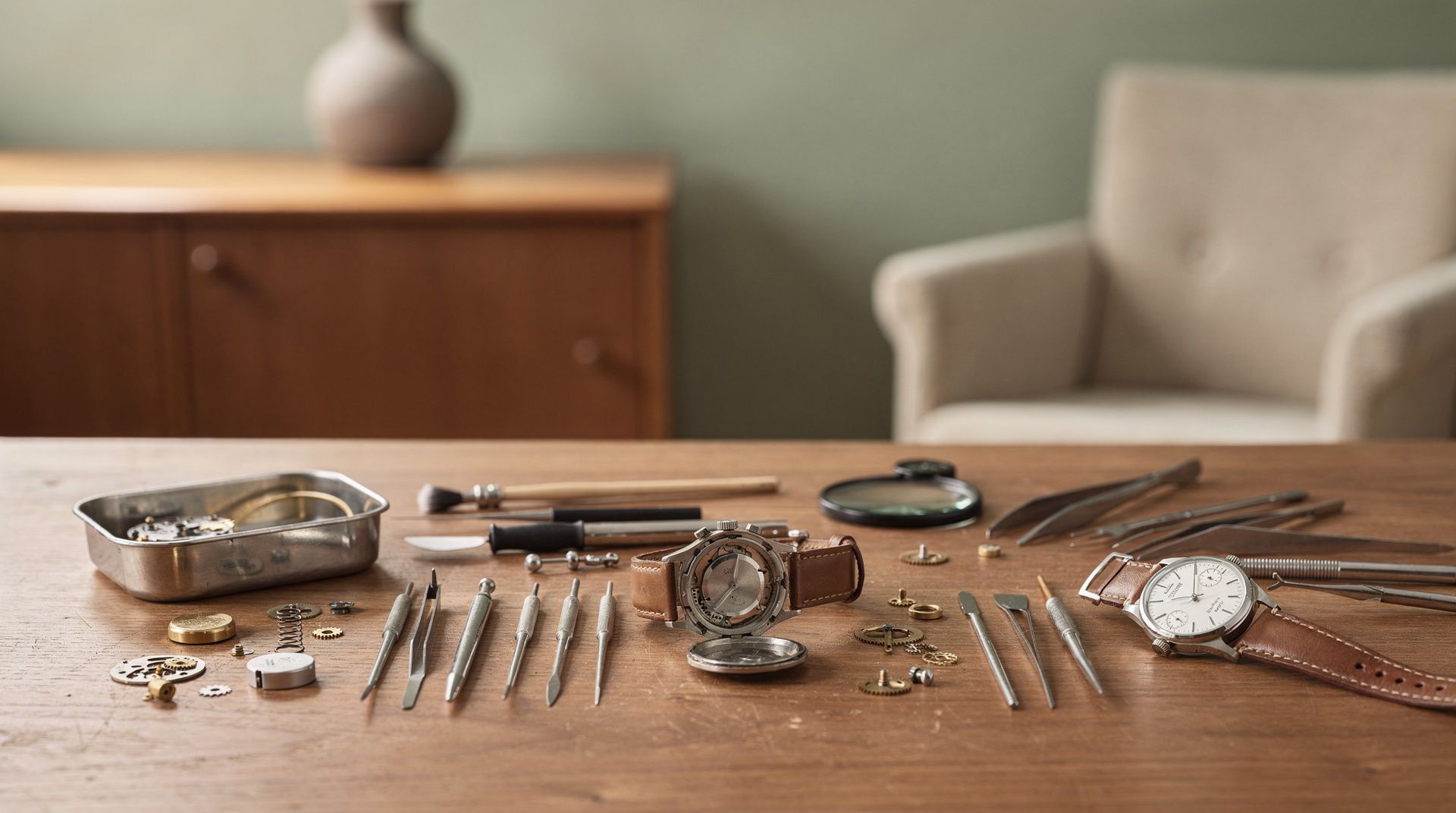
A mechanical watch from the 1950s or 60s lives on clean bearings, fresh oil and a regulated balance wheel. Purely mechanical calibres need no battery, but a service every four to six years: disassemble the movement, clean it, replace the mainspring and worn parts such as the crown stem, gaskets or shock absorbers, and regulate the rate on a timegrapher. With the automatic and hand-wound movements of that era, this care determines both value retention and timekeeping accuracy.

mid-century·designs

Vintage watch maintenance

ESSAY · 01

Work & Context

mid-century·designs

Servicing and maintaining mechanical watches: a question of attitude

Anyone wearing a mechanical watch from the mid-twentieth century is tending a technical object that relies on friction, lubrication and precision. Unlike quartz watches, the issue here is not replacing a battery but managing a delicate system of mainspring barrel, gear train, lever and balance wheel. Even small deviations in amplitude, lift angle or beat alter the rate in a measurable way. Proper maintenance therefore encompasses far more than the occasional winding: it means regular servicing, cleaning the movement in an ultrasonic bath, re-oiling according to manufacturer specifications and the careful replacement of typical wear parts.

With vintage watches from the 1950s to 1970s, additional considerations arise: spare parts are no longer available in the trade, dials carry patina, and cases show signs of wear. Anyone caring for such pieces must continually decide between restoration and conservation. This decision is not purely technical but cultural. It touches on questions of authenticity, material memory and collector value.

Characteristic materials and their ageing

Mechanical vintage watches were made from a clearly defined range of materials. Cases were usually stainless steel, gold-plated brass with a galvanic coating of 10 to 40 microns, or solid gold in 14 or 18 carats. Watch crystals were predominantly Hesalite — acrylic glass — until the late 1960s, and increasingly mineral glass from the 1970s onwards. Sapphire crystal only became widespread later. Dials were lacquered, galvanically coated or fitted with applied indices in brass; the luminous material was initially radium-based paint, and from the mid-1960s tritium.

Inside the movement, brass alloys dominate for plates and bridges, steel is used for springs, arbors and levers, and synthetic rubies serve as jewel bearings. Typical wear parts include the mainspring, which loses its force after decades, the crown stem, crown and gaskets. Shock absorbers such as Incabloc or Kif also seize up over time when old oil congeals. A thorough service involves disassembling the movement, cleaning it in an ultrasonic bath, replacing worn parts and applying oils precisely — such as Moebius 9010 for high-speed bearings or HP-1300 for loaded pivots.

Regional schools and formative movement makers

Mechanical watchmaking in the mid-century era was clearly organised along regional lines. In Switzerland, production was concentrated in the Jura arc around Le Locle, La Chaux-de-Fonds, Biel/Bienne and Grenchen. Manufactures such as Rolex, Omega, Zenith, Longines, IWC and Jaeger-LeCoultre developed their own calibres, while ébauche suppliers including ETA, Valjoux, Lémania, Peseux and AS supplied numerous brands. The Valjoux 72 became the reference for chronographs; the Zenith El Primero of 1969 is considered one of the first automatic chronograph movements running at high frequency.

In Germany, Glashütte workshops including the later GUB and brands from Pforzheim shaped the landscape, while Junghans in Schramberg developed its own formal language in collaboration with Bauhaus-influenced designer Max Bill. In Japan, Seiko and Citizen made their own technical mark from the 1960s onwards with calibres such as the Seiko 6139. The American tradition, embodied by Hamilton, Bulova and Elgin, lost ground to Switzerland during this period but left a lasting imprint on the design of military and civilian utility watches. Anyone servicing a vintage watch today is inevitably working within the conventions of these schools: movement types, thread standards and parts catalogues all follow their logic.

Authenticity and condition for collectors

For collectors, the technical condition of a watch is inseparable from its authenticity. An original dial with even patina carries more weight in collecting terms than a freshly relacquered replacement, even if the latter looks optically flawless. Redialing — the subsequent reprinting of a dial — significantly reduces value. Equally critical are polished cases where the original edges and bevels have been lost. Collectors refer to “unpolished” or “sharp” as a quality attribute.

When examining a vintage piece, it is worth looking at several levels: the correspondence of reference number, movement number and production year; the completeness of original components such as crown, hands and bezel; the consistency of the luminous material between dial and hands; and the service history. A well-maintained watch should display a stable rate of only a few seconds’ deviation per day across multiple positions, as measured on a timegrapher. Amplitudes below 250 degrees at full wind indicate congealed oil, worn bearings or a fatigued mainspring. Papers, boxes and receipts enhance the traceability of provenance but do not replace a technical inspection.

The curation on mid-centurydesigns.com follows precisely this perspective. Every piece is checked for originality of components, condition of the case, integrity of the dial and timekeeping values; service history and provenance are documented. We only present what meets this standard, and we describe patina, minor signs of ageing and completed services openly. This way, when acquiring a mechanical vintage watch, you can decide which form of care and maintenance aligns with your understanding of authenticity.


This article was generated automatically by an AI system. Disclosure pursuant to Article 50 of the EU AI Act.

FAQ · 02

Frequently asked about Vintage watch maintenance

5 Answers

01
How do I tell whether my mechanical vintage watch needs a battery change or is still running?
A mechanical watch needs no battery. If your vintage watch has stopped, the cause is either a depleted wind or wear within the movement. Quartz watches from the 1970s–80s, however, run on a battery: a ticking that stops abruptly or grows weaker indicates a dying battery. On a quartz chronograph with no seconds movement, the battery is usually dead. You should leave battery replacement to a watchmaker to avoid damaging the movement.
02
Can I regulate the rate of my mechanical vintage watch myself?
The rate is regulated by means of adjusting screws on the balance wheel, but this requires specialist tools and experience. Careless adjustment leads to chronometric deviations or damage. A qualified watchmaker uses a timing machine to control the rate precisely. For vintage watches, professional regulation every 3–5 years is recommended, especially if the watch is worn daily.
03
How often should I have the movement of my mechanical vintage watch cleaned?
A complete cleaning and oil service is advisable every 5–7 years, depending on how frequently the watch is worn and the age of the movement. Vintage watches that have gone more than 30 years without a service should in principle be inspected by a professional. Bearing lubricant congeals and hardens over time, and wear particles accumulate. A professional cleaning involves disassembly, ultrasonic cleaning and fresh oiling of the bearings and pallet stones.
04
Which wear parts in vintage watches need to be renewed regularly?
Gaskets (the rubber seals of the case back and bezel) should be renewed at every service, as they become brittle and then allow water ingress. Hands can wear and stick; the crown and setting lever wear mechanically. On older chronographs, the switching mechanism and the wheels within the chronograph train often need checking. A precise analysis by an expert shows what genuinely needs replacing, without unnecessary intervention.
05
What causes typical damage to the movement of vintage watches?
The main causes are wear due to missing or aged lubrication, moisture ingress (oxidation of steel and brass parts), shocks and vibrations, and worn mainsprings and bearings. Chronograph movements often suffer from pallet stone wear. Water ingress leads to rust and seizure. Winding too frequently without wearing the watch also damages wheels and gear teeth. Proper storage with stable winding technique and occasional inspection by a professional significantly minimise these risks.

GLOSSARY · 03

Related Terms

9 Entries

Movement
The mechanical gear and spring system of a watch that governs timekeeping through regulated energy delivery. In vintage watches, a distinction is made between hand-wound and automatic movements; regular cleaning prevents wear and rate deviations.
Timekeeping accuracy
The measure of a watch's deviation from actual time, expressed in seconds per day. For mechanical vintage watches, a deviation of plus/minus 10–20 seconds per day is normal; larger deviations require rate regulation by a watchmaker.
Balance wheel
The regulating organ of a mechanical watch whose oscillation sets the consistent rhythm for timekeeping. The balance wheel rate (the oscillation speed) determines accuracy; balance wheel adjustment is necessary when the watch runs too fast or too slow.
Jewel bearings
Synthetic stone or ruby bearings in mechanical watches on which the rotating arbors (wheels) run. Worn jewels cause frictional losses and rate disturbances; their replacement is a common maintenance procedure in vintage movements.
Hairspring
The fine spiral spring attached to the balance wheel that regulates its oscillation. Bent or corroded hairsprings are a typical wear issue in older watches and lead to rate deviations; replacement requires specialist expertise.
Sweep seconds mechanism
The transmission system between the seconds beat and the seconds display in mechanical watches. A defective sweep seconds mechanism leads to uneven seconds motion; repair is part of a full overhaul of vintage movements.
Escapement
The mechanism in mechanical watches that converts the continuous energy flow of the mainspring into rhythmic impulses to the balance wheel. The lever escapement is the most common type; wear on escapement stones leads to timing deviations and requires replacement or overhaul.
Quartz cell
The battery in modern battery-powered watches that drives the oscillator. Standard cells are consumed every 1–2 years; their replacement is a simple maintenance task, though care must be taken to prevent moisture ingress.
Gear wheel wear
Wear on the tooth flanks of wheels in the movement after decades of use, particularly in vintage watches. Worn gear wheels cause play (backlash) and rate errors; one or more wheels must then be replaced.