CATEGORY · VINTAGE CAMERAS CARE STORAGE

Caring for and storing old cameras: preserving the value of vintage cameras

A guide for collectors of mechanical precision instruments

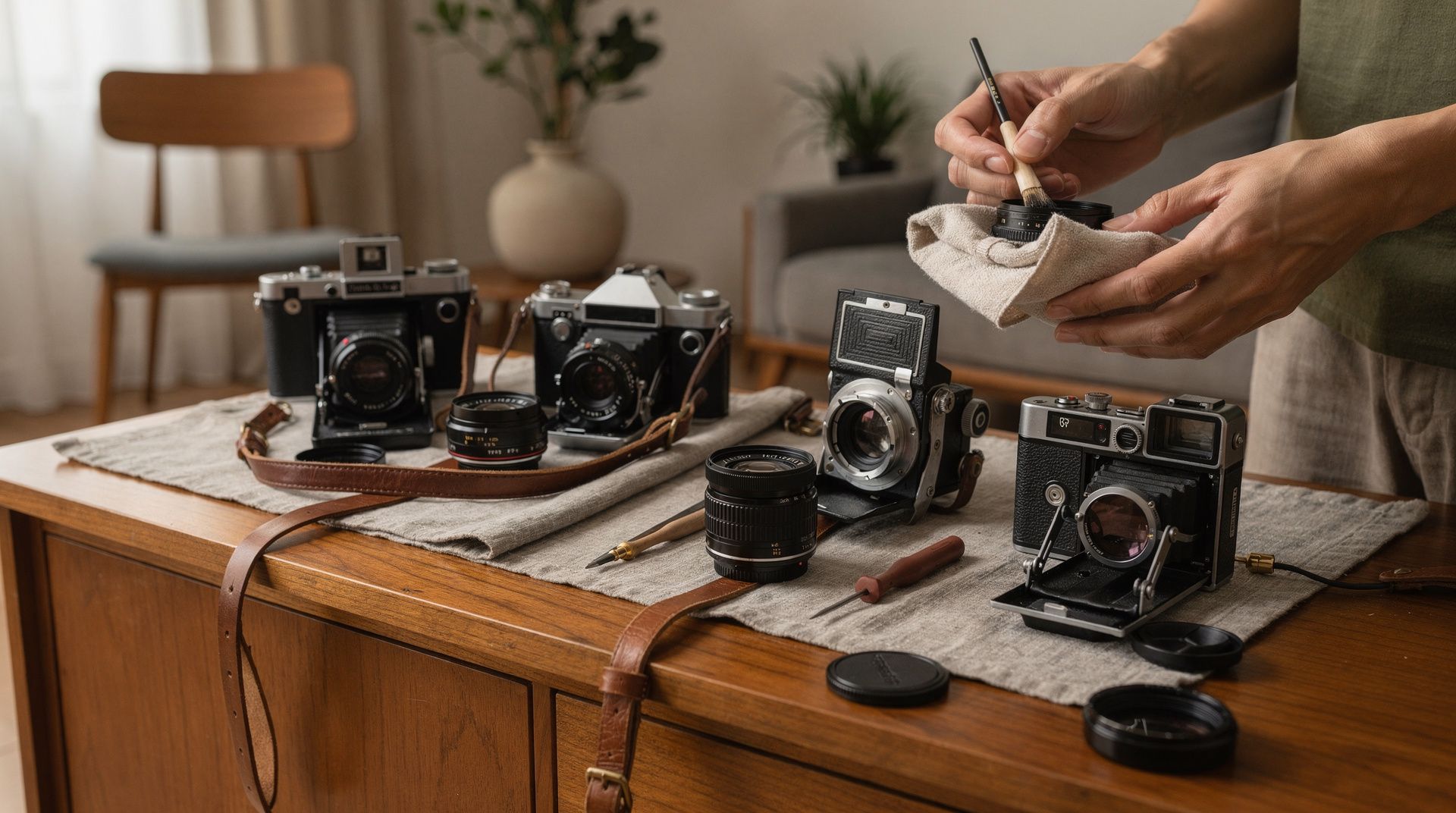
A Leica from the fifties, a Rolleiflex or an early-series Hasselblad will only retain collector quality if optics, mechanics and storage climate work together. You will learn how to clean lenses gently, have the shutter aperture checked and adjusted, test the film transport for smooth operation and protect your cameras from moisture, fungus and plasticiser degradation. The focus is on conservational practice rather than restoration at any cost: every intervention is guided by the original condition and the documented manufacturer's specification.

mid-century·designs

vintage cameras care storage

ESSAY · 01

Work & Context

mid-century·designs

Caring for and storing old cameras

Vintage cameras from the 1950s and 1960s are precision mechanical instruments that have long held the same status among collectors as lighting, seating furniture or ceramics from the same era. A Rolleiflex 2.8F, a Leica M3 or a Nikon F are not merely tools but testimonies to industrial precision culture. Those who preserve such pieces maintain a dual heritage: that of the engineers who combined shutter, transport and optics within the tightest of spaces, and that of the photographers who used these devices. Care here does not mean restoration to the point of unrecognisability, but attentive preservation. Lenses need to be cleaned gently, shutter apertures adjusted, film transports moved regularly and bodies stored in a stable climate. Every intervention should remain as reversible as possible, because for collectors the sum of function, surface condition and originality determines value.

Characteristic materials

The range of materials used in classic mid-century cameras is manageable yet demanding in terms of care. Brass bodies, chrome-plated or lacquered, form the core of many rangefinder and SLR cameras. Coverings made of vulcanite, embossed leatherette or genuine leather encase the body and become brittle over the years. Solvent-based cleaners should be avoided here; a slightly dampened microfibre cloth is sufficient. Optics consist of coated lenses whose coating is sensitive to aggressive agents. Pure isopropanol or specialist lens-cleaning fluids used together with clean lens tissue have proven effective, always working from the centre outward with minimal pressure. Shutter curtains made of rubber, fabric-coated cloth or metal blades are affected by dryness and UV radiation. Regular actuation across the full range of shutter speeds prevents lubricants in the shutter mechanism from congealing and causing the faster speeds to stick. The film transport, spool spindle and rewind knob benefit from occasional operation without a film loaded, keeping springs and gears in working order.

Regional schools and designers

Mid-century camera design can broadly be divided into three traditions. The German school, represented by Leitz in Wetzlar, Zeiss Ikon in Stuttgart and Rollei in Braunschweig, favoured brass-based precision mechanics, tight manufacturing tolerances and a restrained, functional design language. The Leica M3 of 1954, developed under the direction of Hubert Nerwin and Willi Stein, is still regarded by many as the benchmark of ergonomic reduction. The Japanese school centred on Nippon Kogaku (Nikon), Canon and Asahi Pentax absorbed impulses from Germany in the late 1950s and developed them further into robust, system-capable SLR cameras. The Nikon F of 1959, designed by a team led by Masahiko Fuketa, shaped professional photojournalism for two decades. The Scandinavian line, above all Victor Hasselblad in Gothenburg, combined square medium format with modular construction. The 500C of 1957 embodies the principle of modular system design that also played a central role in the furniture design of the same era. Alongside these, the Olympus Pen F half-frame camera by Yoshihisa Maitani (1963) deserves mention, its half-frame design offering a distinctive design response to the question of miniaturisation.

Authenticity and condition for collectors

For collectors, the legibility of a piece is paramount. Serial numbers on the body, lens and accessories should be documented and, where possible, cross-referenced with the manufacturers’ production records. Leitz, Hasselblad and Nikon maintain extensive production lists, some of which are publicly accessible, allowing dating to the exact year of manufacture. Original covering, un-retouched chrome surfaces and original screws are indicators of an unaltered example. Signs of use – so-called patina – do not necessarily reduce value, as long as they do not point to improper repairs. Items that require critical examination include shutter speeds across the full range, mirror return on SLR systems, smoothness of film transport, light-tightness of the film chambers and lens clarity in terms of haze, fungus and separation. For storage, a constant room climate of approximately 18 to 22 degrees Celsius and a relative humidity of between 40 and 50 per cent is recommended. Silica gel in ventilated display cases prevents fungal growth on lenses without drying out the coverings. Lenses are stored with the aperture open, shutters relaxed and batteries removed. Leather cases and original boxes should be stored separately, as plasticisers and acid-containing cardboard can act on metal and optics over time.

At mid-centurydesigns.com we focus on original mid-century furniture design. Every piece included in our curation undergoes an assessment of provenance, materiality and condition. We document origin, designer and any interventions transparently, so that you as a collector or designer can make an informed decision. The care that classic cameras of their era deserve is the same care we apply to seating furniture, lighting and storage systems from the 1950s and 1960s.


This article was generated automatically by an AI system. Disclosure pursuant to Article 50 of the EU AI Act.

FAQ · 02

Frequently asked about vintage cameras care storage

5 Answers

01
How do I clean old camera lenses without damaging them?
For vintage lenses, use a lint-free microfibre cloth and specialist lens-cleaning fluid for optical glass. Begin with a soft blower to remove dust and grit that could cause scratches if wiped directly. Then use circular motions from the centre outward. Never use dry cloths and avoid household cleaning products, as these attack coatings. For stubborn contamination or internal marks, consult a specialist to avoid putting the lens elements at risk.
02
Why does the shutter of an old camera get stuck, and how do I fix it?
In mechanical shutters, the most common causes of seizure are dried-out lubricants, dust or corrosion. You can carefully try gentle movements without applying force. Repeatedly actuating the shutter at various exposure times is often effective in mobilising the mechanism. Genuine problems require a repair workshop, as improper intervention can cause irreversible damage to the precision mechanism. A professional cleaning and lubrication costs less than rebuilding a damaged shutter.
03
How do I check whether the film transport of a vintage camera still works?
Load an old test film and operate the film advance lever or wheel. Pay attention to whether the resistance is even and controlled. When winding back, the film spool should rotate in unison without slipping. Visually inspect the frame counter or sprocket system to ensure everything is correctly seated. If there is jerking, blockages or the film runs through freely, the sprocket engagement is not functioning correctly. In such cases, a workshop is needed to check the gears and couplings.
04
At what temperature and humidity should I store my camera collection?
Ideal conditions are a constant 16 to 21 degrees Celsius and a relative humidity of between 30 and 40 per cent. Temperature fluctuations and high humidity accelerate rust formation on metal parts and trigger mould on lens coatings. Store your cameras in dry, dark locations away from direct sunlight, radiators and damp areas. Use silica gel sachets in sealed containers. Basements and attics are unsuitable; climate-controlled display cases or safes with desiccant are preferable.
05
How do I store camera lenses with different aperture mechanisms optimally?
Always store lenses in their original cases or specialist foam boxes to prevent scratches and knocks. The aperture blades should not remain permanently in the open position, as this can lead to deformation. Storage at a half-closed aperture is ideal. Cover the lenses with lens caps and store them vertically or horizontally, but never resting on the glass elements. Excessive light exposure attacks the coatings. A regular visual inspection every six months helps to identify damage at an early stage.

GLOSSARY · 03

Related Terms

8 Entries

Shutter aperture
Precision mechanism in cameras that controls the exposure time through the controlled opening and closing of the shutter. When servicing vintage cameras, the shutter must be checked for correct closing speed and light-tightness, as wear leads to exposure errors.
Film transport
Gear system in cameras that advances the film strip by one frame after each exposure. When servicing collector items, it must be checked whether the gears are worn, whether the spring mechanisms are tensioning correctly and whether the transport operates smoothly.
Lens coating
Thin multi-layer coating on optical elements that reduces light reflections and increases light transmission. When cleaning lenses, this coating layer must be protected, as scratches and incorrect solvents impair optical quality.
Fungal growth
Fungal growth on lens surfaces and internal optical elements, caused by humidity and insufficient air circulation. In the storage of vintage cameras, fungal growth is the greatest threat to collectible pieces and leads to optical defects and permanent damage to the glass.
Flash synchronisation
The precise timing between shutter release and flash firing. In mechanical vintage cameras, synchronisation accuracy can be impaired by wear of the release mechanism and must be checked regularly.
Mirror mechanism
In single-lens reflex cameras, the interlocking mechanism that raises and lowers the mirror. In vintage SLR cameras, wear or insufficient lubrication can cause vibrations and shutter failure, requiring optical examination.
Relative humidity
The percentage of water vapour in the air relative to the maximum possible amount. For safe storage of cameras, relative humidity should be between 35 and 45 per cent to prevent corrosion, mould and drying out of rubber components.
Element separation
Detachment or delamination of cemented lens elements in multi-element lenses. A common defect in vintage lenses caused by thermal ageing, incorrect storage or improper cleaning, which destroys the optical system.