CATEGORY · VINTAGE CAMERA MAINTENANCE LENSES SHUTTER

Caring for and maintaining old cameras: diligence for vintage cameras

Keeping lenses, shutter and film transport in balance

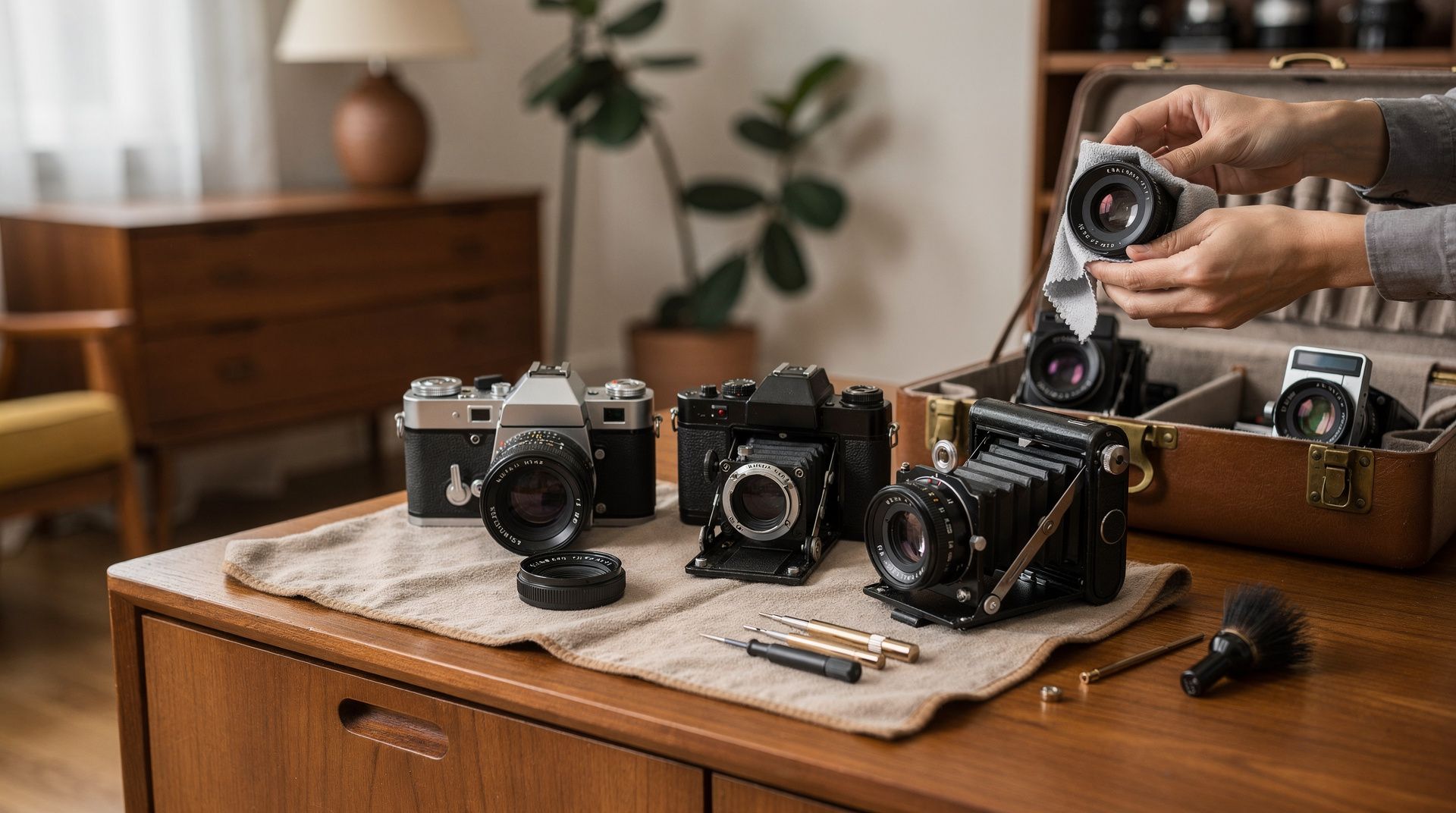
Mechanical cameras from the 1950s to 1970s reward careful maintenance with decades of reliable function. Lenses call for lint-free cleaning without aggressive solvents, shutter blades require proper lubrication with suitable precision oils, and the shutter itself needs precise timing adjustment. The film transport mechanism, often the first component to show noticeable wear, can be preserved through regular use and occasional dry-firing.

mid-century·designs

Vintage camera maintenance lenses shutter

ESSAY · 01

Work & Context

mid-century·designs

Caring for and maintaining old cameras: a matter of attitude

Vintage cameras are precision mechanical instruments, built at a time when optics, fine mechanics and materials science converged in a single object. Anyone who owns a Rolleiflex, a Leica M3 or a Hasselblad 500 C from the 1950s and 1960s is the custodian of a piece of modern industrial culture. Maintenance here means preserving the original condition for as long as possible, without weakening the substance through excessive intervention. This applies equally to cleaning the lenses, lubricating the shutter blades, adjusting shutter speeds and keeping the film transport running smoothly. The guiding principle is the same as with a chair by Finn Juhl or a lamp by Serge Mouille: work reversibly, replace as little as possible, conserve as much as necessary. Following this path preserves not only functionality, but also market value and provenance.

1. Characteristic materials and their care

The classic camera bodies of the mid-century era are made of brass, chrome-plated or covered in vulcanite. The lenses carry coated glass elements from the workshops of Zeiss, Schneider-Kreuznach, Rodenstock or Leitz Wetzlar. For cleaning the lenses, a blower bulb, a soft goat-hair brush and a microfibre cloth with a drop of distilled isopropanol are generally sufficient; aggressive solvents attack the coatings and cannot be undone on an Elmar 50 mm or a Planar 80 mm. The vulcanite covering of older Leicas tends to shrink; a light application of neutral leather conditioner to the edges helps here — never silicone. Shutter curtains made of rubberised silk fabric, as found in Barnack and early M models, must never come into contact with cleaning fluid. For the shutter blades — the leaf shutter of the Compur or Synchro-Compur series — a high-purity watchmaker’s oil is used, applied in tenth-of-a-millimetre quantities. Too much oil migrates onto the blades and makes the shutter sluggish, leading to exposure errors at fast shutter speeds.

2. Regional schools and influential designers

Mid-century photography cannot be understood without its regional schools. In Wetzlar, Oskar Barnack shaped the 35 mm camera; his successors Willi Stein and Hugo Wehrenfennig refined the Leica M series from 1954 onwards. In Braunschweig, Rollei under Reinhold Heidecke elevated the twin-lens Rolleiflex to an icon of reportage photography. Zeiss Ikon in Stuttgart and Oberkochen delivered precision instruments with the Contarex and the Contax IIa, whose fine mechanics remain a reference to this day. In Sweden, Victor Hasselblad developed the modular medium-format system from 1948, later adapted by NASA for the Apollo missions. Japan entered the world market from the mid-1950s with Nippon Kogaku (Nikon), Canon and Asahi Optical (Pentax); the Nikon F of 1959, designed under Masahiko Fuketa, redefined the system camera. Each of these schools has its own service ethic: German leaf shutters require different oils and tolerances than Japanese focal-plane shutters, and a Swedish Hasselblad magazine is adjusted differently from a Rollei film transport. Anyone servicing these cameras should know which workshop culture the instrument comes from.

3. Authenticity and condition for collectors

For the collector, condition is paramount — not cosmetic perfection. A Leica M3 with its original vulcanite, unpolished chrome edges and functioning cloth shutter is far preferable to a re-leathered, high-gloss-polished example. Key indicators are the serial number, the matching of body and lens numbers in documented sets, original screws, the engraved manufacturer’s designation and the presence of the original back. Shutter speeds should be measured with a shutter tester; deviations of up to one third of a stop are acceptable in sixty-year-old equipment, but anything beyond that calls for a CLA (clean, lubricate, adjust) by a qualified technician. For the film transport, look for even resistance, clean engagement of the frame counter and no play in the take-up spool. A light film of oil on the aperture blades, visible as a rainbow sheen, significantly reduces value, as it indicates years of storage without use. Documentation such as factory invoices, service records from manufacturer workshops or customs documents substantially enhance provenance and thus market value.

At mid-centurydesigns.com we curate furniture, lighting and objects of the classic modern era with the same care that a collector of vintage cameras devotes to their collection. Every piece is examined for the originality of its materials, the traceability of its provenance and the integrity of its construction before being included in our selection. We document restorations openly, keep interventions minimal and reversible. This means that the pieces you find with us are ones whose condition is not concealed but evidenced, and whose history remains legible.


This article was generated automatically by an AI system. Disclosure pursuant to Article 50 of the EU AI Act.

FAQ · 02

Frequently asked about Vintage camera maintenance lenses shutter

5 Answers

01
How do I clean the lenses and glass elements of an old camera without damaging them?
Use only optical cleaning cloths (microfibre) and specialised lens cleaners or distilled water. Start with a soft brush to remove loose particles, then gently dab from the centre outwards. Compressed air is suitable for the body and gaps. Avoid paper and aggressive chemicals that attack coatings. For stubborn marks: apply minimal amounts of ethanol to the cloth, never directly onto the glass.
02
Why does the shutter blade of a vintage camera become stiff, and how do I lubricate it correctly?
Dried-out or resinified lubricants and dust accumulate in the delicate shutter blades. Professional cleaning requires disassembly by a specialist. Self-lubrication with light machine or watchmaker's oil is possible: apply minimal amounts directly to the blades, actuate several times, remove excess with a cloth. Too much oil causes spots on the film. With valuable cameras: take them to a workshop instead.
03
The shutter on my camera operates unevenly. Can I adjust the shutter speed myself?
Professional adjustment requires specialised measuring instruments (shutter testers) and expert knowledge. Manual adjustment leads to miscalibration and potential damage to spring and gear mechanisms. Some cameras offer external adjustment slots for minor corrections. Consult specialist repair workshops familiar with the brand. A professional inspection costs considerably less than buying a replacement.
04
How do I store old film in vintage cameras to avoid transport damage?
Store cameras with loaded film at a constant temperature (15–21°C) and low humidity (30–40%). Wind the film loosely onto the spool without tension. For longer storage: protect the film from light, keep the camera in an airtight container with silica gel. The film itself ages due to temperature and moisture, not because of the camera. Use archive-suitable containers. If film has been stored for a long time: allow it to acclimatise before processing.
05
Which lubricants are safe for the film transport and gears?
Synthetic light machine or watchmaker's oil (ISO VG 10–15) is suitable for gears and transport mechanisms. Avoid WD-40, silicone sprays and grease pastes, which become sticky and attract contamination. Apply minimal doses and remove excess. For valuable pieces: use synthetic oils such as Moebius 9010 (watchmaking industry standard). Regularly actuating the transport mechanism lightly keeps it running smoothly.

GLOSSARY · 03

Related Terms

8 Entries

Shutter blade
Mechanical shutter system in vintage cameras, consisting of overlapping metal blades or curtains that open and close to control the exposure time. Requires regular lubrication of the joints to maintain functionality.
Lens haze
Optical deterioration caused by moisture deposits, dust or chemical decomposition on lens surfaces. Can impair image quality and results from improper storage. Requires careful cleaning with suitable materials.
Focal-plane curtain
Fast shutter mechanism made of cotton or silk that covers the film plane during exposure. Ageing processes lead to hardening and cracking, which compromises the accuracy of exposure times.
Film transport mechanism
The gear and lever system of a camera that advances the film evenly and precisely through the body. Susceptible to wear from contamination and drying out of lubricants; essential for consistent frame spacing.
Rear element fungus
Fungal growth on the rear lens surfaces, which can develop due to moisture inside closed cameras. A biological process that leads to permanent marks and requires disassembly and expert cleaning.
Shutter calibration
Calibration of the timing mechanism of a camera to ensure accurate exposure times, e.g. from 1 second to 1/1000. Necessary after wear or during servicing, as tolerances affect image exposure.
Lens contamination
Accumulation of particles, grease, dust or oxidation on lens glass elements. Particularly possible in vintage cameras due to leaky bodies. Requires cleaning with lint-free cloths and specialist lens cleaning agents.
Lubricant glazing
Hardening or resinification of machine oil and lubricants in the moving mechanisms of a camera over decades. Leads to shutter stiffness and blocked gears; requires partial disassembly and cleaning.