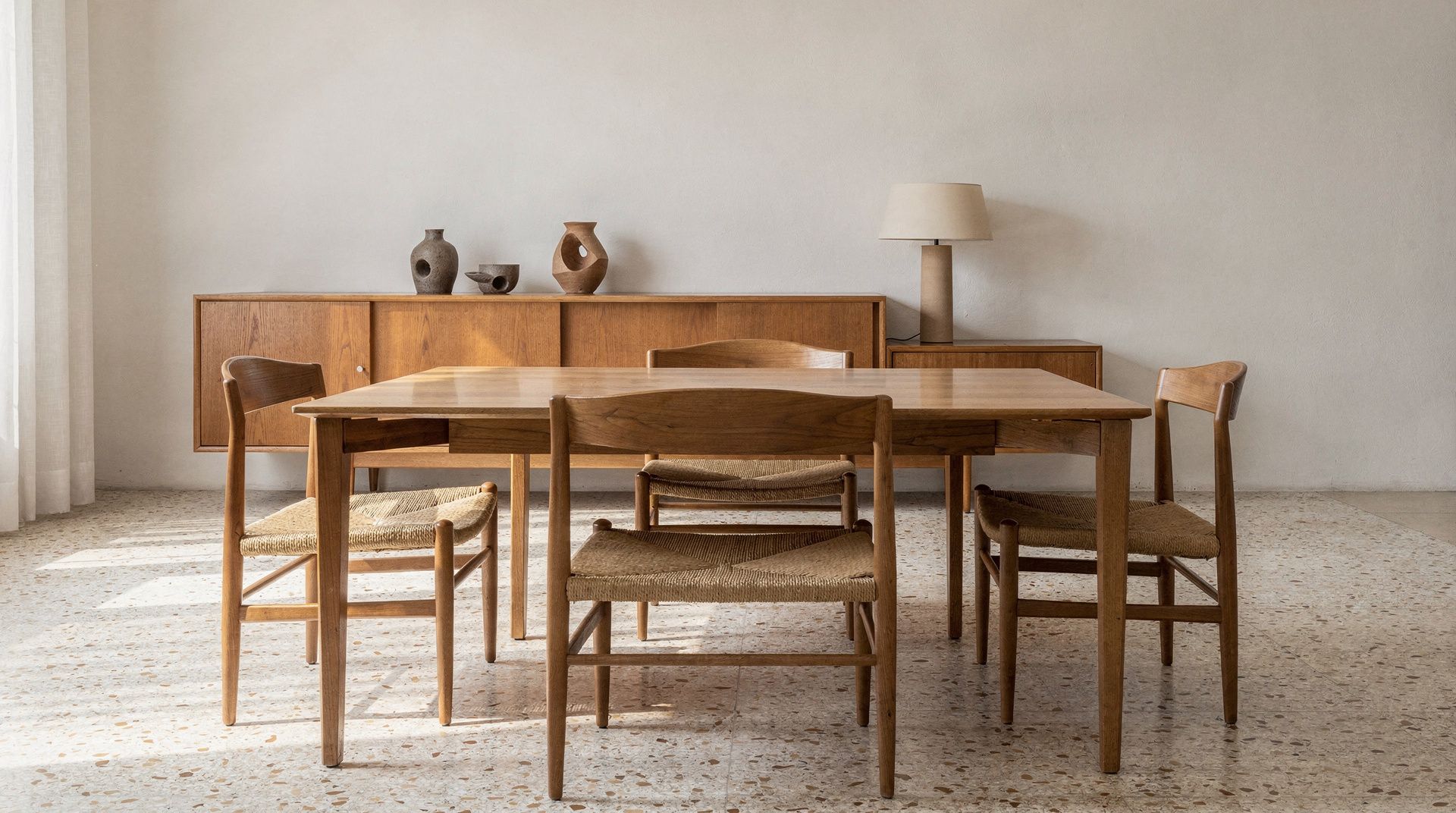
Vico Magistretti and the Quiet Authority of Milanese Modernism
Vico Magistretti (1920–2006) belongs to those designers whose work is explained not through gesture, but through precision. Trained at the Politecnico di Milano, shaped by the rationalism of the pre-war period and the debates around a social modernity, he developed a formal language reduced to the essential without feeling cold. His furniture pieces are thinking figures: the Maralunga armchair for Cassina (1973), the Eclisse lamp for Artemide (1965, Compasso d’Oro 1967), the Chimera floor lamp, or the Selene chair for Artemide (1969) made from a single piece of plastic. The recurring principle is that an idea must make itself fully recognizable in a single gesture, a silhouette, a material decision.
The Carimate 892, designed in 1959 for the bar of the golf club in Carimate that Magistretti himself planned, and produced in series by Cassina from 1963 onwards, is perhaps the clearest manifesto of this stance. The lacquered beech chair with woven rush seating translates the rural typology of the Italian tavern chair into an industrially reproducible icon. The characteristic red, the conical backrest, the fine lacing of the seat surface: none of it is decorative, everything is a consequence of construction and use. Carimate thus stands as an exemplar of the Italian post-war idea of not quoting vernacular tradition, but rationally continuing it.
Materials: Beech, Rush Weave, Lacquer, and the Discipline of Simplicity
Magistretti’s material palette is restrained and precisely so. For the Carimate series (892, 905, armchair and barstool variants), Cassina uses solid beech, turned and lacquered in a muted vermillion red, less frequently in black, white, or natural finish. The seat consists of hand-woven Indian rush, drawn through drilled holes in the frame using the classic Viennese technique. This combination of closed, colour-bound wood and open, breathable woven structure is the true design core.
The same discipline appears in other bodies of work: colour-pigmented ABS plastic in Selene and Gaudì, mouth-blown opal glass in Eclisse and Chimera, deep-drawn aluminium, thick vegetable-tanned leather in Maralunga and Veranda. Magistretti never uses materials as surface, but as argument. Where a rush covering suffices, no upholstery is added; where a single-piece plastic casting carries the structure, every additional joint is omitted.
Regional School: Milan, the Second Generation, and Rationalism after 1945
Magistretti cannot be understood without the Milanese context. Together with Achille and Pier Giacomo Castiglioni, Marco Zanuso, Franco Albini, Ignazio Gardella, and Gio Ponti, he shaped that second generation of Italian modernism which, between the Triennale, Domus, and the Politecnico, formulated the self-conception of disegno industriale culture. Ponti became an early advocate; Cassina, Artemide, Oluce, and later De Padova became the central manufacturing partners, most notably the long-standing collaboration with Maddalena De Padova from the late 1970s onwards.
Within this school, Magistretti represents the sober, constructively argued wing. While the Castiglioni brothers worked with ready-made approaches and ironic displacements, and Zanuso leaned more towards engineering design, Magistretti remained committed to typological thinking: chair, armchair, table, lamp are reformulated from within their own history. This stance carries through to the work of Jasper Morrison, Konstantin Grcic, and James Irvine, all of whom have repeatedly cited Magistretti as a point of reference.
Authenticity and Condition: How to Identify Original Pieces
On Carimate chairs from the early Cassina production run (from 1963), you will generally find a burned-in or stamped Cassina signature on the underside of the seat rail, supplemented by the model number (892) and sometimes a year. Later editions carry paper labels or laser-engraved marks. Pay attention to the consistency of the red tone: the original nitro lacquer of the 1960s is more matte and open-pored than modern two-component lacquers, and shows a characteristic wear patina on edges and feet through which the beech shines through. Repainting can be identified by lacquer runs in the turned grooves and by an overly uniform coverage.
The rush weave is a wear part. A carefully re-woven seat in the classic hexagonal technique does not diminish collector value, provided the frame, lacquer, and construction are original. More critical are interventions in the substance: replaced legs, re-cut tenons, glued breaks in the backrest. Check the symmetry of the turned profiles, the fit of the tenon joints, and the depth of colour in the cross-section of the backrest.
For luminaires such as the Eclisse and Chimera, manufacturer marks from Artemide, correct lamp holders, and the original lacquering of the inner reflector dome are decisive. For the Maralunga, look for the patented folding mechanism of the headrest, the original upholstery, and the frame stamps from Cassina. Provenance documents, invoices from the first owner, or catalogue entries from the relevant years considerably increase the certainty of attribution.
At mid-centurydesigns.com, we curate works by Vico Magistretti with precisely these criteria in mind: documented manufacture, traceable provenance, honest condition descriptions, and, where necessary, professional restoration by specialist workshops. Every piece is assessed for marks, materiality, and originality before it is included in our offering, so that you can make a decision on the basis of reliable facts.
This article was generated automatically by an AI system. Disclosure pursuant to Article 50 of the EU AI Act.