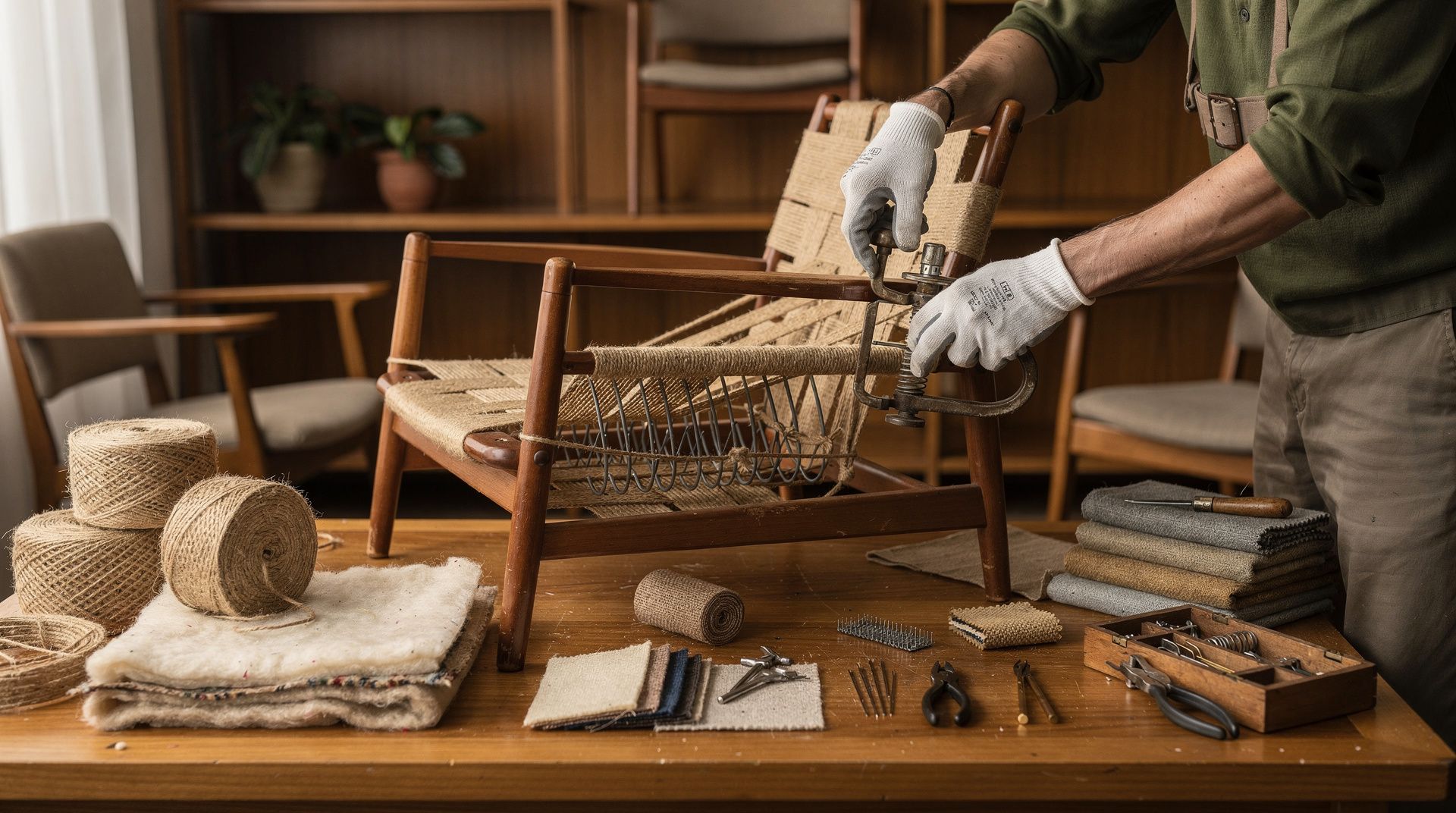
Replacing Webbing and Spring Units: Upholstery Restoration Done Right
An original Mid-Century upholstered piece lives on two layers: the visible shell of wool fabric, leather, or bouclé, and the invisible interior of webbing, springs, horsehair, and cotton wadding. If the latter is neglected, even a signed piece loses its seating geometry, its silhouette, and with it part of its authorship. The good news: webbing and spring units were traditionally conceived as wear parts. They may — and should — be renewed once they have lost their tension. What matters is how carefully the intervention is carried out, which materials are used, and whether the original constructional logic is respected.
Whoever opens a vintage upholstered piece encounters the handwriting of a workshop. Visible staples from the 1960s, hand-sewn spring pockets, numbered frame parts, supplier stamps — all of this is part of the provenance. A respectful restoration documents what is removed, preserves original components wherever possible, and replaces only what can no longer be salvaged functionally. When dismantling: always release fabric along the grain, lift staples sideways with a narrow chisel rather than tearing them out, and photograph every upholstery element before it leaves the frame. This keeps a return to the original state possible at any time.
1. Characteristic Materials and Their Quality Features
The classic Mid-Century seat rests on jute webbing approximately 50 to 60 millimetres wide, woven in red-black or natural, with a tensile strength that can be read from the density of the weave. Elastic rubber webbing — as supplied by Pirelli from the late 1940s onward for Scandinavian manufacturers — is a chapter unto itself: it ages brittly, loses tensile force, and generally needs to be replaced entirely. Original Pirelli straps often still bear the embossed stamp. Replacement with high-quality natural-rubber successor products is accepted; synthetic budget alternatives, however, noticeably alter the feel of the seat.
The spring unit consists either of waisted steel springs tied eight ways with hemp twine, or of No-Sag sinuous springs, which dominated industrial production from the 1950s onward. Assess material quality at three points: rust on the wire, fatigue in the coils, and the condition of the connecting clips. Above this lie horsehair pads, often sewn into jute, as well as cotton or kapok wadding. High-quality horsehair is long-fibred, resilient, and odour-neutral after airing. Clumped, short-fibred material is usually second-grade stock and should be replaced with washed horsehair or — on a tight budget — coconut fibre matting plus a cold-foam topper. Pure foam as a complete replacement destroys the character of the seat and diminishes collector value.
2. Regional Schools and Their Upholstery Traditions
The Danish school around Hans J. Wegner, Finn Juhl, and Arne Vodder worked preferentially with interlaced webbing on slender teak frames, combined with loose cushions of horsehair and, later, latex. Workshops such as Johannes Hansen, Niels Vodder, or France & Søn are recognisable by the clean frame joinery, stamped metal fittings, and spare, precise tacking. Here the rule applies: the less material between frame and seat surface, the more important the exact tension of the webbing.
The Italian tradition, represented by Osvaldo Borsani for Tecno, Marco Zanuso for Arflex, or Gio Ponti for Cassina, embraced technical innovation early on: Pirelli rubber webbing, moulded latex, and mechanical adjustments characterised models such as the D70 or the Lady Chair. Replacement here demands expertise in the original supply sources, as seat firmness is part of the design. German and Swiss production — Walter Knoll, de Sede, or Wilkhahn, for example — frequently used robust No-Sag constructions and industrially produced foam cores. French designs by Pierre Guariche, Joseph-André Motte, or René-Jean Caillette for Steiner and Airborne, by contrast, combined filigree metal frames with sewn spring cushions that require a conservationally demanding restoration.
3. Authenticity, Condition, and Cost Framework for Collectors
For assessing the condition of a vintage upholstered piece, a four-stage inspection is recommended. First, frame integrity: are mortise-and-tenon joints tight, are there hidden cracks in the wood or corrosion on the metal frame? Second, the interior: does the spring unit still carry, is the webbing intact, does the horsehair smell neutral? Third, the cover: is it original, contemporaneously reproduced, or a later addition? The fourth stage is documentation: manufacturer and designer labels, purchase receipts, workshop stamps, model numbers.
The cost framework varies considerably. Simply replacing the jute webbing on a lounge chair in professional execution typically runs between €150 and €350. A complete re-upholstery with horsehair, spring unit overhaul, and high-quality wool fabric ranges between €800 and €2,500 depending on model size — and can exceed that for three-seater sofas. Vegetable-tanned leather upholstery roughly doubles the material portion. For collectors, the rule of thumb is: invest in a full restoration only where the frame substance and provenance documentation justify the cost. An unattributable 1960s armchair merits a solid basic overhaul; a signed Finn Juhl design, by contrast, calls for a conservatorial restoration by a specialist workshop — ideally with photographic documentation before, during, and after the intervention.
When dismantling, three steps are critical: release the cover in reverse order of assembly, sort staples and tacks into labelled trays, and lift each layer of upholstery material individually rather than tearing it out. Secure tension-loaded elements such as pre-tensioned springs or rubber webbing before releasing the final fixings. Work gloves and safety glasses are not excessive caution when dealing with old spring constructions.
At mid-centurydesigns.com, every upholstered piece undergoes a condition assessment before being listed — evaluating frame, interior, and cover separately and documenting findings transparently. Where a restoration was necessary, we name the components replaced, the materials used, and the workshop that carried out the work. This allows you to trace provenance, original substance, and condition of care before committing to a piece.
This article was generated automatically by an AI system. Disclosure pursuant to Article 50 of the EU AI Act.