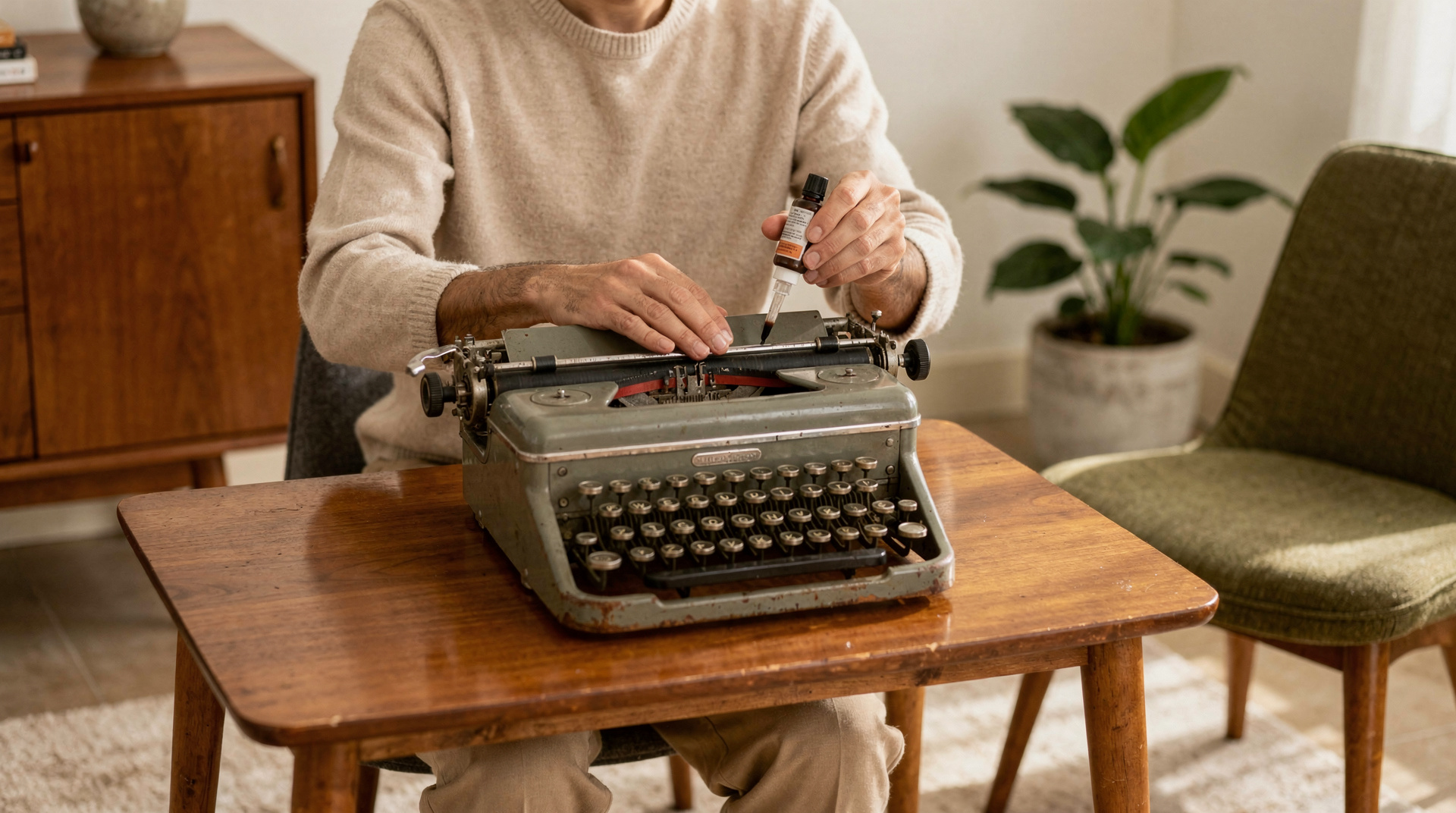
Cleaning and oiling a typewriter: professional maintenance and servicing of mechanical vintage typewriters
A mechanical typewriter from the 1950s and 1960s is a precision instrument made up of several thousand individual parts that operates without electricity and yet works with remarkable reliability, provided it is maintained properly. Between the typebar, segment, universal bar and carriage, a delicate interplay emerges that is sensitively disturbed by dust, resinous old oil and dried-out rubber parts. Anyone who acquires an Olivetti Lettera 22, an Olympia SM4 or a Hermes 3000 therefore takes on not only a design object, but also responsibility for its mechanical integrity.
The short answer to the frequently asked question is: a typewriter is primarily cleaned, not oiled. Oil belongs at very few, clearly defined points, while the vast majority of the mechanism must run dry. Old manuals from Olympia, Adler and Triumph explicitly point out that the segment, in which the typebars are mounted, must under no circumstances be oiled. Anyone who observes this basic rule lays the foundation for maintenance that preserves the value and function of the piece for decades.
Characteristic materials and their care
Mid-century typewriters combine cast aluminium housings, chrome-plated steel, Bakelite or early plastics, and rubber into a technically demanding unit. The housing of an Olivetti Lettera 22, designed by Marcello Nizzoli, consists of lacquered aluminium casting that reacts sensitively to aggressive solvents. A soft, lightly dampened cloth is sufficient to clean the body, and a mild soapy solution for stubborn residues. Acetone, nitro thinner or brake cleaner are unsuitable and attack the original paintwork.
The actual mechanism is cleaned dry using compressed air and a soft brush to remove dust and paper fibres. For resinous areas, pure white spirit or isopropanol, which evaporates without residue, has proven effective. Oil is used exclusively at the carriage bearing points, the carriage axle and the rack, in very small quantities. A light watchmaker’s oil or sewing machine oil is sufficient, applied with a needle rather than an oiler. The platen and paper pressure rollers made of rubber harden over time; glycerine or special rubber care products can keep the surface supple in the short term, but they are no substitute for re-coating, which should be carried out by a specialist workshop for severely hardened platens.
Regional schools and designers
The European typewriter of the post-war period is a chapter in design history that can be clearly structured by origin. Italy, with Olivetti from Ivrea, stands for the consistent fusion of industrial design and engineering. Marcello Nizzoli was responsible for the Lexikon 80 (1948) and the portable Lettera 22 (1950), and Ettore Sottsass later for the Valentine (1969), together with Perry A. King. The Lettera 32 (1963) continued Nizzoli’s design language in a more robust travel version.
The German school from Wilhelmshaven produced, with the Olympia SM series — in particular the SM3, SM4 and SM9 — portable machines of great mechanical precision, whose segment guidance and stroke consistency are still considered a reference today. Adler in Frankfurt and Triumph in Nuremberg complemented the picture with models such as the Adler Tippa and the Triumph Perfekt. From Switzerland came the Hermes family from Paillard-Bolex, whose Hermes 3000 in its sea-green version is a visual hallmark of the mid-century era. In the USA, Smith Corona and the IBM Selectric — with its golf ball element designed under Eliot Noyes from 1961 — set their own accents. Those who know the regional signatures can read the origin directly from the chassis, keyboard and colour scheme.
Authenticity and condition for collectors
For collectors, three criteria determine the value of a piece: original condition, completeness and function. The serial number, usually stamped on the underside or beneath the carriage, allows precise dating in conjunction with published manufacturer lists. For Olivetti, Olympia and Hermes, these lists are documented and publicly accessible. Pay attention to the original colour, as repaints significantly reduce the collector’s value, even if they are executed to a high standard of craftsmanship. Equally relevant are the original keycaps with unfaded label paper beneath the clear disc, the original type wheel or complete typebar set, and the accompanying case or hood.
Functionally, check the strike of each individual type, the return of the typebars without sticking, the carriage travel across the full width, the line spacing, the margin stops and the shift to upper case. A slight resistance after decades of standing is normal and usually remedied by cleaning; a dull, muffled strike, on the other hand, points to hardened rubber buffers in the segment, whose replacement should be carried out by a specialist. Ink ribbons are consumable parts and are still available as new stock for most models, so their condition says nothing about the machine itself. A transparently documented service record — with date, work carried out and materials used — increases traceability and is the rule rather than the exception for high-quality pieces.
At mid-centurydesigns.com, we check every typewriter for originality, completeness and mechanical function before it is included in our curated selection. Serial numbers are verified, datings substantiated, and condition documented photographically and in writing. Where professional cleaning was appropriate, we list the work carried out. This way you receive a piece that demonstrates both its provenance and its usability, and you need only concentrate on the essentials when it comes to your own maintenance.