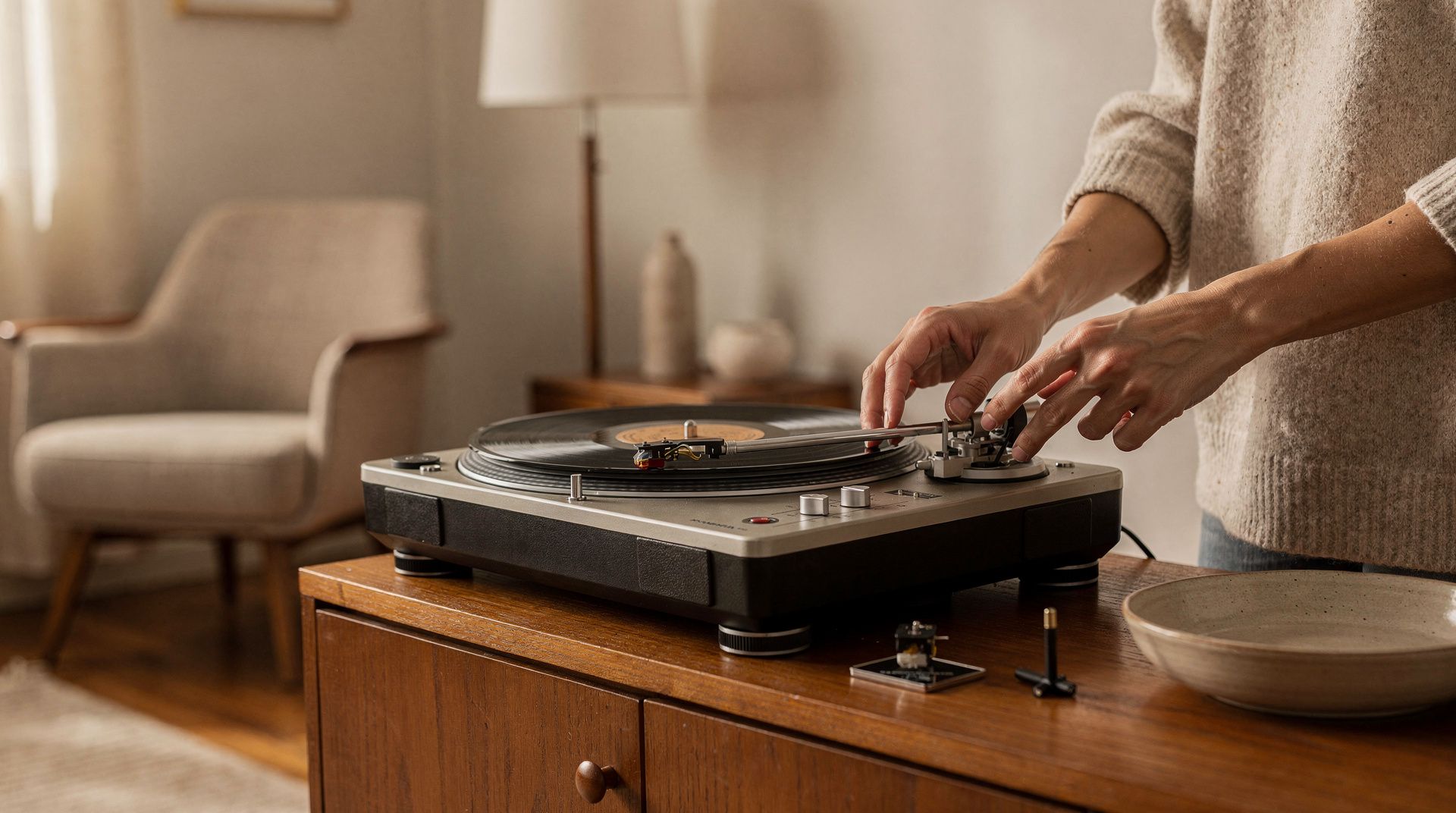
Setting up a turntable: Why precision matters with vintage decks
A vintage turntable is only as good as its alignment. Anyone who has a Thorens TD 124, a Garrard 301 or an early Braun in their listening room knows that sound quality and groove preservation depend directly on the interplay of tonearm geometry, tracking force and stylus condition. The three key parameters can be named quickly: tracking force in grams, overhang together with the offset angle for correct tangential deviation, and anti-skating, which compensates for the inward-pulling friction force. Add to these the azimuth (perpendicular alignment of the cantilever to the record) and VTA/SRA, i.e. the vertical tracking angle. It sounds technical — and it is. But the system is manageable if you follow your cartridge manufacturer’s specifications and work with an alignment protractor (Baerwald, Löfgren or Stevenson) and a tonearm scale. Especially with original mid-century turntables, the effort is worthwhile: these devices were designed for precisely the kind of hands-on work that today once again belongs to the ritual of listening.
We approach the subject from the perspective of curated collecting. A cleanly aligned turntable is not only sonically superior — it also preserves the value of your records and the device itself. Incorrect tracking force grinds down groove walls, a skewed azimuth distorts the stereo image, and a worn stylus destroys shellac and vinyl collections irreversibly. Anyone investing in original furniture pieces and HiFi icons of post-war modernism should take maintenance just as seriously as provenance.
1. Characteristic materials and components: What you should know about vintage decks
The classic turntables of the 1950s through the early 1970s were built from materials that are rarely used with such consistency today. Plinths made of laminated wood with veneers of walnut, rosewood or teak are the norm at Braun, Dual, Thorens and Bang & Olufsen. Chassis and sub-platters are often made of die-cast zinc or aluminium, main platters of heavy grey cast iron, sometimes with a machined surface. Motors are either idler-driven (Garrard, EMT, Lenco), belt-driven (Thorens from the TD 150, Braun PS 500) or direct-drive (Technics from the SP-10, later Dual series).
For alignment purposes, the tonearm and headshell are of particular relevance. Original tonearms such as the SME 3009, the Ortofon RMG 212 or the Thorens TP 14 have defined effective lengths and offset angles. Only those who know these values can correctly set overhang and null points. Cantilevers are typically made of aluminium; higher-quality systems use boron or ruby. The stylus tip itself is diamond, ground as spherical, elliptical, line contact or Shibata. When changing the stylus: an MM (Moving Magnet) system often allows only the stylus insert to be swapped, while an MC (Moving Coil) system usually needs to be replaced entirely or re-tipped by the manufacturer. Tracking force ranges from 1.25 to 2.5 grams depending on the system, measured with a digital tonearm scale directly at record level.
2. Regional schools and formative designers
The mid-century era produced distinct schools of turntable design in Europe and Japan that continue to shape the collector market to this day.
Germany stands for industrial precision and design clarity. Braun in Frankfurt, under the design direction of Dieter Rams and with contributions from Hans Gugelot, developed from the SK 4 (Schneewittchensarg, 1956) a formal language that redefined the turntable as a piece of furniture. Dual in St. Georgen and Perpetuum-Ebner in the Black Forest supplied robust changers and single-play decks for the middle-class household. Switzerland contributed, through Thorens (Sainte-Croix) and Lenco, turntables that elevated mass and quiet running to a guiding principle. The TD 124 remains a reference to this day for idler-drive with an all-metal chassis. Great Britain focused on the studio and high-end sector: the Garrard 301 and 401, EMT-licensed builds and the tonearms from SME (Scale Model Equipment, Steyning) are milestones of precision engineering. Denmark, through Bang & Olufsen (Struer), stood for radical design, visible in the Beogram 4000 (1972, Jacob Jensen), the first tangential consumer tonearm. Japan entered the scene from the mid-1960s with Technics, Denon and Pioneer, establishing direct drive as the new standard.
For alignment, this diversity means: there is no universal setting. An SME 3009 on a Garrard 301 requires different null points than an original TP 14 on a Thorens. Service manuals and manufacturer documents are indispensable here.
3. Authenticity and condition: What collectors look for
With a vintage turntable, the condition determines sound quality, value and investment security. First check the chassis for original finish, unaltered labelling and intact serial number. Plinths should carry the original veneer, without subsequent staining or aggressive polishing. The platter must show no vertical runout; the sub-platter must spin freely. Motors with dry bearings can generally be overhauled, but worn idler wheels and hardened rubber grommets are consumable parts that should be documented when replaced.
The tonearm is the most sensitive point. Play in the bearings is a disqualifying criterion; the gimbal bearing of an SME must be free of play yet move effortlessly. Original headshells, correct internal wiring and matching counterweights significantly increase value. With the cartridge: an original system with an intact stylus is rare — in most cases an upgrade has been fitted. Document which system is mounted, and have the stylus examined under a microscope whenever you are in doubt. Stylus wear of more than 1,000 to 1,500 hours is the limit for most tip profiles.
Provenance and service records noticeably increase collector value. A Thorens TD 124 with documented first delivery, original purchase receipt and a complete maintenance history commands many times the price of an undocumented example. The same applies to early Braun pieces bearing a Rams design signature.
At mid-centurydesigns.com we curate furniture and objects of post-war modernism with the same standards that a cleanly aligned turntable sets for itself. Every piece is examined, documented and described for originality of materials, structural integrity and complete provenance. If you would like to add an original sideboard, a lounge chair or a matching HiFi console to your listening room, you will find exclusively pieces there whose condition is taken just as seriously as the fine-tuning of your tonearm.
This article was generated automatically by an AI system. Disclosure pursuant to Article 50 of the EU AI Act.