Safely Commissioning a Tube Radio: Soft Start, Risks, and Maintenance of High-Voltage Circuits
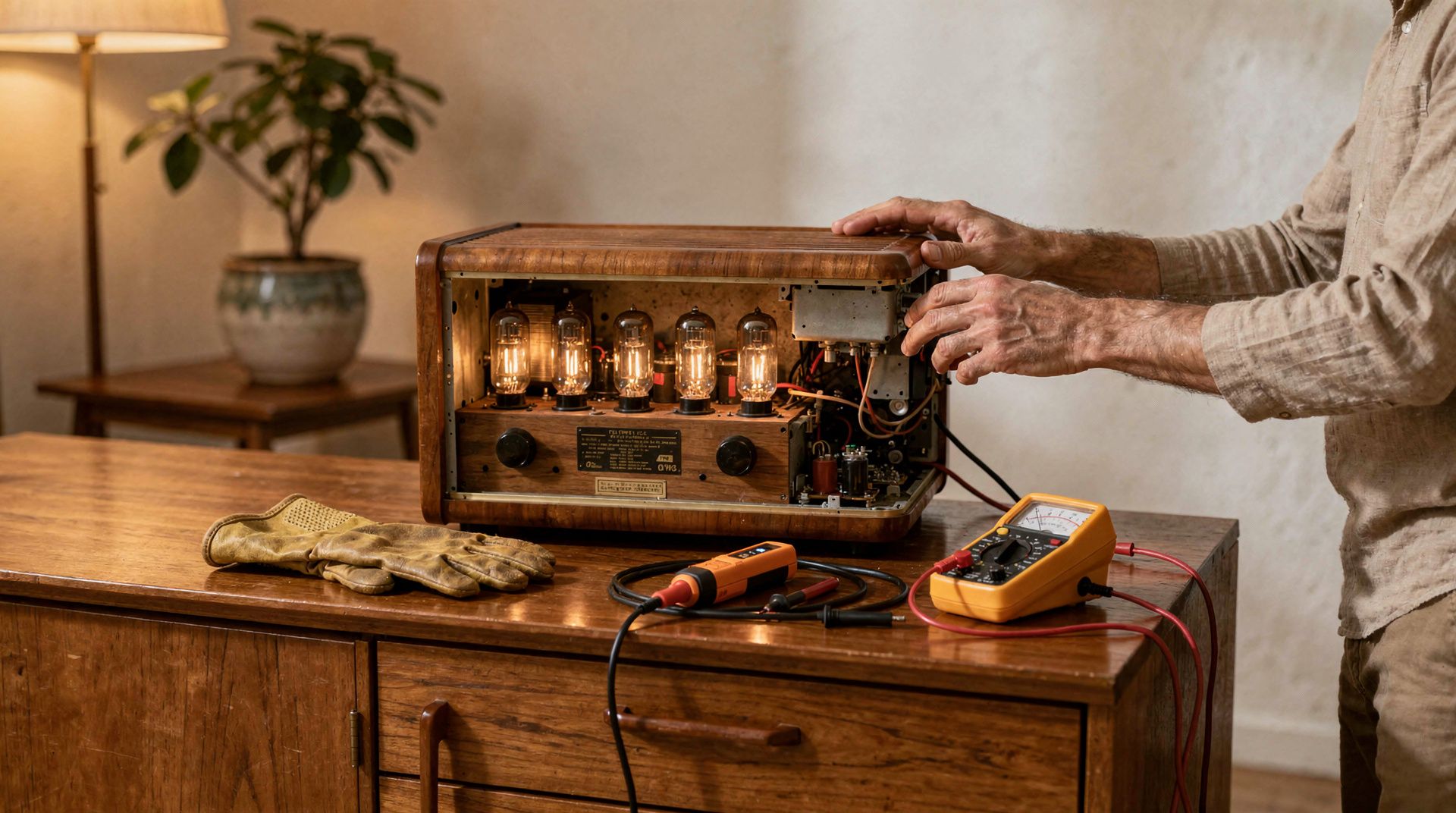
A tube radio from the 1950s or 1960s is no ordinary everyday object. It is a technical document of an era in which radio reception, furniture making, and material sensibility came together in a single cabinet. Anyone who brings such a device back to the mains after decades of storage is, however, dealing with components that have aged chemically and mechanically. Electrolytic capacitors dry out, paper capacitors become conductive, insulation becomes brittle, and inside the set anode voltages of typically 200 to 400 volts DC are present. These voltages sit across charges that can remain stored in filter capacitors for minutes after the set is switched off.
The following sections outline what matters when commissioning, assessing risks, and carrying out maintenance. The aim is not to replace a repair manual, but to sharpen awareness of why a 50-year-old radio should not simply be switched on without professional inspection. Collectors do not merely acquire an object — they take on responsibility for its technical substance.
1. The Soft-Start Procedure: Why Powering Up Slowly Protects the Set
The classic mistake when handling a long-stored tube radio is switching it on directly at 230 volts. Electrolytic capacitors in the power supply that have been without voltage for decades have partially broken down their oxide layer as a dielectric. An abrupt voltage surge causes high leakage currents and, in the worst case, a short circuit with outgassing or explosion of the component. The mains transformer can also be thermally damaged by persistently excessive current if the filter capacitors are faulty, destroying one of the most valuable and hardest-to-replace parts of the set.
The so-called soft-start or forming procedure addresses this by raising the operating voltage slowly via a variac (variable isolation transformer), typically starting at 30 to 50 volts, with hold times of several minutes or hours at each voltage step. The variable isolation transformer also provides galvanic separation from the mains, which is a safety-relevant feature for AC/DC sets (series heater chain without mains transformer), because in these the chassis may be at mains potential. Current and voltage characteristics are monitored with measuring instruments throughout the process. If the current rises disproportionately at low voltage, the capacitors can no longer be reformed and must be replaced. Without this preliminary check, every power-on is a leap in the dark.
2. Electric Shock Risks in Sets Aged 50 Years and More
The high-voltage circuits of a tube radio present two categories of hazard. First, the standing anode voltage during operation, which is openly accessible at valve sockets, coupling points, and the power supply as soon as the rear panel is removed. Second, the residual charge on the filter capacitors, which persists after the set is switched off if no sufficiently low-impedance discharge path via bleeder resistors is provided or if these resistors have failed. Values of several hundred volts across capacitances in the range of 32 to 100 microfarads carry enough energy to cause life-threatening electric shocks.
Added to this are age-related risks: brittle rubber and textile insulation on the mains lead, degraded varnish insulation in the transformer, loose solder joints, charred resistors alongside capacitors that have become conductive. In AC/DC chassis, as were common in compact kitchen and portable radios of the post-war years, the absence of mains isolation is an additional concern. Touching the chassis with the wrong plug orientation can mean direct contact with the live conductor. Proper maintenance therefore means: discharging all capacitors through a defined resistance before any intervention, measuring against ground before touching anything, working via an isolation transformer, checking protective earth conditions, and visually inspecting all current-carrying insulation. Anyone who skips these steps risks not only the set, but their own health.
3. Authenticity, Condition, and What Collectors Should Check
For collectors, a tube radio raises a dual question: is the set preserved in its original state, and is it technically safe to operate? The two levels are in tension with each other. Complete preservation in as-delivered condition is not technically sustainable long-term for a set with electrolytic capacitors. Standard paper capacitors — so-called tar bombs — are practically always defective after decades in storage. A properly restored set therefore receives new capacitors, ideally of comparable form factor and values, while the transformer, coils, valves, dial, chassis, and cabinet remain original.
Items to check include: completeness and labelling of the valve complement, condition of the dial scale and dial lighting, originality of the loudspeaker and output transformer, undamaged rear panel with type plate, condition of the cabinet veneer and fabric grille. In restored sets, transparency is crucial: a documented capacitor replacement does not diminish value, but an undisclosed modification using incorrect parts very much does. Provenance, service booklets, circuit diagrams, and invoices from previous workshops are records that support the character of a collector’s piece.
On mid-centurydesigns.com, objects from the period are presented in a curated manner that documents the formal language of the era far beyond furniture. Where sets with functional substance are part of the selection, the same standard applies as for seating furniture or lighting: documented condition, traceable interventions, and an honest description of originality and restoration. A tube radio deserves the same care in assessment as a signed armchair, because its value lies in the combination of design, technology, and history.
This article was generated automatically by an AI system. Disclosure pursuant to Article 50 of the EU AI Act.