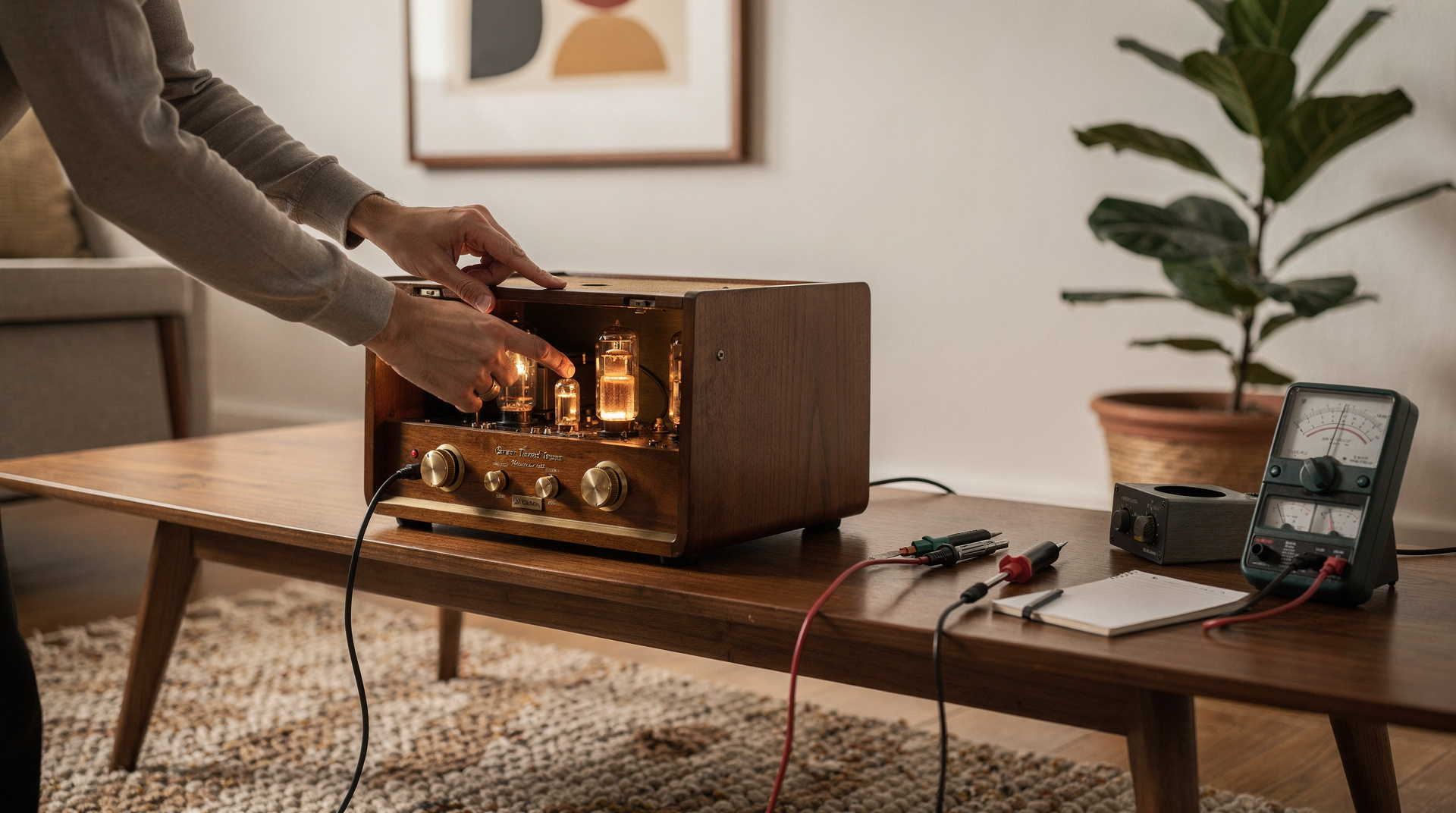
Safely commissioning a tube radio: soft start, capacitor testing and safe operation of vintage tube radios
A tube radio from the late 1940s to early 1960s is more than a piece of acoustic furniture. It is an electromechanical document of its time, built in an era when power supplies, paper capacitors and selenium rectifiers were dimensioned differently than they are today. Anyone who connects such a device directly to 230 volts after decades of storage risks precisely what makes a collector’s item valuable: original components, intact transformers, unrestored substance. Electrolytic capacitors lose their formation during storage, paper capacitors become conductively leaky, and a single short circuit in the power supply can irreversibly damage the output or mains transformer.
The following overview is intended as guidance for collectors and designers who regard a vintage radio as an integral part of a mid-century interior. It does not replace professional repair by a qualified workshop, as tube devices carry voltages of several hundred volts in the chassis, which remain stored in the filter capacitors even after switching off. Anyone testing themselves works exclusively with the mains plug pulled out, using insulated tools and discharged capacitors. The goal is not a quick sound, but the preservation of substance.
1. Characteristic materials and components
Tube radios of the mid-century era combine materials whose ageing behaviour determines the testing procedure today. The cabinets are typically made of veneered plywood with walnut, rosewood or cherry, occasionally from thermoplastic materials such as Bakelite or early polystyrenes. These materials are sensitive to heat, which means a defective chassis running too hot can permanently mark the cabinet.
Inside, components that require a forming start-up dominate:
- Electrolytic capacitors in the power supply, usually in wound or can format, lose their oxide layer after long storage. Without a slow power-up, a high residual current flows, which can short-circuit the capacitors.
- Paper capacitors, often constructed as wax or tar rolls, absorb moisture and become ohmically conductive. They are the most common cause of burning out output tubes and output transformers.
- Selenium rectifiers emit an unmistakable smell when faulty and release toxic fumes. Their condition must be checked before any commissioning.
- Tubes themselves are generally robust, but heating filaments may be broken due to vibration. A visual check for white discolouration of the getter provides clues about vacuum loss.
The so-called soft start is classically performed using a regulated isolation transformer, with which the mains voltage is gradually raised from around 30 volts to nominal voltage over several hours. This allows the electrolytic capacitors to re-form without peak currents occurring. A series ammeter shows the current progression and makes faults visible early.
2. Regional schools and manufacturers
The formal language of tube radios reflects regional design traditions and is relevant for classification in the mid-century context. In Germany, Braun, Grundig, Saba, Telefunken and Loewe shaped the landscape. Braun in particular, from 1955 onwards with the work of Hans Gugelot and Dieter Rams, stands for the consistent translation of the Ulm School into consumer electronics. The SK 4, often referred to as the Snow White’s Coffin, is a reference point for the combination of radio, record player and rational design.
In Italy, Brionvega produced designs by Marco Zanuso and Richard Sapper from the late 1950s, whose later transistor models such as the TS 502 had already superseded the tube era, but whose predecessors share the same engineering culture. In Scandinavia, Bang & Olufsen and Dux Radio supplied cabinets in rosewood and teak that seamlessly fit the furniture vocabulary of Wegner, Juhl or Mogensen. American manufacturers such as Zenith, RCA or Philco, on the other hand, more frequently worked with more voluminous consoles and colourfully finished plastics.
For safe commissioning, the country of origin is not irrelevant. Devices from the USA are designed for 110 to 120 volts and 60 hertz and require a suitable isolation transformer. European all-current receivers without a mains transformer absolutely require an isolation transformer, because the chassis can otherwise carry mains voltage.
3. Authenticity and condition for collectors
The value of a tube radio on the collector’s market is determined not only by its sound, but by the completeness of the original substance. A carefully maintained restoration log documents which capacitors were replaced, which components were substituted and which interventions were carried out reversibly. Replaced electrolytic capacitors in original can sleeves, preserved dial plates and intact fabric grilles on the speakers are among the hallmarks of a professionally executed restoration.
Items to check critically:
- Mains and output transformers: Both should be original and free of winding shorts. Replacement transformers significantly reduce collector value.
- Dial and pointer mechanism: Cracks in the plastic, faded lettering or broken cord drives are costly to repair.
- Cabinet and veneer: Heat damage on the top panel indicates previous overloading.
- Type plate and serial number: Agreement with the chassis is a prerequisite for reliable attribution.
A radio that runs stably at nominal voltage after the soft start, receives all wavebands cleanly and draws a defined quiescent current in the power supply is electrically sound. Whether it is worthy of a collection is ultimately decided by its material history.
At mid-centurydesigns.com we curate tube radios and audio furniture of Mid-Century Modernism with the same standards we apply to seating or lighting. Every electrically operated piece is technically inspected and documented before being added to our inventory and, where necessary, carefully commissioned by a specialist workshop. Provenance, original components and the condition of transformers, dial and cabinet are included in the description, so that you as a collector or designer have a reliable basis for your decision.