CATEGORY · TRANSPORTING AND STORING VINTAGE FURNITURE

Transport and Storage of Mid-Century Furniture

What collectibles made of rosewood, teak and leather really need

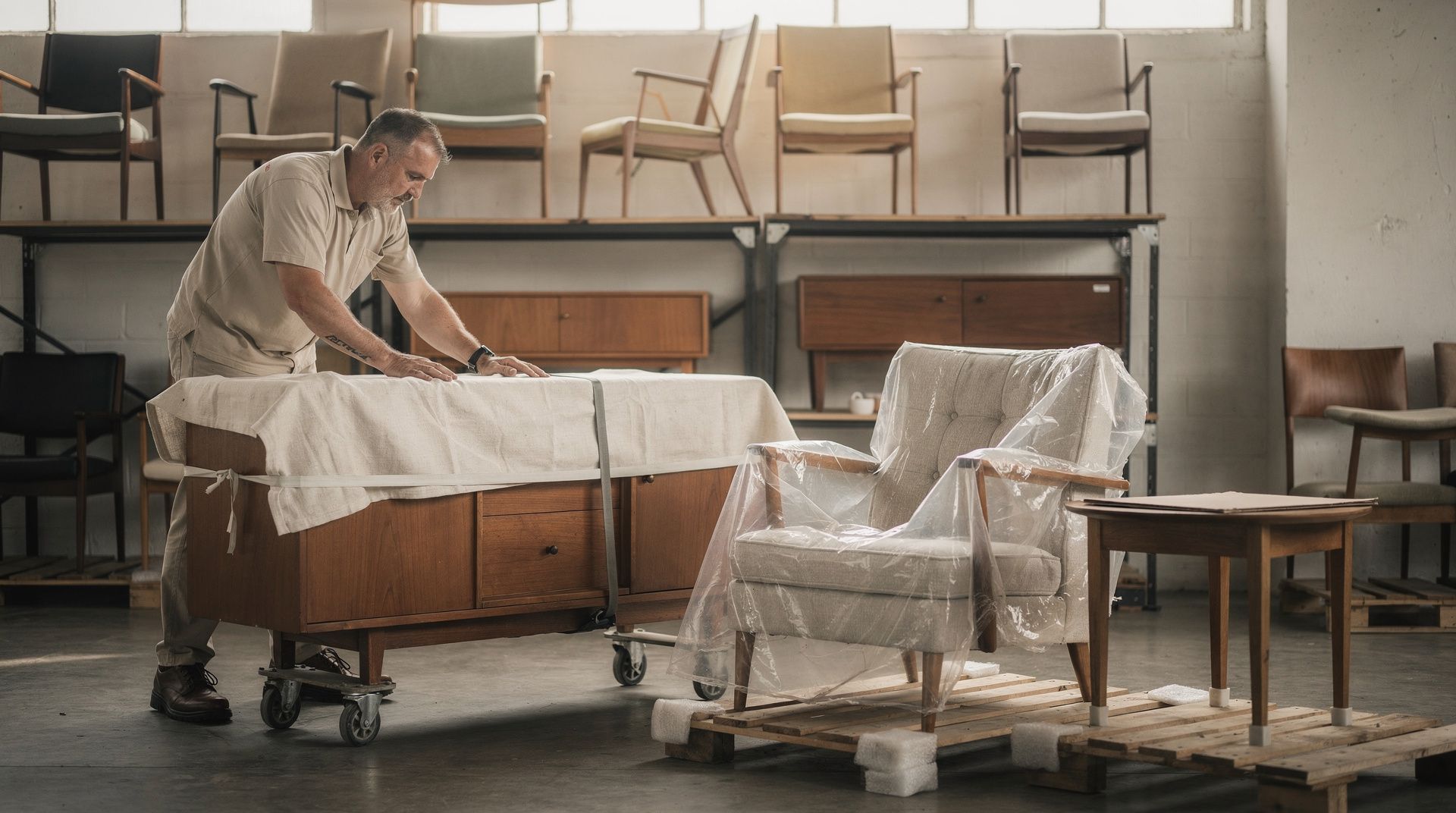
Originals from the 1950s and 1960s are sensitive to climate fluctuations, pressure points and improper handling. Anyone moving an armchair by Wegener, a sideboard carcass in rosewood or a loose upholstered suite should be familiar with veneer direction, joints and upholstery material before the first strap is applied. This guide addresses the key factors: relative humidity, temperature ranges, padding during transport and the correct load distribution for longer-term storage.

mid-century·designs

transporting and storing vintage furniture

ESSAY · 01

Work & Context

mid-century·designs

Transport and Storage of Mid-Century Furniture: A Matter of Care

An original sideboard from the late 1950s, a lounge chair with aged aniline leather upholstery, a delicate rosewood dining table: such pieces have survived six decades because they were built with precision craftsmanship and because their owners cared for them in everyday use. The most critical moment in the life of a vintage piece of furniture is rarely its daily use, but rather the change of location: moves, interim storage, international transport. Veneers come loose when humidity and temperature fluctuate, mortise-and-tenon joints shift, and upholstery takes on permanent deformation. Those who collect Mid-Century design therefore treat transport and storage as part of value preservation, not as a logistical footnote.

The following sections outline what matters in terms of materials, which regional construction styles require special consideration, and how to recognise at the point of purchase whether a piece has been handled professionally. The aim is not an exhaustive restorer’s manual, but a precise look at the points where collector quality is determined.

1. Characteristic Materials and Their Climatic Requirements

The dominant woods of the era behave very differently. Teak, as favoured by Danish workshops of the 1950s and 1960s, is considered comparatively dimensionally stable due to its high natural oil content, but is sensitive to localised heat and dry central heating air. Rosewood, in particular Rio rosewood (Dalbergia nigra, listed in CITES Appendix I since 1992 and thus strictly trade-restricted), is denser, more brittle and prone to hairline cracks in the veneer under significant climate swings. Oak, walnut and maple, as frequently used by American and German manufacturers, move more across the grain and require constant relative humidity.

As a guideline for storage and living conditions, 45 to 55 percent relative humidity at 18 to 22 degrees Celsius is recommended. Values below this, as regularly reached during heating periods, lead to shrinkage cracks, detached veneer and open joints. Values above this promote mould and metal corrosion on fittings. For transport, this means: no unheated storage halls in winter, no uninsulated containers in summer sun, no positions directly against exterior walls or above underfloor heating.

Upholstery deserves its own attention. Cold foam, latex and the horsehair or coir fibre inserts typical of the era react differently to pressure and moisture. An armchair that is stacked for months loses its resilience; original coverings of wool, linen or aniline leather absorb odours and moisture. During transport, upholstered furniture should stand upright and individually in breathable cotton covers — never in plastic film over extended periods.

2. Regional Schools and What Their Construction Means for Handling

The Danish cabinetmaker furniture by Hans J. Wegner, Finn Juhl, Arne Vodder or Kai Kristiansen is designed around precise wood joints. Dovetails, concealed tenons, conically screwed legs: much of it is dismantlable and should be dismantled for transport. Round table legs on dining tables and sideboards are traditionally screwed into recessed threaded plates and are the most common breaking point when a piece of furniture is transported lying down without removing the legs.

American classics from the circle of Charles and Ray Eames, George Nelson or Florence Knoll frequently combine plywood with metal and rubber. The shock mounts on the Eames Lounge Chair and Plywood series are aged rubber and can tear under sudden stress. These models should be transported seated and secured, not lying on the backshell.

Italian modernism by Gio Ponti, Ico Parisi or Osvaldo Borsani often works with brass, lacquered metal frames and marble. Marble tops are transported exclusively upright, on felt pads, never stacked flat. German post-war designs from the Ulm and Braun circle, as well as production furniture by Knoll International Germany or WK Möbel, frequently rely on plywood constructions with exposed edges that are sensitive to impact and require edge rather than surface protection.

3. Authenticity and Condition: What Collectors Should Look for When Purchasing

A carefully transported and stored piece can be identified by several details. Veneer edges are closed, without raised chamfers; drawer runners operate smoothly; mortise and tenon joints show no gaps of more than one millimetre. On seat surfaces, check the resilience of the upholstery and the tension of webbing or springs. On rosewood and teak surfaces, a matt, even patina indicates well-maintained storage, while dull spots or white rings point to moisture damage and unsuitable locations.

Provenance and marking are the second test. Original brand stamps from Danish control marks (such as the control stamp of the Møbelfabrikanternes Kontrollforening for Massivmøbler, abbreviated FDB control stamp, or the Dansk Møbelkontrol mark), manufacturer marks from Fritz Hansen, Carl Hansen & Søn, France & Søn, Herman Miller, Knoll, Cassina or Tecno and documented invoices increase attribution certainty. For CITES-relevant timbers, particularly Rio rosewood, a pre-acquisition certificate (pre-convention proof) is required for cross-border trade.

Restorations are not a flaw if they are carried out professionally and reversibly and communicated openly. Reupholstered cushions with period-appropriate textiles, refinished surfaces with oil rather than thick lacquer, and replaced webbing keep a piece functional. Critical, however, are sanded-down veneers, thick new lacquer coatings and replaced original fittings that irreversibly alter the substance.


At mid-centurydesigns.com, we examine every piece before it enters the inventory for construction, material condition, marking and provenance. Transport and interim storage take place in climate-controlled spaces; packaging and shipping are guided by the structural characteristics of each individual model — from the demountable table base to the lounge chair with aged shock mounts. This way, you receive a piece of furniture in the condition its documentation promises.


This article was generated automatically by an AI system. Disclosure pursuant to Article 50 of the EU AI Act.

FAQ · 02

Frequently asked about transporting and storing vintage furniture

5 Answers

01
How do I safely transport an Eames Lounge Chair without damaging the plywood shell?
The Eames Lounge Chair requires horizontal transport. The backrest and armrests are made of plywood that cracks under pressure or bending. Wrap the piece in lint-free protective cardboard and pad the edges and wooden parts with at least 5 cm of foam. Transport should take place on a level surface, without tilting. Afterwards, store the piece flat or at an upright 45-degree angle — never positioned on its side, where the plywood can deform under its own weight.
02
What climate conditions are ideal for protecting upholstered furniture from the 1950s from mould?
Keep humidity between 45 and 55 percent. Original upholstered furniture from this period was filled with natural materials such as horsehair, straw or cotton, which promote mould and rot above 60 percent humidity. Temperature should remain constant at 18 to 21 degrees Celsius. Avoid storage rooms without air circulation, damp basements or uninsulated attics. A hygrometer for monitoring is essential, as is regular ventilation during dry months.
03
How do I protect veneered wood from scratches and delamination during a move?
Mid-Century veneered wood, such as on tables by Florence Knoll or Herman Miller, is sensitive to scratches and temperature shocks. Wrap such pieces in multi-layer protective paper, then in bubble wrap, with foam at corners and edges. Do not use sliding boards without padding during transport. For packing and storage: maintain constant temperature (18–22°C) and humidity, as rapid fluctuations cause the veneer to lift from the substrate board. Transport flat, not upright.
04
What should be considered when storing leather furniture from the 1960s to prevent cracking?
Original leather furniture from this era, such as cordovan leather pieces, requires 45 to 50 percent humidity. Air that is too dry (below 40 percent) leads to cracking and brittleness; air that is too moist (above 60 percent) causes mould and discolouration. Store these pieces in well-ventilated, dark rooms away from direct sunlight, as UV rays bleach the leather. Cover them with breathable fabric, not plastic, which promotes condensation. A semi-annual inspection and gentle repositioning prevent structural stress.
05
What should I bear in mind when transporting a wood-veneer sideboard by Charles and Ray Eames up several flights of stairs?
Eames sideboards with walnut or teak veneer are susceptible to scratches and peeling under vibration and impact. Transport exclusively using a furniture lift or very carefully over stairs, on a stable platform or with a furniture dolly fitted with rubber wheels. Packaging: cardboard, then 10 cm of foam on all surfaces; secure doors and drawers with foam and fix them so they cannot shift. Afterwards, store on a level surface in a climate-controlled room. Avoid placement directly under or next to heat sources, air conditioning units or windows (temperature and humidity fluctuations).

GLOSSARY · 03

Related Terms

10 Entries

Wood Swelling and Shrinkage
Natural volumetric change in wood caused by the absorption or release of moisture. Critical for Mid-Century furniture, as historical timbers such as teak or rosewood react to varying degrees. Optimal storage conditions: 45–55% relative humidity at 18–21°C prevent cracks, warping and joint gaps.
Surface Protection During Transport
Multi-layer protection system for vintage furniture: covering with lint-free cloths, underneath bubble wrap cushions or foam pads (min. 5 cm), outer protective layer of hardboard. Protects original surfaces, lacquers and polishes from scratches, dents and dust particles.
Climate Stabilisation
Controlled adjustment of temperature and humidity over several days following transport. Prevents shock-swelling or shock-shrinkage of wooden parts and ensures that furniture components such as drawers or doors return to their original dimensions. Ideal: transitional storage under stable conditions prior to final placement.
Upholstery Environment and Storage Climate
Specific requirements for seating furniture with historical filling materials (horsehair, coir, sheep's wool). A climate that is too dry (<40% humidity) leads to brittleness and cracking; a climate that is too moist (>65%) promotes mould and material degradation. Ideal: 45–55% relative humidity at a stable temperature.
Veneer Fracture and Adhesive Failure
Damage patterns caused by transport-related vibrations and impacts. The veneer (thin facing layer) separates from the substrate wood; glue joints open up. Commonly affects tables and sideboards with large-area veneer panels. Prevention through rigid packaging, shock-absorbing underlays and vibration protection during transport.
Height Compensation and Level Control
Adjustment of furniture feet and structural components after transport to restore stability and squareness. Mid-Century classics with tapered or splayed legs require checking with a spirit level. Misalignment leads to uneven weight distribution and accelerates wear.
Buffer Zones and Stacking Protection
Spatial clearances and interleaved materials when storing multiple pieces of furniture. Prevents scratches from direct contact and allows air circulation. Use of separating boards made of plywood, foam separators or felt pads between stacked elements (maximum 2–3 pieces on top of each other).
Light Stability During Storage
Protection from UV radiation and artificial light during storage and transport. Historical wood veneers (particularly light-coloured hardwoods such as ash or maple) age under light, tones change and surfaces grey. Storage areas should be darkened or covered with opaque cloths.
Static Load Test
Inspection carried out after transport to identify damage to load-bearing structures. The aim is to check frame rigidity, joints, aprons and legs. For seating furniture: conduct a load test with distributed weight and check for unexpected movement, creaking or visible cracks.
Conservation-Grade Packaging
Specialised packaging method for high-value collectibles that takes material and construction characteristics into account. Use of acid-free materials, pH-neutral papers, no PVC films. Documentation of pre-existing damage via photographic record. Standard practice for valuable Mid-Century classics with a documented provenance history.