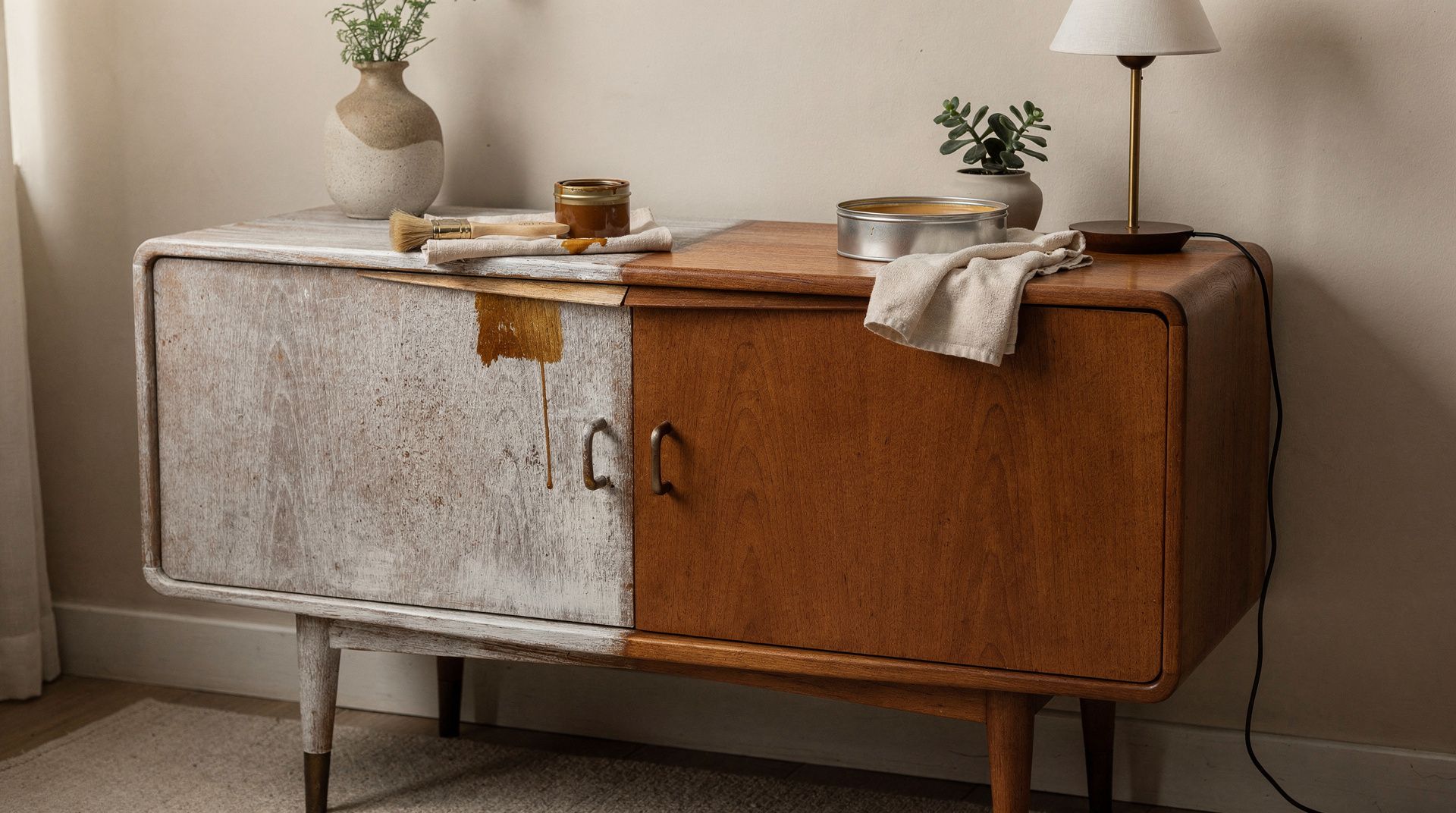
Refreshing teak without losing its character
Greyed teak is not a defect but a condition. The silvery patina develops through UV radiation, oxidising tannins and oils that have been washed out of the superficial cell structure. Removing it exposes fresh tissue; preserving it conserves an aged surface that, in Scandinavian furniture of the 1950s and 1960s, is often part of its historical testimony. The decision is therefore not made at the sandpaper stage but in front of the piece itself: is it an indoor piece that was originally given a satin-matte oil finish, or an object that was later reworked with clear lacquer or alkyd resin? And how much solid material or veneer thickness is actually still available?
The three common approaches are cleaning and re-oiling, mechanical stripping followed by a new treatment, and sealing with a hard-wax or wax-oil system. Each approach has different implications for feel, reversibility and maintenance cycle. In the following we describe what is materially established, where the limits lie and what distinguishes collectable pieces from over-restored ones.
1. Characteristic materials and their response to care
Teak (Tectona grandis) naturally contains silica and essential oils that make it resistant to moisture and fungal attack. It is precisely this self-oiling property that is the reason why teak furniture in classic Danish workshop practice was not lacquered but treated with thin-bodied oils. Common systems are pure linseed oil, tung oil (wood oil from Aleurites fordii) and blended products based on linseed oil with added driers and solvents, frequently sold as “teak oil” or “Danish Oil”. All of these oils cure oxidatively, penetrate the cells near the surface and leave an open-pored, matte finish that can be retreated and repaired locally.
Waxes — typically beeswax or carnauba wax in a turpentine or balsam solution — work differently: they form a thin film on the surface, barely penetrate the wood and protect primarily against fingerprints and light soiling. Hard-wax oils combine both principles but leave a visible film that often looks out of place on a vintage piece and dampens the characteristic open-pored appearance. For furniture that was originally only oiled, oil therefore remains the more faithful system. Wax is useful as an additional protective layer on heavily used surfaces such as tabletops, but should be removed before the next re-oiling, as it otherwise acts as a separating layer.
Greying in interiors can usually be reversed without sanding. A mild clean with a soft brush, warm water and a drop of pH-neutral soap lifts dust and oxidised oil film. Only if the fibres are raised after drying is very fine abrasive fleece used along the grain to even them out — not coarse sandpaper. Oxygen-based bleaching agents or oxalic acid are unnecessarily aggressive on mid-twentieth-century indoor furniture and permanently alter the colour tone.
2. Regional schools, designers and their surface philosophy
The Danish school around Finn Juhl, Hans J. Wegner, Arne Vodder and Kai Kristiansen used teak as a rule with a thin oil surface, executed in the workshops of Niels Vodder, Johannes Hansen, Sibast or France & Søn. With Wegner chairs produced by Johannes Hansen or Carl Hansen & Søn, the original treatment is almost always an oiling, not a lacquer finish. Anyone who reworks such pieces with hard wax or polyurethane not only changes their appearance but also complicates any future restoration.
In Sweden and Norway — for example in work by Yngve Ekström for Swedese or Fredrik Kayser for Vatne Møbler — rosewood and oiled beech appear alongside teak in a similar surface philosophy. The German and Dutch interpretations of the genre, such as furniture by Wilhelm Knoll, Walter Knoll or Pastoe under Cees Braakman, partly use thicker, closed lacquer builds that require a different maintenance approach and generally cannot tolerate re-oiling. Examining the construction, fittings and maker’s marks before any treatment is therefore obligatory.
The re-oiling cycle depends on use and room climate, not the calendar. A reliable rule of thumb for a regularly used indoor piece is: once a year, apply a very thin coat of oil with a lint-free cloth, leave to penetrate for around 20 to 30 minutes, then remove all excess completely. On tabletops a second thin coat after 24 hours may be beneficial. Too much oil remains tacky, attracts dust and polymerises into a greasy film that is laborious to remove later. Soaked cloths must be spread out to dry or stored in water due to the risk of spontaneous combustion.
3. Authenticity and condition from a collector’s perspective
For collectors, the surface is a carrier of information. It reveals whether a piece has been left in its original state, sensitively maintained or completely refinished. A uniformly sanded-through, over-oiled surface with broken edges and lost tool marks reduces both the cultural and usually the monetary value. Worth preserving are traces of use that do not compromise the structure: darker zones at handle edges, fine scratches, slightly lightened sun-facing sides. These are part of the provenance.
What needs critical scrutiny are structural interventions: subsequently glued aprons, replaced tenons, over-veneered losses, new metal brackets beneath seat frames. With teak veneers, veneer thickness is decisive. Pre-war and early post-war veneers are frequently 1.5 to 2.5 millimetres thick and can tolerate careful sanding; late productions from the 1970s sometimes measure under a millimetre and can only be cleaned chemically. A second point to check is the hardware: original slotted brass screws, stamped maker’s marks or branded stamps are important dating clues and should not be reworked during a refresh.
From a conservation perspective, oiling is the most reversible, transparent and historically documented treatment for Danish Modern teak furniture. Wax is a temporary additional protection, not a primary system. Film-forming lacquers and hard-wax oils are as a rule a break with the original condition and can only be removed at the cost of further material loss.
At mid-centurydesigns.com we examine every teak piece before adding it to our inventory for substance, veneer thickness, surface originality and documented provenance. We generally work with a cleaning refresh and thin re-oiling, keep interventions minimal and transparently record all treatments found or carried out in the object data sheet. This ensures that as a collector you can trace exactly what you are acquiring and how the piece should be maintained going forward.
This article was generated automatically by an AI system. Disclosure pursuant to Article 50 of the EU AI Act.