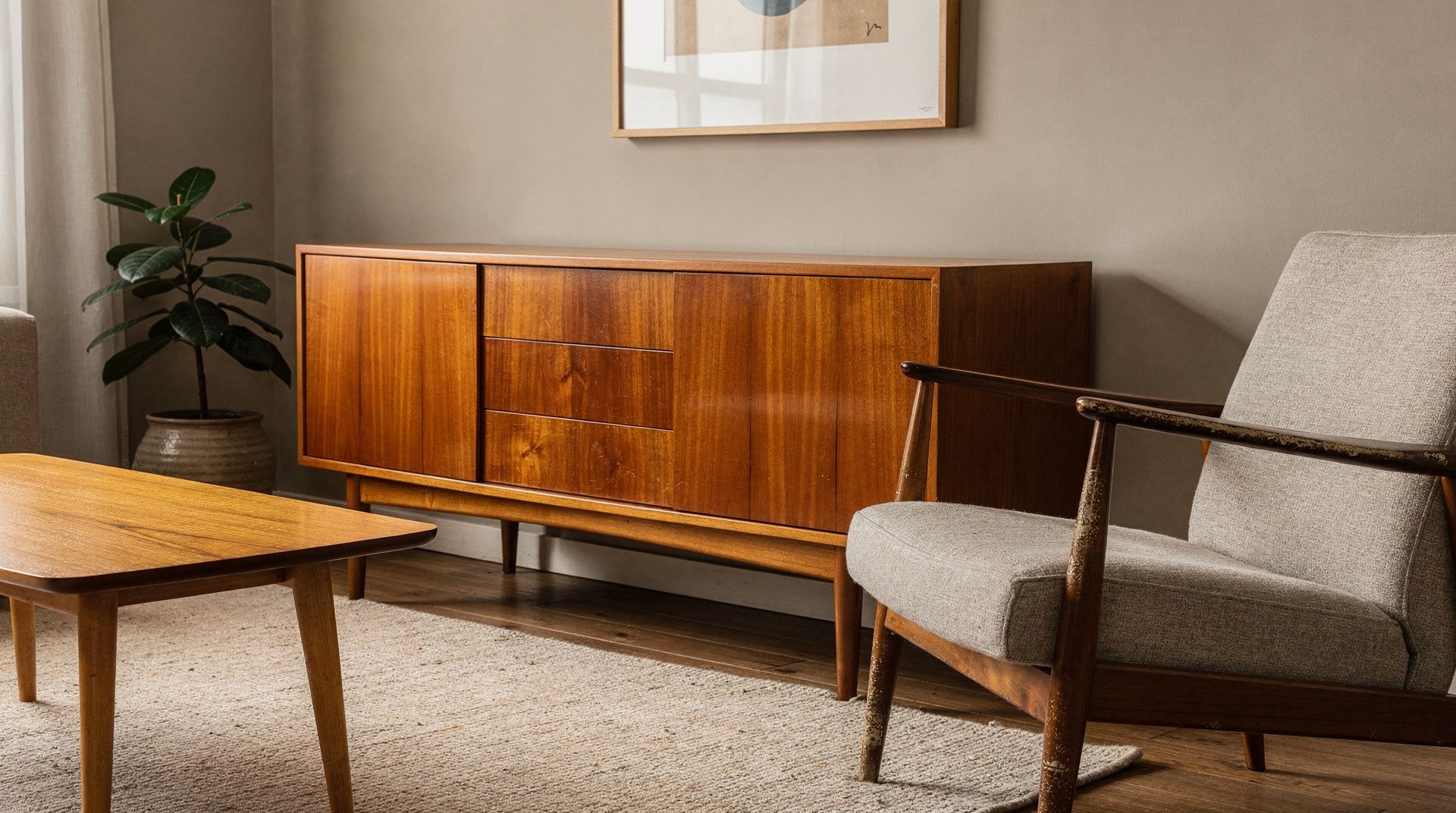
Identifying, understanding and evaluating teak
Teak (Tectona grandis) is the defining wood of Scandinavian Modernism of the 1950s and 1960s. Few other materials combine craftsmanship precision, natural resilience and such a distinctive aesthetic. Those who collect vintage teak furniture or integrate it into an interior move between material knowledge, design history and market expertise. A sideboard by Arne Vodder is not valuable because it is made of teak, but because the choice of wood, design, execution and provenance come together. Conversely: without a trained eye for the grain, the ageing of the surface and the typical constructional details of a given workshop, neither authenticity nor value can be assessed with any reliability.
The following sections summarise what matters when examining teak, which schools and designers have shaped the canon, and which criteria are decisive for collectors today.
1. Characteristic materials: grain, colour, patina
Real teak shows a straight to slightly wavy, open-pored grain with clearly visible dark lines caused by mineral deposits and oily constituents. Freshly worked, the colour ranges from warm golden-brown to a greenish-olive ochre. Under the influence of light, the surface oxidises and develops a deep, honey-coloured to walnut-brown tone over decades. A high natural oil content makes the wood surface feel slightly greasy-smooth — a tactile characteristic that is virtually impossible to imitate.
The most important inspection criteria include:
- Pores and figure: Large, partly dark-filled pores running lengthways. On end-grain surfaces you can often see concentric rings with light and dark bands.
- Weight and hardness: Teak is medium-weight (around 650 kg/m³ air-dry) yet very dimensionally stable. Pieces that are too light or noticeably soft are suspicious.
- Smell: Freshly sanded, teak smells slightly leathery and spicy, owing to rubber compounds and terpenes.
- Look-alike timbers: Iroko, Afrormosia and Nyatoh were frequently used as teak substitutes in the 1960s, sometimes even labelled as teak. Iroko looks more uniform, Afrormosia is darker and more finely structured. Later reproductions often feature teak-veneered plywood instead of solid wood.
Patina is more than a visual detail. It documents use, location and care. A calm, even ageing with light signs of wear enhances character and, as a rule, value. Pieces that have been sanded down completely and re-oiled, on the other hand, lose historical substance.
2. Regional schools and defining designers
Teak was processed primarily in Denmark in the post-war years, because Danish workshops had early access to Burmese plantation teak and because the Cabinetmakers’ Guild in Copenhagen cultivated a craft culture that did justice to the material.
- Danish school: Finn Juhl, Hans J. Wegner, Arne Vodder, Kai Kristiansen, Peter Hvidt & Orla Mølgaard-Nielsen, Ib Kofod-Larsen and Johannes Andersen shaped the international perception of teak. Workshops such as Niels Vodder, Johannes Hansen, A.J. Iversen, France & Søn and the later serial manufacturers Sibast, Vejle Stole, Bramin and Skovby represent different quality levels, from individual craftsmanship to industrial precision.
- Swedish and Norwegian contributions: Yngve Ekström, Nils Jonsson and Torbjørn Afdal also worked with teak, often in combination with beech or rosewood. Swedish production more frequently relied on veneered constructions with load-bearing solid-wood frames.
- German and Dutch interpretations: Companies such as Wilhelm Renz, Musterring, Bartels as well as Pastoe and Topform adopted the formal canon and produced quality, mostly somewhat more sober interpretations for the Central European market.
Attribution is decisive for valuation. A signed sideboard by Arne Vodder for Sibast occupies a different price bracket than an unsigned, formally related piece by a serial manufacturer. Brand stamps, labels (such as the round Dansk Møbelkontrol label with control number), metal plaques and typical constructional features such as hand-cut dovetails, chamfered grip recesses or mortise-and-tenon joints are the most important reference points here.
3. Authenticity and condition for collectors
Anyone who seriously collects vintage teak examines on three levels: material, craftsmanship, provenance.
Material: Solid teak on legs, frames and edges, often with teak veneer on more stable panel substrates for surfaces and carcasses. Look for consistent grain flow between front and side panels, clean mitres and the characteristic, often trapezoidal treatment of edges. Check undersides and back panels. Original pieces typically have an untreated or lightly oiled back panel of solid wood or plywood with age-typical yellowing.
Craftsmanship: Hand-cut dovetails, concealed wooden dowels, screwed metal brackets with slotted screws and originally made drawer runners speak for authentic manufacture from the 1950s to the early 1970s. Phillips-head screws, industrial stapling on back panels or MDF components point to repairs or later reproductions.
Provenance: Labels, invoices, photographs from previous ownership, exhibition or publication records significantly increase documentary value. For well-known designers, catalogues raisonnés, manufacturers’ catalogues and auction archives are reliable references for attribution and dating.
On condition: restoration is permissible, but it should be reversible and appropriate to the material. Careful re-oiling with pure teak oil, repair of individual veneer damage and retention of original fittings are value-stabilising measures. Complete re-lacquering, dark staining to conceal water marks or replaced handles often reduce collector value considerably. Structural interventions — such as glued repairs to load-bearing joints — also diminish value if visibly or poorly executed.
Price formation follows a clear logic: designer and workshop, rarity of the model, documented provenance, originality of the surface and completeness of fittings together determine market value. An average teak sideboard from Danish serial production currently trades in the low to mid four-figure range; outstanding designs by Vodder, Juhl or Wegner achieve significantly higher prices.
At mid-centurydesigns.com we curate teak furniture of this era according to the same criteria described in this text. Every piece is examined for material, construction and attribution; restorations are documented and provenances, where available, disclosed. You will not find anonymous bulk-lot commodity pieces with us, but selected designs of Scandinavian and German Modernism whose condition, history and craftsmanship quality speak for themselves.
This article was generated automatically by an AI system. Disclosure pursuant to Article 50 of the EU AI Act.