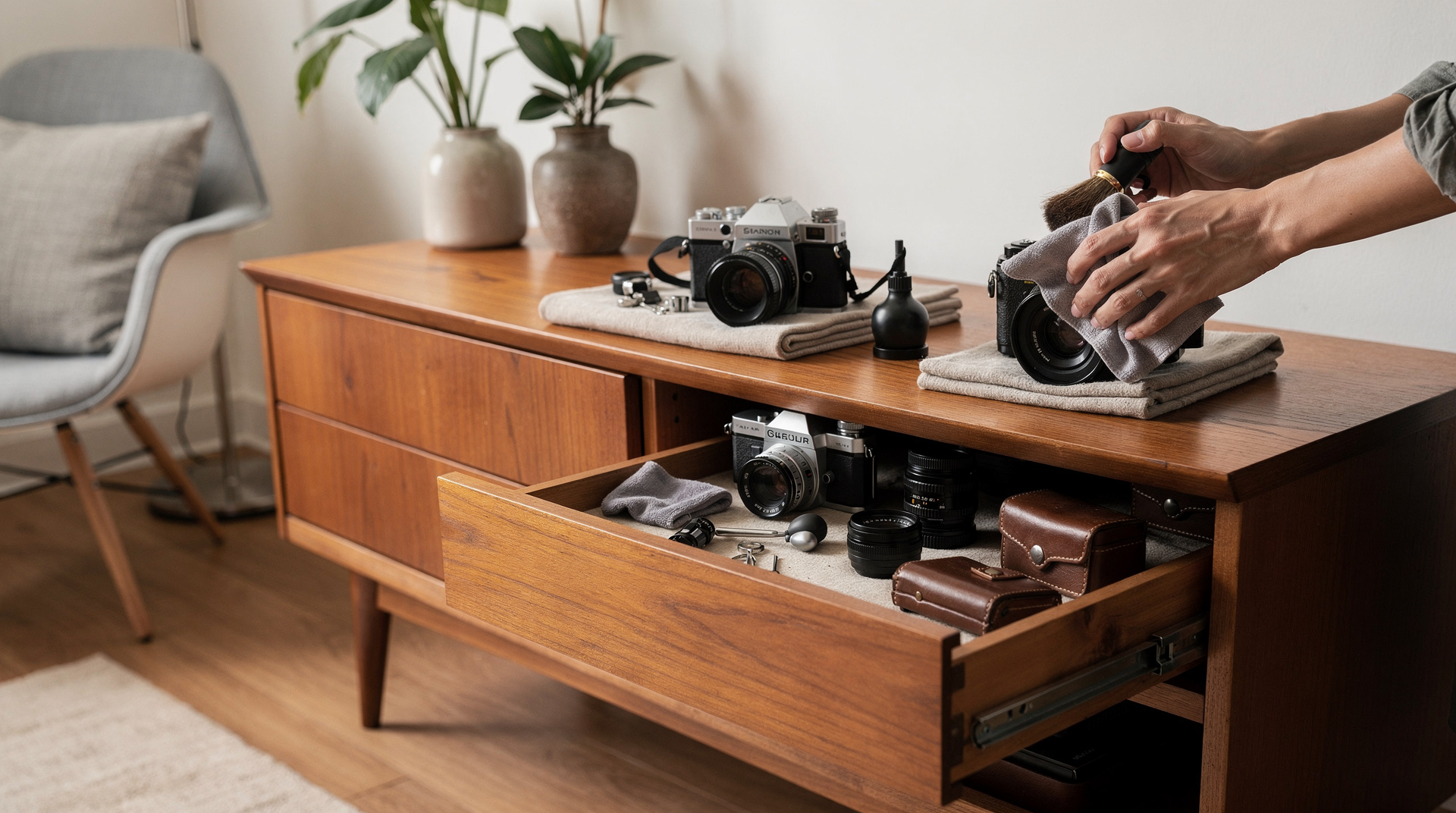
Caring for and storing old cameras: Professional maintenance and storage of vintage photo cameras
Vintage photo cameras from the mid-twentieth century are not mere everyday objects, but precision mechanical and optical instruments that emerged from a very specific industrial-cultural context. Whoever owns a Rolleiflex, an early Leica M, a Hasselblad 500 C or a Nikon F holds in their hands a testament to precise craftsmanship, in which brass, ground glass, tanned leather and lubricated gears interact in a very finely calibrated balance. This balance is sensitive to moisture, temperature fluctuations, dust and inactivity. Care and storage are therefore not a secondary concern, but the very reason why some of these cameras still fire flawlessly after more than sixty years while others have long since become frozen museum pieces.
The approach we recommend is that of a connoisseur: do not over-restore, do not polish, do not conceal, but stabilise, document and use in a climatically sound environment. A camera that is regularly and gently operated generally ages better than one that sleeps for decades in a damp drawer. This applies to the mechanical shutter just as much as to the aperture blades and the lens coatings.
Characteristic materials and their care requirements
The typical materials of a camera from this era can be grouped into three categories, each requiring its own approach.
Metal and mechanics. Housings made of brass with chrome plating or black lacquer, die-cast aluminium, steel springs and gears of hardened brass form the skeleton. Old lubricants resinify over the years, which manifests in sluggish shutter speeds, sticky aperture blades and stiff film transport. No home remedy will help here; what is needed is a periodic CLA (Clean, Lubricate, Adjust) by a specialist workshop, ideally every ten to fifteen years with regular use. Between service intervals it is sufficient to occasionally fire the shutter at all speeds so that the mechanism does not seize up.
Optics. Lenses from this period are individually coated, some with thorium-containing glass elements (for example in certain Takumar or Kodak Ektar designs), which tend to turn slightly yellowish with age. Clean front lenses exclusively dry with a blower bulb and, if necessary, a microfibre cloth or lens tissue with a drop of pure cleaning alcohol. Avoid kitchen towels, everyday spectacle-cleaning cloths and anything abrasive. The greatest enemy is not dust but fungal growth inside the lens, which develops under damp storage conditions and appears as a spider-web-like structure.
Leather, textiles and bellows. Coverings made of cowhide, vulcanite or early synthetic materials dry out and come loose. A sparingly applied, neutral leather conditioner once a year is sufficient. Bellows on folding and field cameras should be checked against light for fine holes. Textile focal-plane curtains made of rubberised silk become brittle over time and are a classic cause of costly service work.
For storage the following applies: relative humidity between 40 and 55 percent, temperature consistently between 15 and 22 degrees Celsius, no direct sunlight, no proximity to radiators. A dry cabinet for photographic equipment is the cleanest solution; alternatively, silica gel deposits in a sealed display cabinet serve well, provided they are regularly regenerated. Batteries should always be removed, lenses decoupled and stored with front and rear caps in place.
Regional schools and defining designers
Whoever cares for cameras of this era simultaneously tends to different design philosophies that are clearly legible by region.
Germany. Wetzlar and Solms stand for Leitz with the Leica rangefinder series from Oskar Barnack to the M3 of 1954, which remains a benchmark of precision engineering to this day. Braunschweig, home to Rollei, defined twin-lens medium-format photography through the Rolleiflex, whose Zeiss and Schneider optics belong to the canon. Stuttgart and Oberkochen, with Zeiss Ikon and Carl Zeiss, produced the Contax range as well as a lens output that remains a reference to this day. Dresden gave rise, through VEB Pentacon, to the Praktica, the Pentacon Six and the early Exakta models, which are regarded as the very first small-format single-lens reflex cameras. The maintenance of these instruments benefits from the fact that Germany retains a dense network of workshops with access to original parts.
Sweden and Denmark. Victor Hasselblad defined, with the V-System from 1957, in close collaboration with Sixten Sason on industrial design and Carl Zeiss on optics, the square medium format for studio and reportage. The modular construction with interchangeable magazine, viewfinder and lens makes servicing straightforward, but requires an understanding of the synchronisation between magazine and body.
Japan. The post-war industry in Tokyo and Osaka produced, through Nikon, Canon, Pentax, Olympus, Minolta and Mamiya, a distinctive formal language. The Nikon F of 1959, designed under Yusaku Kamekura, is regarded as an icon of the professional system camera. Yoshihisa Maitani shaped at Olympus, with the Pen half-frame series and later the OM-1, a school of miniaturisation whose engineering influence continues to this day. Japanese cameras are generally constructed with more serviceability in mind than their European contemporaries, with more accessible screws and documented service manuals.
These regional signatures are not merely an ordering principle, but are relevant to every care decision: a cloth focal-plane shutter from Wetzlar is serviced differently from a metal blade shutter of Kopal manufacture in Japan.
Authenticity and condition from a collector’s perspective
For collectors, substance matters alongside function above all else. Five checkpoints have proved reliable.
First, the serial number: it allows chronological classification and cross-referencing with documented production runs, as with Leica, Hasselblad and Nikon, whose manufacturing lists are largely publicly accessible. Second, the correspondence of body, lens and accessories with the original configuration; subsequently combined sets are legitimate but should be identified as such. Third, the original engravings and inscriptions, whose depth, typeface and colour fill provide evidence of later retouching. Fourth, the condition of the coatings, visible under raking light, as well as the clarity of the lens interior without fungus, haze or balsam separation. Fifth, shutter accuracy across all speeds, measured with a shutter tester, not by ear.
Patina is not a flaw. Brightly worn edges on a black Leica M2 that reveal the brass core, or an evenly darkened covering on a Rolleiflex 2.8 F, tell of use and time, and are increasingly valued more highly on the market than over-restored examples. What matters is honesty of description: documented service history, identified replacement parts, disclosed re-coverings. A carefully maintained data sheet is, for a collector’s item, part of the object itself.
On mid-centurydesigns.com, cameras and photographic instruments of this era are curated with the same care we apply to furniture and lighting of Mid-Century Modernism. Each piece is checked for provenance, completeness and functional integrity; serial numbers are verified, shutter speeds measured, optics assessed and documented under raking light. What does not correspond to the described condition does not enter the inventory. This is how you will find with us instruments that remain legible as historical objects while also delivering what they were built for: making precise photographs.