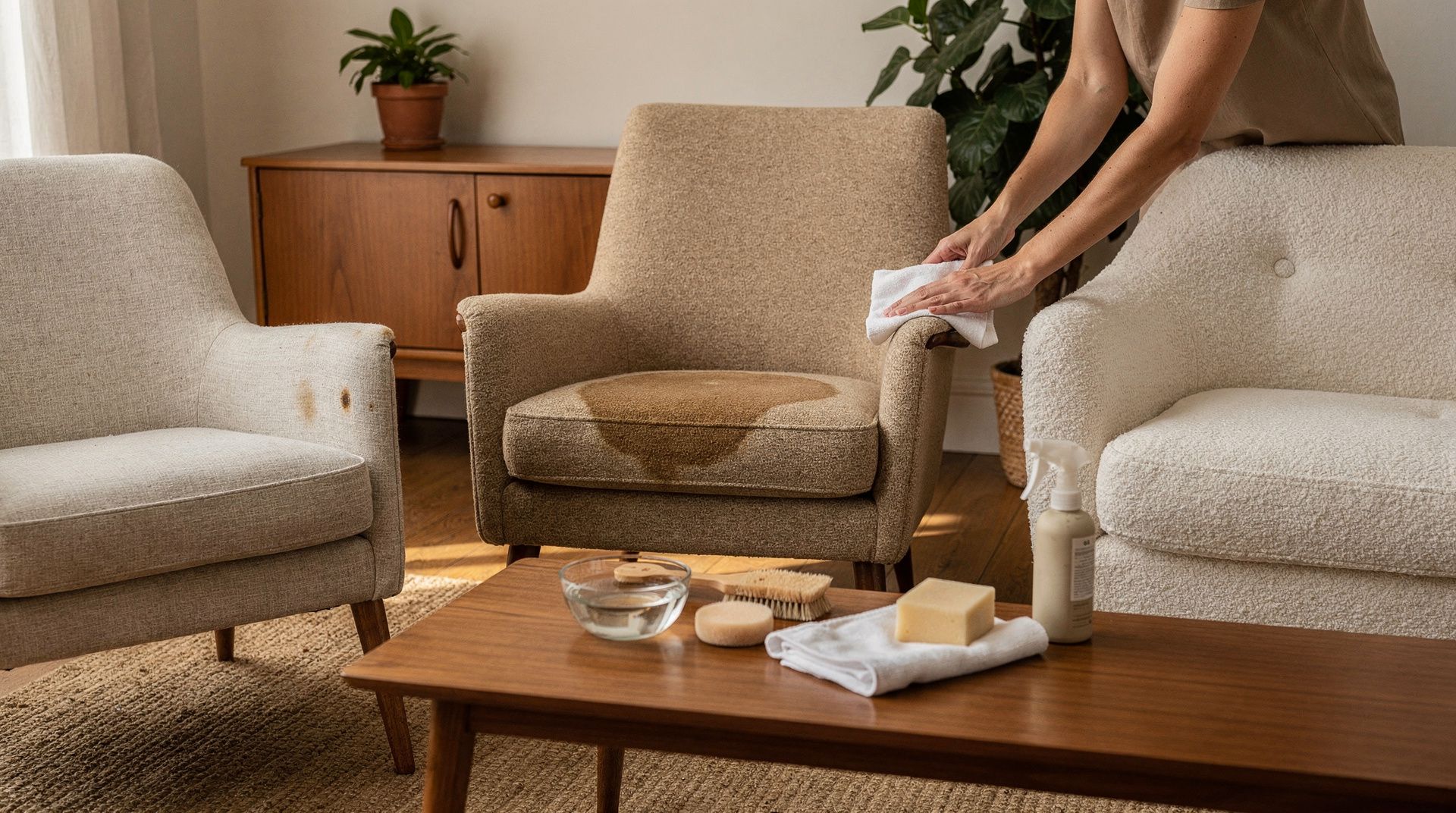
Stain Treatment on Vintage Upholstered Furniture
An upholstered piece of furniture from the 1950s to the 1970s tells its story through the fabric as well: patina, light gradients, small repairs are all part of it. Stains, on the other hand, are not part of this narrative – they obscure it. The good news: most fresh soiling can be managed if you correctly identify the type of stain and choose the appropriate product. The less good news: the wrong reaction in the first few minutes – too much water, overly aggressive chemicals, or rubbing instead of blotting – can permanently devalue the cover, especially with original upholstery fabrics that represent a piece of contemporary history.
The basic rule: blot, never rub, work from the outside inward, and always test on a hidden area first. Water is not neutral – it is itself a risk, as it can cause rings, shrinkage and, with sensitive fillings, mold stains. In older upholstery, there is often an interlayer between the cover and the horsehair, coconut fiber or early foam that retains moisture and releases it only slowly. The less liquid you introduce, the better. For anything uncertain – particularly documented original covers or signed designs – a visit to an upholstery restorer is worth more than any home remedy.
Identifying Stain Types and Treating Them Correctly
Grease stains (skin oil, cooking oil, butter, cosmetics) bond to the fiber and cannot be dissolved with water alone. First measure: place dry kitchen paper on the stain, allow it to absorb the grease, do not press. Then sprinkle an absorbent powder generously – classically potato starch, cornstarch or a specialist dry-cleaning powder – and leave it to work for several hours, overnight for old stains. Carefully vacuum with a nozzle and gauze in front of it to avoid roughening the fiber surface. Only once the powder is no longer absorbing anything should a solvent be considered, such as refined white spirit applied to a white cotton cloth, always blotted from the outside toward the center.
Water stains and rings are caused less by water itself than by dissolved minerals, dust in the fabric and residues that migrate to the surface during drying. Re-dampen the area broadly and evenly with distilled water, then pat dry evenly with a clean terry cloth and allow to dry flat, ideally with a cool air flow, not in the sun and not near a radiator. This distributes the rings rather than fixing them.
Protein stains (blood, egg, milk, vomit) must never be treated with heat, as protein coagulates at high temperatures and becomes permanently trapped in the fiber. Cold water, with a drop of enzymatic delicate detergent if needed, leave to act briefly, blot off, then rinse with clean water. Enzyme cleaners on wool should be used very sparingly and for no longer than a few minutes, as proteases also attack wool fibers.
Safe Cleaning Products for Wool, Bouclé and Linen
Wool is the dominant upholstery fabric in many Scandinavian, German and Italian designs of the era, often as dense furniture textile from manufacturers such as Kvadrat, De Ploeg or Rohi. Wool tolerates pH-neutral to mildly acidic cleaning, but not alkaline heavy-duty detergents, chlorine bleach or high temperatures. Suitable options include wool detergent in strong dilution or specialist upholstery cleaners for natural fibers. Keep mechanical action as low as possible, as wool felts. After treatment, raise the pile with a soft natural-bristle brush in the direction of the nap.
Bouclé, characteristic of designs associated with Pierre Paulin, Eero Saarinen or the soft forms of the 1960s, is inherently delicate due to its construction: the loops snag, pull threads and can barely be smoothed out afterward. Strict blotting in the direction of the loops is prohibited – always press down vertically only. Powder methods are far preferable to wet cleaning. No brushes with hard bristles, no microfiber cloths that pull fibers out of the loop.
Linen, often found on Italian sofas of the 1950s and 1960s and on Nordic lounge chairs, is strong but prone to ringing. Any localized wet treatment leaves visible halos, because linen demarcates moisture sharply. Work over a large area, rinse with distilled water, and dry flat. No optical brighteners, no soaps with a high fat content that can create grey veils.
Absolutely off-limits on vintage upholstery: steam cleaners (heat plus uncontrolled moisture), household vinegar at high concentration on wool, all-purpose cleaners with excess surfactant, colored microfiber cloths whose pigments can bleed.
Prevention and Immediate Measures
Prevention is the true form of care for original covers. A position out of direct sunlight prevents fading, which is irreversible and noticeably diminishes the value of a piece. Regular vacuuming with an upholstery nozzle at reduced suction – ideally weekly – keeps dust out of the fiber, which otherwise reacts with moisture to form grey veils. A professionally applied textile impregnation based on fluorocarbon or a more modern formulation can be worthwhile on robust wool fabrics; on bouclé and delicate linen qualities it should be assessed critically and left to the restorer.
In an emergency, the first minute counts. Remove solids and liquids mechanically first; blot up liquids with absorbent paper, do not rub them in. Identify the stain type before applying any product. Always test on a hidden seam, wait ten minutes, check for color transfer and rings. Never combine different cleaners, no heat, no direct drying with a hairdryer. Document what you have done in case professional follow-up work is needed later. For signed pieces, documented original covers or rare fabrics from the period of origin, calling an upholstery restorer before any intervention is worthwhile – not afterward.
At mid-centurydesigns.com, upholstered furniture is inspected for the condition of the cover, filling and frame before being added to the inventory; existing cleaning and restoration work is documented and communicated openly. Where the original cover is preserved, this is indicated; where re-upholstered, we name the material and the workshop. This allows you as a collector to make an informed decision about which piece matches your requirements for authenticity and everyday usability.
This article was generated automatically by an AI system. Disclosure pursuant to Article 50 of the EU AI Act.