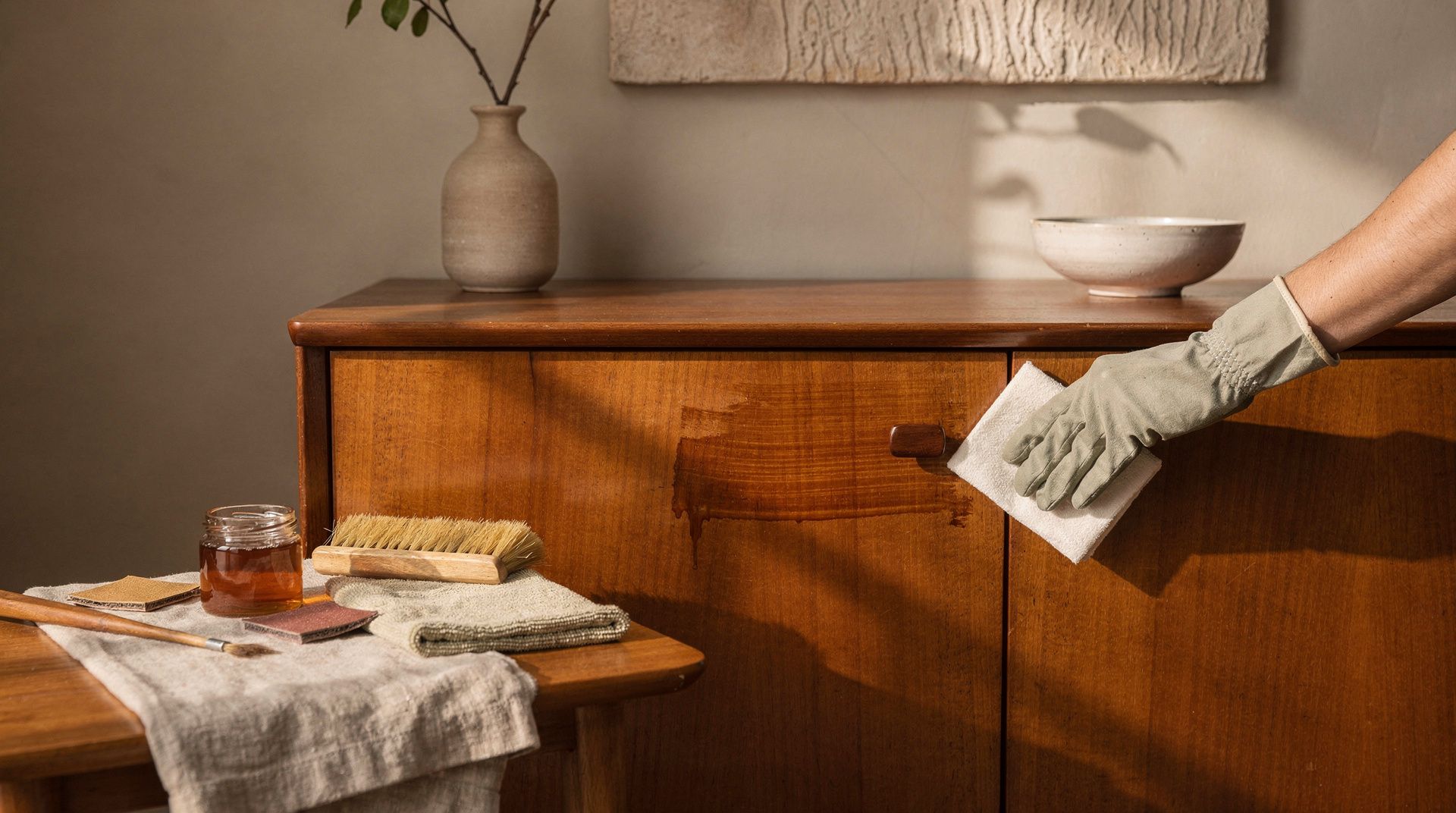
Refreshing Shellac Polish: A Guide to Renewing and Repairing Lacquered Wood Surfaces on Vintage Furniture
Shellac is the classic finish of fine furniture making before the era of synthetic lacquers, and you will still find it on many Mid-Century pieces from the 1950s and 1960s where workshops remained true to tradition — on Scandinavian rosewood sideboards, Italian walnut display cabinets or German post-war work in cherry and oak. The polish has a silky quality, warms the grain and ages openly: it reacts to light, moisture, alcohol and heat, yet can be reworked reversibly without destroying the substance beneath. That is precisely what sets shellac apart from modern two-component lacquers and makes it valuable to collectors. Refreshing a surface is not an intervention in its history, but a continuation of what the original ébéniste began. Steady hand, little material, many layers. We describe here what matters in this process and place the practice in the context of materials, provenance and collector valuation.
Characteristic Materials and Their Behaviour Under Shellac
Shellac is a resin secreted by the lac bug (Kerria lacca) on trees in India and Thailand and dissolved in ethanol. For refreshing, you work with a diluted polish — classically a one- to two-pound cut, meaning approximately 125 to 250 grams of shellac flakes per litre of ethanol. Blonde or dewaxed shellac keeps the tone of Scandinavian timbers neutral; ruby or orange shellac emphasises the warmth of teak, rosewood and American walnut. On Rio rosewood (Dalbergia nigra), now CITES-protected and only tradeable with proof of prior ownership, the polish reacts particularly sensitively because the oily components delay adhesion; a preliminary coat of very thinly cut shellac as an isolating layer helps here. Teak (Tectona grandis) carries its own oils, was frequently oiled rather than shellacked in Mid-Century practice, but can be locally retouched with shellac. Oak, cherry, maple and birch accept the polish directly. The pad (tampon) consists of a core of wool wadding wrapped in lint-free linen; a minimal amount of paraffin oil serves as a lubricant. Steel wool 0000, microfibre cloths and soft cotton rags complete the equipment. Important: shellac dissolves in alcohol, which means a surface that has turned dull can be gently dissolved with an alcohol-soaked pad and levelled out, rather than sanded down. This reversibility is the true conservation advantage.
Regional Schools, Designers and Their Surface Practices
The Danish cabinetmaking tradition surrounding the Snedkerlaugets Møbeludstillinger shaped, in the circle of Kaare Klint, Hans J. Wegner, Finn Juhl and Ole Wanscher, a restrained approach to surfaces. Workshops such as Johannes Hansen, A. J. Iversen, Rud. Rasmussen and Niels Vodder worked with both soap and oil and French polish, depending on wood type and client. Display cabinets and writing furniture in rosewood often carry a thinly applied shellac polish, chair frames in oak more commonly soap or wax. In Sweden, the school around Carl Malmsten and the furniture makers in Bodafors continued classical polishing work, as did workshops in Norway such as Bruksbo and Rastad & Relling. Italian masters like Gio Ponti, Ico Parisi, Osvaldo Borsani (Tecno, Arredamenti Borsani Varedo) and Paolo Buffa had their furniture polished by specialist ébénistes, often in walnut with a deeply built-up pad-polish finish worked to a high gloss. In Germany, workshops such as Deutsche Werkstätten Hellerau, Wilhelm Knoll and the early productions of Behr and Wilhelm Renz maintained hand polishing, while in the USA George Nakashima simultaneously established a consciously more matte, oil- and wax-oriented approach. When refreshing a surface, it therefore helps to know which workshop the piece came from: a Wegner secretaire by Johannes Hansen calls for a different level of gloss than a Buffa cabinet or a Nakashima board. Research into signatures, brand stamps and labels comes before the polishing.
Authenticity, Condition and the Collector’s Eye
For the market value of a Mid-Century piece of furniture, the surface is central. An aged but intact original polish is valued more highly than a full re-polish, even one that is technically flawless. The rule therefore is: assess first, then intervene. A cotton swab dipped in ethanol on a concealed spot reveals whether shellac, nitro lacquer or synthetic resin is present. If the surface dissolves with alcohol, you are almost certainly dealing with shellac and can work reversibly. UV light reveals later retouches and over-lacquering that remain invisible in daylight. Water rings, alcohol stains and dull patches can often be remedied by dissolving and re-polishing with the pad without losing the patina; deep scratches down to the wood require local retouching with retouching stain and an applied shellac layer, not sanding down the entire surface. Collectors also pay attention to original fittings, veneer integrity, unaltered edges and provenance documents such as invoices, workshop labels or exhibition references. A careful refresh is best documented photographically before and after the intervention, with the record kept with the piece. This preserves both value and trust for the next owner.
At mid-centurydesigns.com we curate original furniture from the classic Mid-Century period and examine every piece for provenance, construction and surface condition. Where shellac polishes are refreshed, this is done reversibly and in keeping with the historical character of the furniture — documented and with a view to long-term preservation. You will find with us work from Danish, Italian and German workshops whose provenance is traceable and whose surfaces we hand over as a collector expects: honest, well-tended and legible in their history.
This article was generated automatically by an AI system. Disclosure pursuant to Article 50 of the EU AI Act.