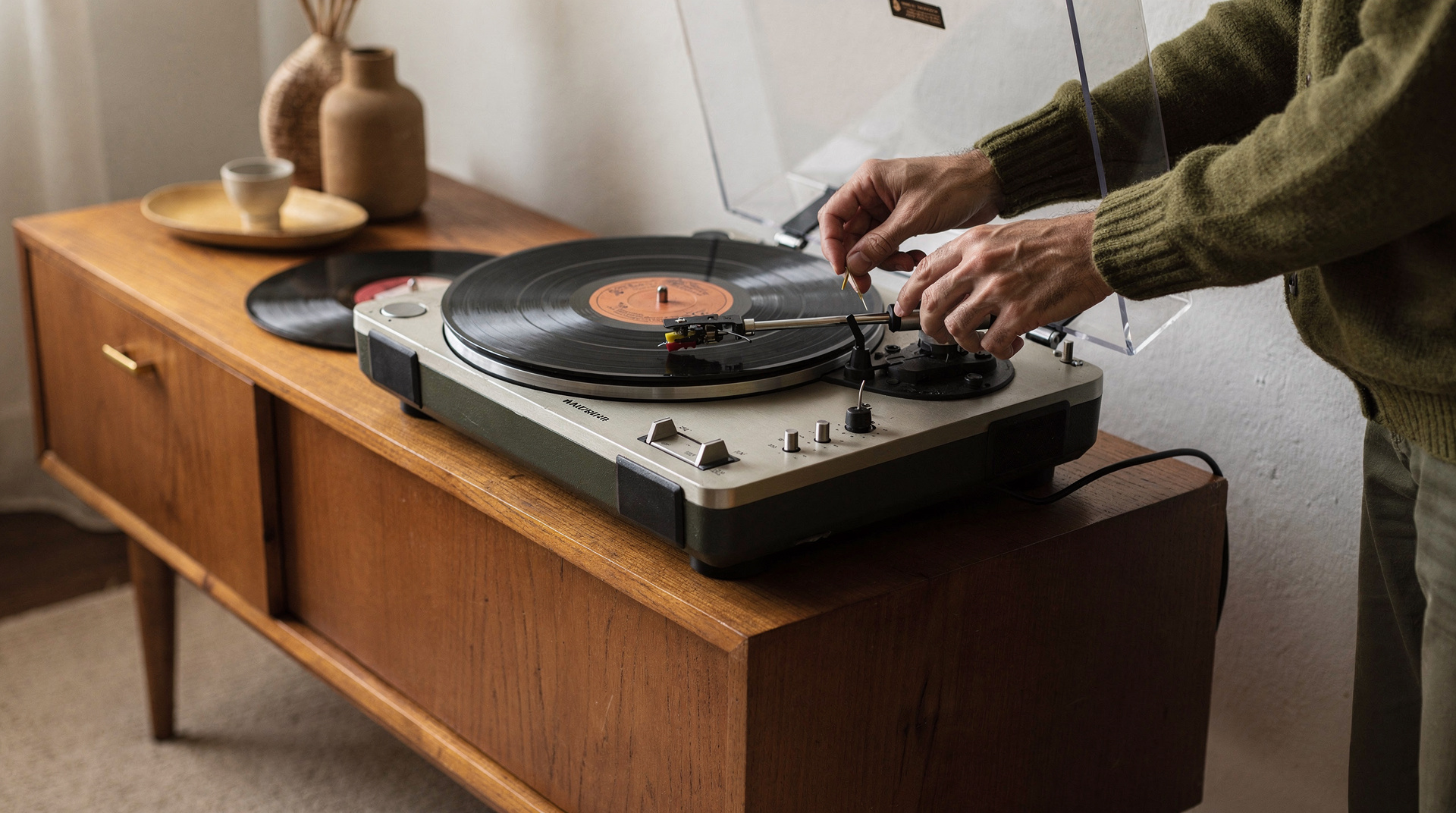
Setting up and maintaining a turntable: Professional alignment of tonearms, styli and drives on vintage turntables
A vintage turntable is not an object that reveals its full quality the moment you unbox it. Between plinth, tonearm and drive lie tolerances in the hundredths-of-a-millimetre range, and the sound a Thorens TD 124, a Garrard 301 or a Braun PS 500 delivered in the early sixties only returns once tracking force, anti-skating, overhang, stylus rake angle and belt or idler tension are precisely dialled in. Choosing a machine from this era means buying not just a piece of furniture or a slice of industrial history, but a precision-mechanical system that needs maintenance and alignment. The following sections summarise what to look for in terms of materials, design schools and condition assessment when seriously operating a mid-century turntable.
Characteristic materials and components
The decks of this period are composite constructions of cast metal, sheet steel, rubber and wood, and each of these materials ages differently. Platters made of zinc die-cast or aluminium generally remain dimensionally stable, but lose their balance if record weights or impacts have stressed the bearing. The platter bearing itself — typically a hardened steel spindle in a sintered-bronze bush with a mirror plate at the bottom — regularly requires fresh oil of the viscosity specified by the manufacturer; oil that is too thin causes rumble, while oil that is too thick impedes start-up.
Belts made of neoprene or rubber become hard, glassy or sticky and should be replaced after at most two decades. With idler-wheel drives, as used by Garrard, Lenco, Thorens and Dual, the idler wheel is the critical component: flat spots or hardened contact surfaces cause wow and flutter and a characteristic thudding. Recovering the wheel is possible but requires specialist workshops.
Tonearms from this era are frequently made of aluminium tube with brass or steel bearings in pivot or knife-edge configurations. The bearings must move freely yet without play; visible vertical or horizontal play means rework is needed. The headshell is usually an SME bayonet or is bolted in place; the internal wiring consists of fine strands that can break. Moving-magnet designs by Shure, Ortofon, ADC or Elac dominate the cartridge landscape; original styli from this period are acoustically almost always spent due to their aged damper rubbers — a current reproduction stylus insert is recommended here.
Regional schools and defining designers
The mid-century era produced three clearly distinguishable design schools. The Swiss tradition, represented by Thorens in Sainte-Croix, favoured substantial plinths, heavy platters and a combination of belt and idler drive, as demonstrated by the TD 124. Precision and ease of repair were paramount, which secures these machines their collector status to this day. Lenco, also Swiss, pursued an uncompromising idler-drive approach with the L75, featuring a continuously variable idler position.
The British school centred on Garrard in Swindon and later SME in Steyning was more strongly shaped by the broadcast studio. The Garrard 301 and its successor the 401 are heavy studio decks with idler drives; the early SME tonearms, particularly the 3009 and 3012, remain references for bearing quality and adjustability to this day. Effective length, overhang and stylus rake angle follow the Baerwald geometry with SME and can be set precisely using the appropriate template.
The German school is divided in two. On one side, the engineering work of Dual in St. Georgen with robust fully automatic changers such as the 1009, 1019 and 1219; on the other, the approach of strict reduction championed by Dieter Rams and the Braun team in Kronberg, visible in models such as the SK 4, PS 500 and Studio 1000. Scandinavia, above all Bang & Olufsen with the Beogram 1000 from the Jacob Jensen era, combined tangentially guided tonearms with a design consistency that was unusual for the time.
Authenticity and condition for collectors
Anyone acquiring a machine from this era today should examine three levels: substance, originality and function. Substance refers to the plinth, chassis and motor. With Braun, original acrylic lids free of cloudiness and cracks are rare and value-defining; with the Thorens TD 124, Mk I and Mk II are distinguished by chassis colour and brake design, and an original iron platter must be assessed independently from later aluminium platters. Garrard serial numbers are documented and allow precise dating.
Originality means: is the tonearm the one fitted at the factory, is the headshell period-correct, are switches, knobs and scales intact? Subsequently drilled plinths, replaced mains cables without restoration, missing rubber feet or substituted type plates significantly diminish collector value. A clean service history with documented belt, idler or bearing work, on the other hand, enhances it.
Function is assessed by checking speed stability, rumble behaviour and tonearm bearing play. A stroboscopic test shows whether 33⅓ and 45 rpm run steadily. The tonearm bearing should move without resistance when the stylus is not installed, yet show absolutely no tactile play. Tracking force is set with a digital stylus scale within the range specified by the cartridge manufacturer, anti-skating force approximately at the same level, overhang using a Schön or Baerwald template, and azimuth by visual inspection or measurement. Only once these parameters are correct does the deck reveal the sonic properties for which it was built.
At mid-centurydesigns.com we curate turntables and audio objects from this era with the same standards we apply to furniture. Every machine is assessed for substance, originality and function; service work is documented and replaced wear parts are declared. That way you receive a piece of design history that does not merely stand there, but plays.