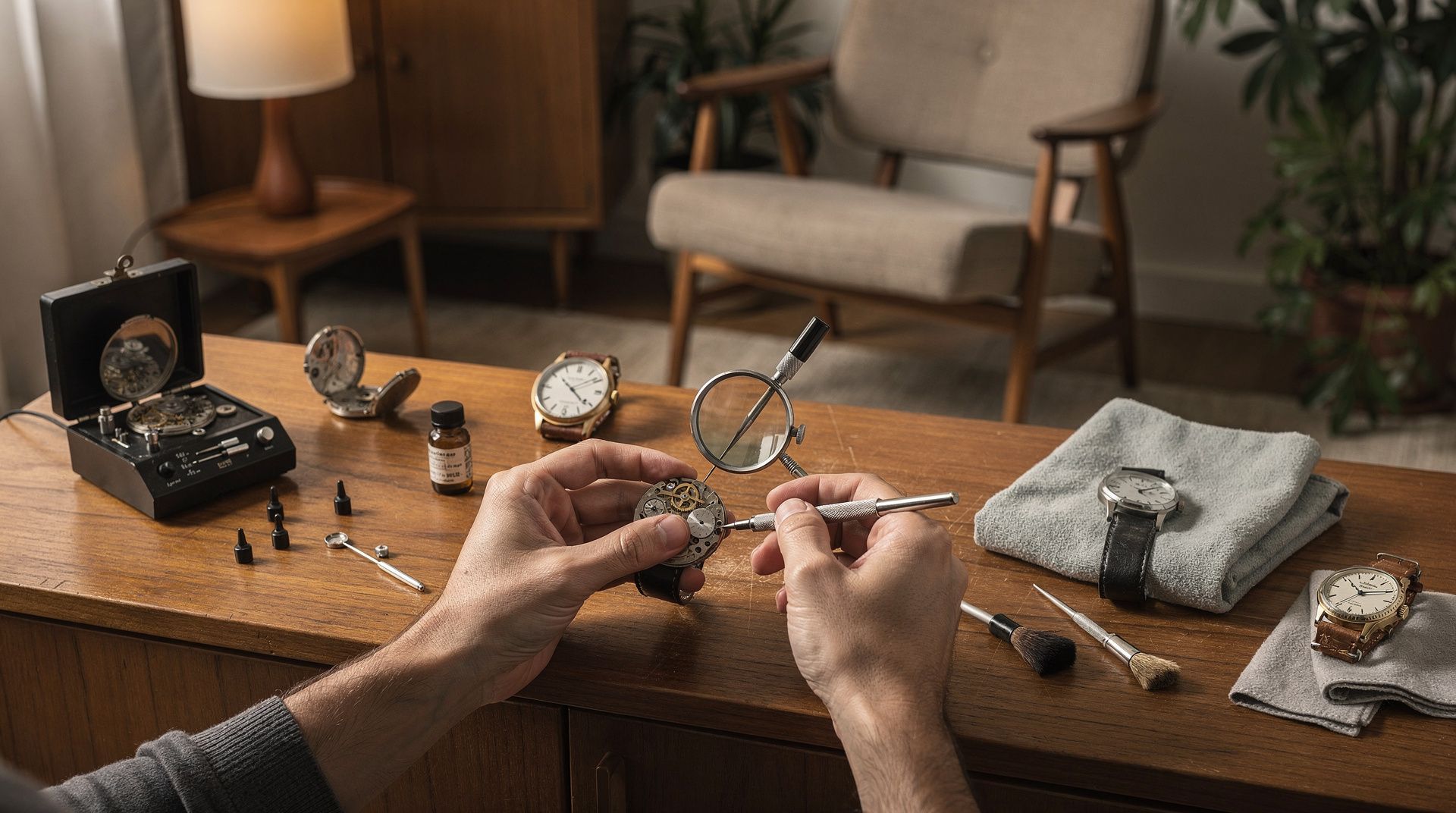
Servicing and restoring mechanical watches
A mechanical watch is a miniaturised precision instrument whose materials, tolerances and lubricants interact to determine how cleanly a calibre runs over decades. Those who collect vintage timepieces therefore work less on the watch than with it: timekeeping accuracy, amplitude and beat error can be measured objectively with a timing machine microphone, while the condition of pivots, jewels and mainspring determines the residual economic viability of a service. The standard service interval, depending on manufacturer and use, is between five and seven years, because modern synthetic oils such as Moebius 9010, 9415 or HP-1300 begin to congeal or migrate within that period. Missing this rhythm risks dry running at the pallet fork and fourth wheel, which can grind down pivots within just a few months. Substantive work such as oiling with calibrated oil dispensers, cleaning in an ultrasonic bath with L&R solutions or adjusting the balance wheel belongs in the hands of a trained watchmaker — especially with gilded gear trains, Breguet hairsprings or early automatic calibres with hammer-rotor winding systems. For care between services, collectors have a precisely defined scope: observation, documented timekeeping and sensitive handling of the crystal, case and crown.
Characteristic materials
The material palette of classic timepieces is manageable but telling. Cases in 750 or 585 gold, platinum 950, stainless steel 316L or gilt tombac respond differently to cleaning agents: mild soapy water and a soft cloth are sufficient for stainless steel, while gilded surfaces can thin even from gentle microfibre polishing. Crystals divide into three families: Hesalite acrylic, as Omega still uses on the Speedmaster today, can be freed of light scratches with polishing paste such as Polywatch. Mineral glass is harder but more brittle and should be replaced by a professional. Sapphire glass at approximately 9 Mohs is virtually scratch-proof but shatters under impact. Inside the movement, brass dominates for plates and wheels, blued steel for screws and hands, rubies as jewel bearings, and Nivarox or Glucydur for the hairspring and balance wheel. Leather straps in vegetable-tanned calf, Louisiana alligator or ostrich leather require dryness and periodic replacement, as perspiration salts corrode the lug area from the inside. Anyone wiping a vintage watch with a damp cloth should ensure the crown is fully pushed in or screwed down, as gaskets from the 1950s to 1970s have almost invariably lost their elasticity.
Regional schools and defining manufacturers
Mechanical watchmaking has clearly defined centres. The Vallée de Joux and Geneva stand for highly complex calibres from Patek Philippe, Vacheron Constantin, Audemars Piguet and Jaeger-LeCoultre, whose ébauches were often supplied to third-party brands. Biel and Grenchen shaped industrial series production of robust automatic movements with Omega, Rolex and ETA — from the Omega 55x to the ETA 2824. Schaffhausen remains a world of its own with IWC, as does Glashütte in Saxony with A. Lange & Söhne, Glashütte Original and the GDR era centred on GUB. German craftsmanship is evident there in three-quarter plates, swan-neck fine regulation and screwed gold chatons. France brought its own traditions with Lip in Besançon and LeCoultre suppliers; Japan, with Seiko and Citizen from the 1960s onwards, developed technically independent hi-beat calibres such as the Seiko 6145 or the Grand Seiko calibre 4520 with 36,000 vibrations per hour. American houses such as Hamilton, Bulova and Elgin delivered precise railroad-grade calibres before the quartz crisis from 1969 reorganised the industry. These schools differ not only aesthetically but also in parts availability, service documentation and the accessibility of historical movement drawings — all of which has a direct impact on every restoration.
Authenticity and condition for collectors
The value of a vintage watch arises from the interplay of originality, condition and provenance. Dial, hands, crown, bezel and case back should match the reference number and serial number in material thickness, print quality and hallmarks. Redials — dials that have been reprinted after the fact — significantly reduce collector value and can be identified under a loupe by blurred index edges, incorrect typefaces or missing signatures such as “Swiss Made” at the lower rim. With luminous material the chronology is clear: radium until approximately 1963, tritium until the late 1990s, then Super-LumiNova. Evenly aged, cream-patinated luminous material on dial and hands is considered strong evidence of originality. Cases should be as free as possible from over-polishing, with edges and bevels intact and hallmarks deep. On the movement side, service booklets, archive extracts — for example from Omega or the Patek Philippe archive — and photographic documentation of past services provide reliable reference points. Timekeeping within the manufacturer’s tolerance, an amplitude of 270 to 310 degrees in the flat position and a beat error below 0.5 milliseconds indicate that the calibre is technically sound.
At mid-centurydesigns.com we curate objects from an era in which precision, material and design intention spoke a common language. Each piece is examined for originality, substance and condition, documented and, where appropriate, delivered with provenance and service records. If you have questions about a specific object, the history of a calibre or the careful maintenance of your own collection, you will find contact persons with us who can read that language.
This article was generated automatically by an AI system. Disclosure pursuant to Article 50 of the EU AI Act.