Sergio Rodrigues and the Floating Elegance of Brazilian Modernism
Sergio Rodrigues (1927–2014) is one of the defining figures of Brazilian furniture design in the post-war modern era. Born in Rio de Janeiro and trained at the Faculdade Nacional de Arquitetura, he never regarded furniture as an isolated object, but as part of a specifically Brazilian culture of space. In 1955 he founded the studio and shop Oca, which became the stage for a distinctive formal language: solid in wood, generous in gesture, relaxed in posture. The armchair Mole – also internationally known as Sheriff – designed in 1957, won first prize at the Concorso Internazionale del Mobile in Cantù in 1961 and marks to this day the moment when Brazilian design emerged as an independent voice alongside the canon from Scandinavia, Italy, and the United States.
To approach Rodrigues is to enter a field where engineering thinking, craft tradition, and a tropically shaped notion of living converge. His furniture is not loud, but self-assured. It claims space without dominating it, and ages in a way that collectors prize: the wood darkens, the leather acquires patina, the seams trace the history of use. This page places Rodrigues’ work in the context of Brazilian modernism and identifies the criteria by which quality, authenticity, and condition can be assessed.
Characteristic Materials: Tropical Woods, Leather, Floating Construction
The vocabulary of Rodrigues is grounded in solid Brazilian hardwoods. Most prominently, Jacarandá da Bahia (Dalbergia nigra, Brazilian rosewood) stands at the centre of many of his iconic designs from the 1950s and 1960s. The wood has a deep, iridescent grain ranging from chocolate brown to violet, is dense, oily, and resonant. Since 1992, Dalbergia nigra has been listed under CITES Appendix I, which subjects cross-border trade in existing stock to strict documentation requirements and increases the importance of documented provenance. Later, Rodrigues turned increasingly to Imbuia, Pau-Ferro (Machaerium scleroxylon), and Sucupira, which offer similar mechanical properties with fewer trade restrictions.
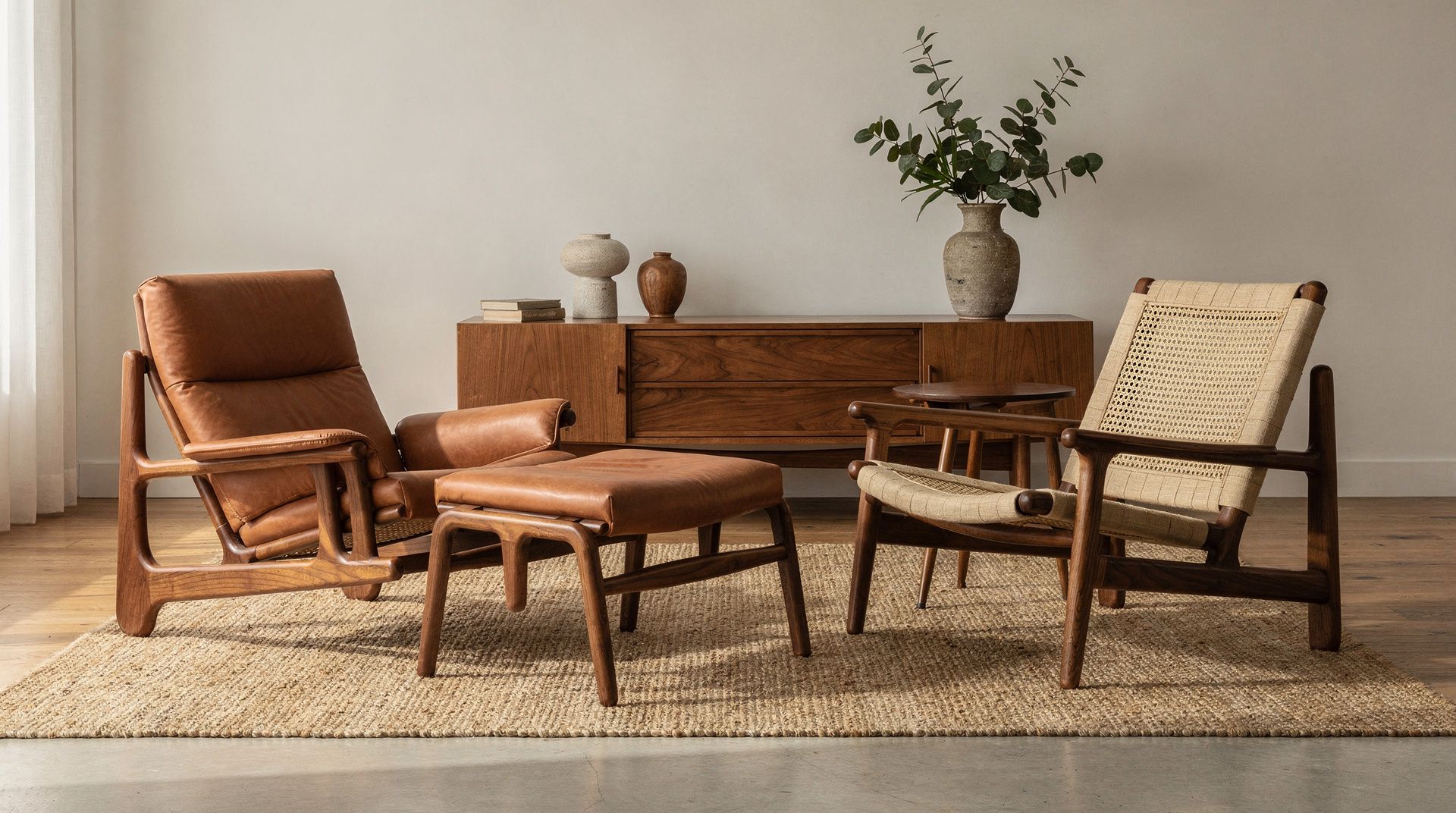
For upholstery and seat surfaces, Rodrigues used vegetable-tanned, thick saddle leather, frequently in cognac, whisky, and tobacco tones. The construction is characteristic: a load-bearing wooden frame receives loose, cushion-like leather elements fixed by straps or lacing. In the Mole, for instance, generous cushions rest on a Jacarandá frame, tensioned with wide leather bands that carry the idea of floating both structurally and visually. This separation of skeleton and soft surface allows repair, reupholstering, and replacement without compromising the substance of the piece – an advantage for long-term collection care.
Regional Schools and Contemporaries: Brazilian Modernism in Context
Rodrigues did not work in a vacuum. Brazilian modernism developed in parallel with the architectural awakening around Oscar Niemeyer, Lúcio Costa, and Affonso Eduardo Reidy, culminating in the planning of Brasília (inaugurated 1960). Furniture design was part of this nation-building and sought forms that combined European modernity with local material culture.
Alongside Rodrigues, several other figures deserve mention: Joaquim Tenreiro (1906–1992), of Portuguese origin, is regarded as a pioneer of modern Brazilian furniture and developed from the 1940s onwards light, precise constructions from five-ply laminated tropical woods. Jorge Zalszupin (1922–2020), who emigrated from Poland and worked in São Paulo, founded L’Atelier and worked with veneer techniques and faceted surfaces. Lina Bo Bardi (1914–1992) brought Italian rationality into dialogue with Brazilian craft, as in her Bowl Chair of 1951. José Zanine Caldas (1919–2001) embodied a more sculptural, solid-wood approach to timber.
Rodrigues occupies a distinct position within this field: less aristocratic than Tenreiro, less technical than Zalszupin, less archaic than Zanine. His furniture is inhabitable in the emphatic sense, tailored to the Brazilian estar – a relaxed, sociable lingering. The core repertoire includes, alongside the Mole, the Kilin armchair (1973), the Poltrona Vronka, the Tonico armchair, and tables and benches whose leg positions and joinery carry recognisable signatures.
Authenticity and Condition: What Collectors Should Look For
An original Rodrigues from the Oca production of the late 1950s to 1970s differs in several details from later licensed editions and reproductions. Key points of examination:
- Signature and marking: Early Oca pieces frequently carry a burned-in or metallic label. Authorised later productions were made by Lin Brasil and, from the 2000s onwards, by further licensees. Missing labels do not exclude authenticity, but require additional supporting evidence.
- Wood identification: Genuine Jacarandá da Bahia displays an unmistakable grain – dark streaks on a warm ground – high density, and a characteristic weight. For pieces that crossed borders after 1992, CITES documentation must be checked; without it, international resale is restricted.
- Construction: Mortise-and-tenon joints, visible brass hardware fixings, and the routing of leather straps follow documented construction methods. Glued edges, modern fittings, or plywood inserts in load-bearing sections are warning signs.
- Leather and upholstery: Original leather shows deep, uneven patina, often with crazing at stress points. A later, professionally executed reupholstering diminishes value less than a poor restoration; decisive factors are material quality and the reversibility of the intervention.
- Provenance: Invoices from Oca sales, in-situ photographs, publications (such as Soraia Cals’ monograph Sergio Rodrigues, 2000), and documentation from Brazilian estates considerably strengthen attribution.
On condition: darkened wood, signs of wear in the leather, and slight settling of cushions are part of the character of these pieces and are not defects. Critical issues are structural interventions, replaced legs, altered proportions, or refinished surfaces from which the original oil treatment has been removed.
At mid-centurydesigns.com, works by Sergio Rodrigues and his contemporaries are individually examined, documented, and offered with details on wood species, production phase, condition, and – where available – CITES documentation and provenance. Every attribution is supported by published references and material analysis. This allows the object itself to reveal what makes these pieces what they are: built testimony to a modern culture that begins in wood and finds its form in everyday life.
This article was generated automatically by an AI system. Disclosure pursuant to Article 50 of the EU AI Act.