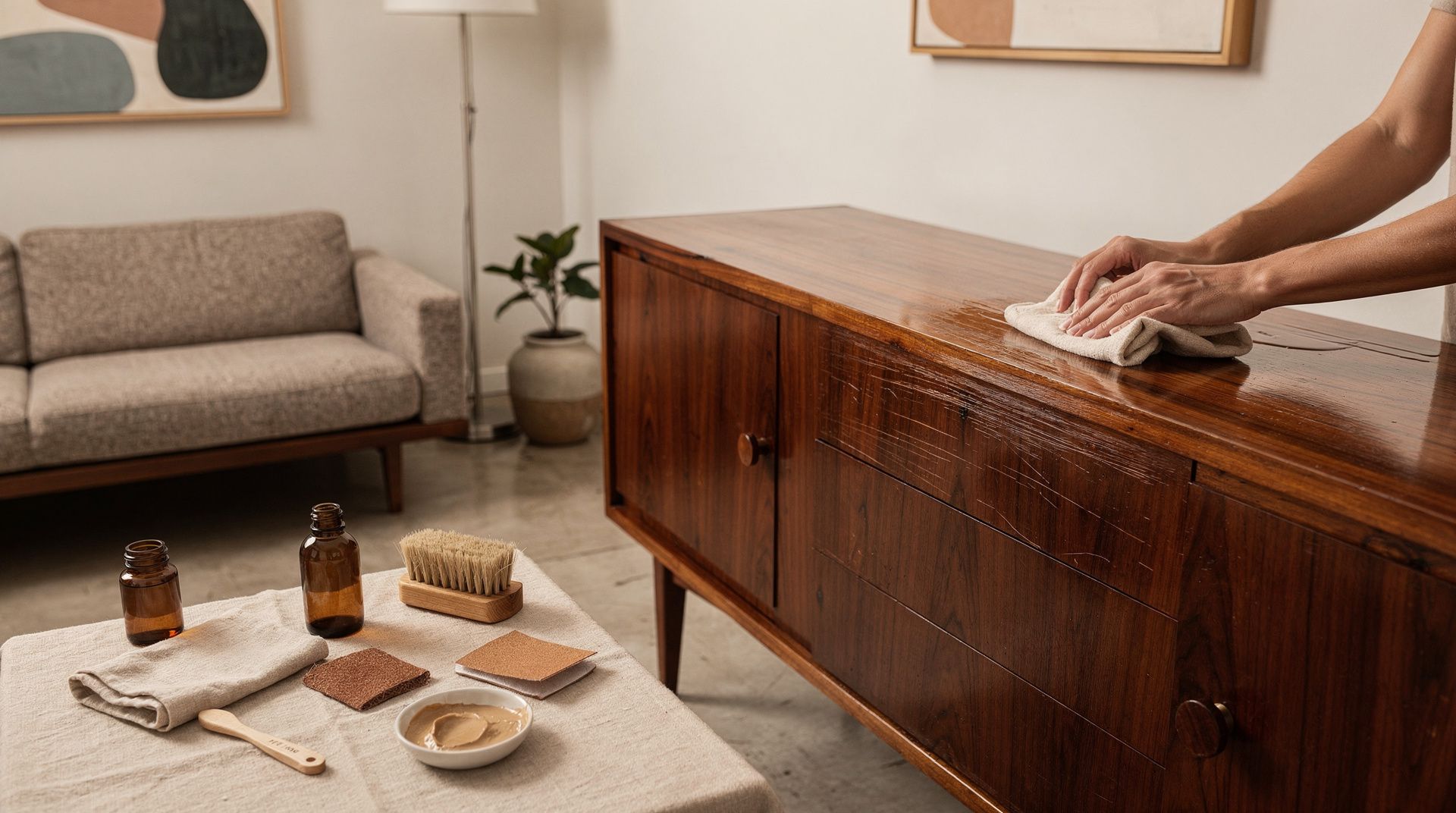
Caring for and Refreshing Rosewood
Rosewood is the signature timber of Scandinavian Modernism of the 1950s and 1960s. Its deeply shifting play of colour between chocolate brown, violet and warm red, the distinctive striped grain and the dense, oil-rich fibre structure have turned pieces ranging from sideboards to lounge chairs into icons. Anyone who owns an original piece of furniture made from Rio rosewood (Dalbergia nigra) or East Indian rosewood (Dalbergia latifolia) today is not merely the custodian of a functional object, but of a CITES-relevant cultural artefact carrying over sixty years of patina.
Proper care therefore follows two principles: restraint and knowledge of the material. Rosewood is naturally oil-rich and requires far less attention than well-meaning guides suggest. Too much oil, the wrong polish or aggressive cleaners regularly cause more damage than decades of normal use. Before any treatment, the first question to ask concerns the original surface finish, since furniture treated with soap, oil or lacquer each demands a fundamentally different approach.
Characteristic Materials and Their Surfaces
Historically, three species of rosewood were used for high-quality Mid-Century furniture, differing in their care requirements and legal status. Rio rosewood from Brazil, listed in Appendix I of the Convention on International Trade in Endangered Species since 1992, displays the darkest streaks, a slightly oily sheen and a distinctly sweet scent when sanded. East Indian rosewood (Sonokeling) appears more uniformly violet-brown and became the standard from the mid-1960s onwards, as Brazilian stocks grew scarcer. Santos rosewood (Machaerium) appears on later pieces.
The original surface finishes applied by workshops in Denmark and Sweden were usually a thin nitro- or shellac-based polish, and in rare cases a soap solution, as used in some works by Hans J. Wegner. Pure oil was rather uncommon on rosewood, as the timber already contains sufficient natural oil. For routine care, dry dusting with a soft cotton cloth is sufficient, together with — once or twice a year — a cloth sparingly dampened with clear water or mild furniture soap, followed by immediate drying. For matte oil finishes, a trace of pure linseed oil or a qualified hard wax oil can be rubbed in thinly with a lint-free cloth every few years and thoroughly wiped off after twenty minutes. Silicone-based polishes, furniture sprays and citrus cleaners should be avoided, as should direct sunlight, which can bleach the play of colour to a flat grey within just a few years.
Superficial scratches can often be minimised with a retouching pen or a cotton swab dipped in a little linseed oil, which causes the fibre to swell back and visually closes the grain. Pressure marks in the veneer can be carefully raised with a damp cloth and a warm iron. Deeper damage, veneer chips or watermarks should be entrusted to a restorer experienced in tropical timbers — not to a general furniture refurbisher.
Regional Schools and Their Signatures
Knowledge of care presupposes knowledge of provenance. The Danish school around Kaare Klint and his students at the Royal Danish Academy of Fine Arts shaped, from the 1930s onwards, an approach to rosewood that emphasised proportion, visible dovetail joinery and honest construction. Finn Juhl worked with cabinetmaker Niels Vodder on sculptural pieces whose exposed edges require particular attention regarding moisture. Arne Vodder, Ib Kofod-Larsen and Kai Kristiansen designed sideboards for Sibast, Faarup and Feldballes, whose sliding doors and tambour shutters are often made from thin rosewood veneer on pine or oak carcasses.
The workshop of Rud Rasmussen and the serial production at France & Søn, Cado and P. Jeppesen differ in construction and veneer thickness. Poul Kjærholm at E. Kold Christensen combined rosewood with brushed steel, which requires consideration of both materials during cleaning. In Sweden, Nils Jonsson for Troeds and Svante Skogh often worked with thicker veneer; in Norway, Torbjørn Afdal for Bruksbo and Sven Ivar Dysthe set their own distinctive accents. The German and Dutch interpretation, through makers such as Behr, Wilhelm Renz, Fristho and Topform, frequently employed more industrialised lacquer structures that impose different cleaning limits compared to open-pore finishes.
Authenticity and Condition for Collectors
For collectors, original substance determines long-term value. A piece of furniture that has been extensively sanded down and re-lacquered in recent decades has often lost a considerable portion of its thin veneer and, with it, much of its colour depth. Check at the edges whether the veneer still has its original thickness — typically between 0.8 and 1.5 millimetres on pieces from the 1960s. Look for branded stamps, paper labels and metal plaques from the manufacturer, as well as the obligatory marks relating to cabinetmakers’ guilds, such as the circular quality mark of the Danish Furniture Makers’ Quality Control with year of manufacture.
For Rio rosewood, trade within the EU has since 2017 required a pre-acquisition certificate demonstrating that the piece was made before it was listed in Appendix I. Reputable dealers document this accordingly. The condition of the surface should be aged but homogeneous: an even, warm patina indicates careful use, while sudden colour shifts and glossy patches suggest localised retreatment with oil or polish. Scent, weight and pore density are additional indicators of the wood species. Minor signs of age rarely diminish value; inappropriate restorations, on the other hand, do so permanently.
At mid-centurydesigns.com we curate original rosewood furniture of Scandinavian and Continental Modernism, examining every piece for provenance, veneer condition, original fittings and, where applicable, the required CITES documentation. We document all completed restorations transparently and advise you on the long-term care of your acquisition, so that the grain and depth of a rosewood piece over sixty years old will endure for the decades to come.
This article was generated automatically by an AI system. Disclosure pursuant to Article 50 of the EU AI Act.