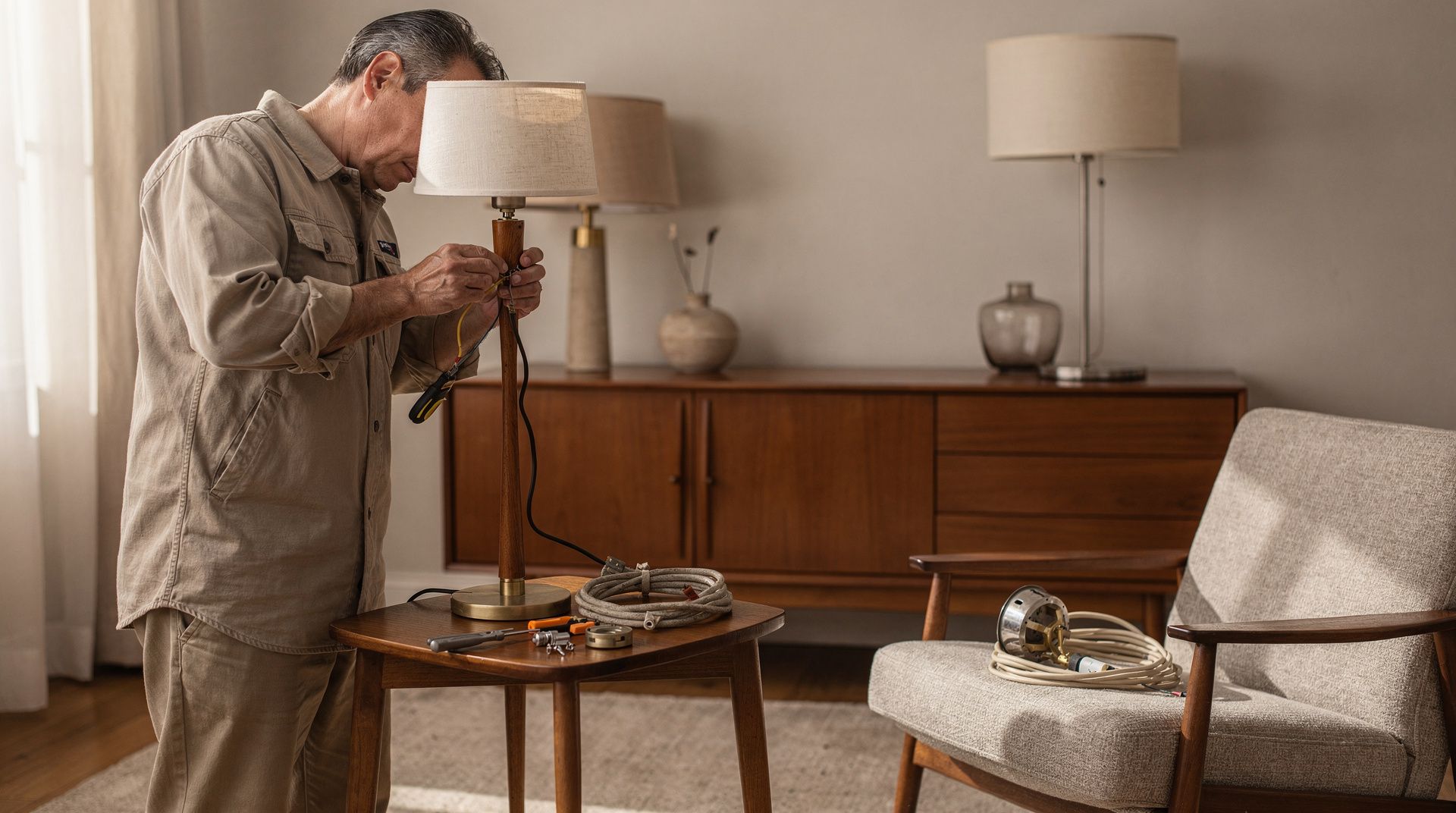
Have old luminaires professionally rewired
An original Mid-Century luminaire is more than a light source. It is a technical object whose substance — brass, aluminium, opal glass or lacquered steel — has aged over decades, while its electrics have generally not done so in comparable quality. Fabric-sheathed cables become brittle, Bakelite sockets develop hairline cracks, solder joints oxidise, strain reliefs work loose. Anyone who wants to use a luminaire from the 1950s to 1970s on a permanent basis cannot avoid a professional inspection and, in many cases, a rewiring. The guiding principle is: preserve as much of the original fabric as possible, renew only what is necessary. A carefully executed restoration replaces the wear-prone electrical components without altering the character, the patina or the constructive logic of the design. It is therefore not a modernisation but a conservation measure that secures the object’s usability while at the same time stabilising its collector value.
Characteristic materials and their electrical weak points
The palette of materials used in Mid-Century luminaire production is closely tied to the manufacturing traditions of the time and largely determines what must be considered during restoration. Brass — frequently nickel-plated, chrome-plated or clear-lacquered — was used for frames, joints and socket sleeves. It can be cleaned and polished, but reacts sensitively to aggressive agents that may attack an original lacquer finish. Aluminium, often found in reflectors and shades of Italian and Danish origin, is frequently white powder-coated or painted on the inside. Dents and scratches are a visible part of the object’s history and should only be addressed with restraint. Opal and Murano glass is mechanically demanding: shades frequently sit on metal rings with felt or cork gaskets that crumble during disassembly and must be replaced to prevent stress cracks. Electrically, three points are decisive: fabric-sheathed supply cables whose insulation is typically hardened after fifty years; Bakelite and early plastic sockets that develop cracks when subjected to heat from oversized bulbs; and the absence of a protective earth conductor in metal housings, which by today’s understanding should be executed as Protection Class I. Professional work here means: replacement with period-tested components of historically appropriate appearance — for example, fabric-sheathed cables in original colours, ceramic sockets and LED-compatible dimmer solutions where desired.
Regional schools and their constructive signatures
The origin of a luminaire determines how it may be disassembled and reassembled. The Italian school, centred on manufacturers such as Arteluce, Arredoluce, Stilnovo, Oluce and later Flos, worked with filigree brass joints, spot-welded reflectors and often non-demountable shades. Designs by Gino Sarfatti, Angelo Lelii, Vico Magistretti or Gio Ponti are constructively precise and well thought through, but rewiring demands patience because cables are frequently routed through narrow tubular joints. The Danish tradition, shaped by Louis Poulsen with Poul Henningsen’s PH series, Verner Panton or Jo Hammerborg for Fog & Mørup, follows a different logic: clear screw connections, robust socket carriers, frequently with a bayonet system for the shade lamellae. Here it is generally possible to work in a fabric-conserving manner. German producers such as Kaiser Leuchten, Doria or Staff stood for solid series quality with easily accessible terminal points. Dutch production — in particular Raak Amsterdam and Philips — is often characterised by complex glass arrangements that must be fully documented before any electrical work begins, so that reassembly in the original configuration is achievable. Anyone who knows the constructive signature of the respective school can avoid the typical damage left by an unprofessional restoration.
Authenticity and condition from a collector’s perspective
For collectors, the decisive question is not whether a luminaire has been rewired, but how. A documented, reversible and materially appropriate restoration does not diminish the value of an original piece — it secures it. Problematic are interventions that alter the fabric: subsequently drilled holes for strain reliefs, sanded-down lacquer finishes, replaced shades from a later production run, substituted canopies or deviating socket threads — for example, a change from E14 to E27 that shifts the optical proportions of the light source. Condition assessment therefore includes the inspection of all visible and concealed metal parts for original lacquer, the comparison of manufacturer marks and stampings with the known production periods, the examination of the shade glass thickness and form, and the verification that counterweights, balance weights and spring mechanisms correspond to the design. A reliable provenance, supplemented by photographs taken before and after the electrical restoration as well as a test report to VDE 0701-0702, is now an industry standard and should be requested with every high-value purchase. Whoever collects is not merely buying an object, but its documented history.
At mid-centurydesigns.com, every luminaire undergoes a careful inspection before being accepted into stock. The electrics are checked by specialist firms and, where necessary, renewed with materially appropriate components. Original shades, socket carriers and surfaces are preserved; interventions are reversible and documented. This is how you find pieces with us whose fabric you can collect and whose light you can enjoy every day.
This article was generated automatically by an AI system. Disclosure pursuant to Article 50 of the EU AI Act.