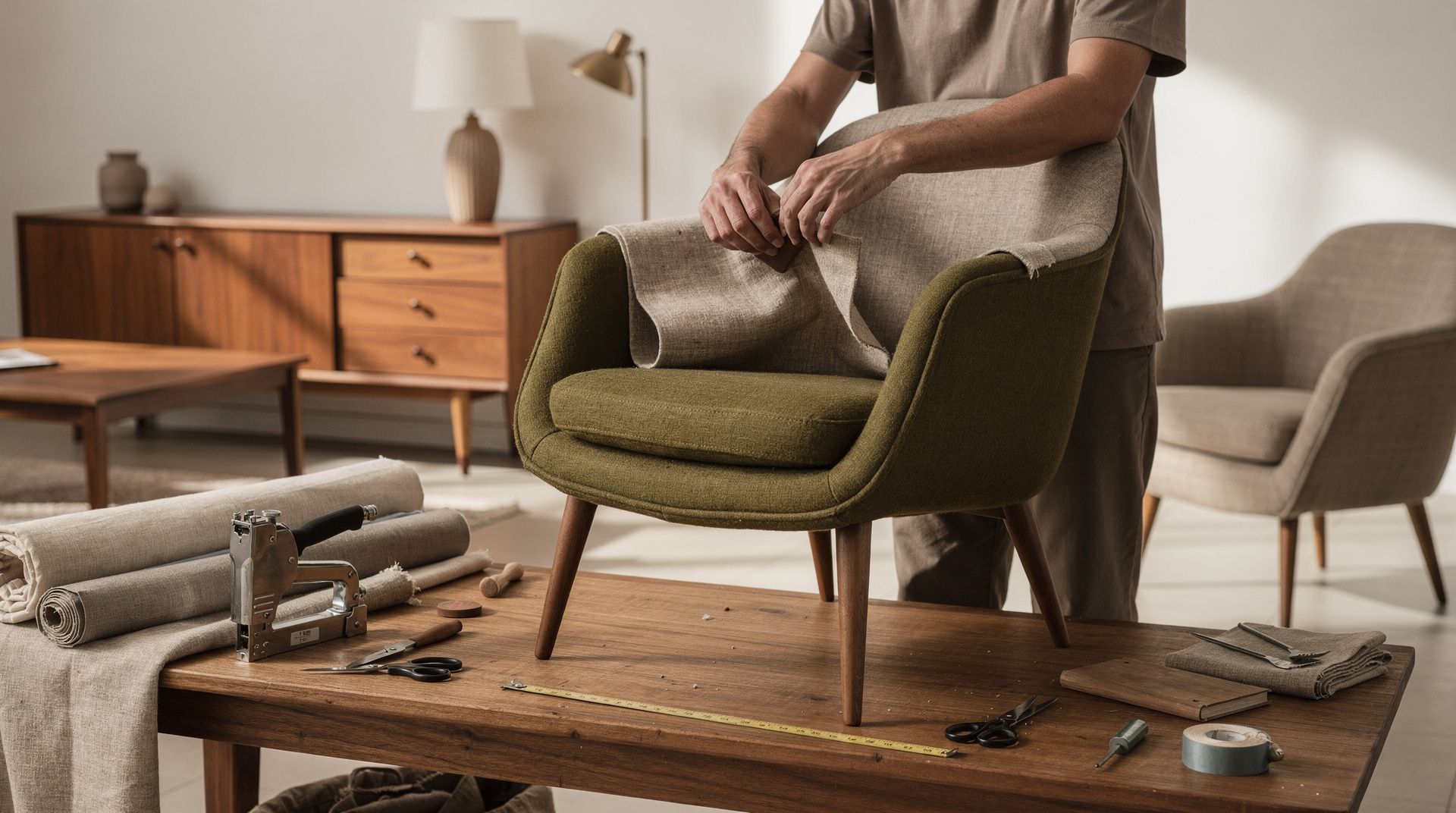
Reupholstering Vintage Furniture: When It Makes Sense, How It Works and What It Costs
An armchair by Illum Wikkelsø, a sofa from the workshop of Arne Vodder, a lounge chair with a questionably renewed cover from the nineties: anyone who engages with original mid-century furniture design cannot avoid the question of reupholstering. It is neither a purely craft nor a purely aesthetic decision, but a curatorial weighing of structural preservation, usability and provenance. A piece of furniture that has been in use for over sixty years has typically already undergone one or more upholstering phases. The art lies in recognising which layers are historically relevant, which are technically spent, and where renewal stabilises value rather than diminishing it.
As a general rule: the original fabric covering is rare, but not necessarily the better solution. If it is heavily worn, sagged, bleached by the sun or hygienically problematic, the loss of usability outweighs the historical testimonial value. If the webbing base has gone slack, the foam core has crumbled or the springing has collapsed, proper reupholstering is not a compromise but a prerequisite for the piece to remain usable at all. What matters is how this work is carried out and how it is documented.
1. Characteristic Materials and Their Proper Handling
Mid-century upholstered furniture works with a clearly defined canon of materials that also shapes subsequent restoration. In Scandinavian workshops of the 1950s and 60s, webbing in natural fibre or rubber (Pirelli straps) predominates, with a layer of horsehair, coconut fibre or, in later years, latex and cold-foam cores placed on top. Fabrics include wool cloths from Kvadrat predecessors, woven structures by Bernat Klein, or vegetable-tanned aniline leather as used by Fredericia, France & Søn or Getama.
In Italian and American design of the same years, foam on metal frames appears more frequently — for instance in works by Marco Zanuso, Osvaldo Borsani, or in the early Knoll and Herman Miller series. These foams age chemically, become brittle, lose their resilience and realistically need to be replaced after four to five decades. A serious reupholstering job uses materials that match the originals in density, construction and seat firmness. A furniture-grade cold foam replaces age-damaged original foam without distorting the sitting feel. Horsehair pads are reworked and reused wherever possible.
The process follows a clear sequence: disassembly, documentation of the build (photography of every layer), cleaning and inspection of the wooden frame, renewal of webbing and springing, building up the upholstery layers, cutting and covering. For complex seat shells such as Hans Wegner’s Papa Bear Chair or the curved sofas of Illum Wikkelsø, between 40 and 80 working hours is realistic. The pure material costs for a high-quality wool fabric range from 90 to 180 euros per running metre; for vegetable-tanned aniline leather, depending on hide size, between 350 and 700 euros per hide. For a lounge chair, the total cost of a professionally executed reupholstering is typically in the range of 1,200 to 2,800 euros; a two-seater starts at around 2,500 euros, and a three-seater can quickly reach 4,000 to 6,500 euros.
2. Regional Schools, Designers and Their Upholstery Traditions
Anyone planning to reupholster a specific piece should be familiar with the workshop tradition it comes from. The Danish school around Kaare Klint, Børge Mogensen, Hans J. Wegner and Finn Juhl worked closely with upholsterers such as A. J. Iversen, Niels Vodder or the workshops of Fredericia. The upholstery here is comparatively flat, built up with horsehair over tensioned webbing, with fabrics often in Savak wool or saddle leather. A faithful restoration respects this restraint and avoids additional foam builds that would alter the silhouette.
The Swedish tradition around Bruno Mathsson and the Norwegian one around Fredrik Kayser or Ingmar Relling rely more heavily on visible strap and webbing constructions, where the covering functions as a removable cushion package. Renewal here is technically simpler but demands precise fit. In Italy, Cassina, Arflex and Tecno, working with designers such as Gio Ponti, Franco Albini and the Castiglioni brothers, practised a more industrial upholstery logic: foamed form parts on steel tube, with machine-cut covers. Anyone reupholstering a D.153.1 by Ponti or a Lady Chair by Zanuso will inevitably work with replacement foam, but should pay close attention to the original seam routing and the characteristic button tufting.
American modernism by Charles and Ray Eames, George Nelson, Edward Wormley or Milo Baughman encompasses both craft and early industrial approaches. The Eames Lounge Chair 670, for instance, has a precisely defined cushion system for which Herman Miller still supplies replacement parts. Reupholstering outside this system is possible but significantly reduces collector value.
3. Authenticity and Condition: What Collectors Should Check
For the assessment of a piece, what lies beneath the covering is decisive. An original frame with a maker’s mark, model number and intact wood substance retains its value even after professional reupholstering. It becomes critical when earlier restorations have altered the construction: new drill holes, glued breaks at visible points, replaced armrests or substituted rails. Such interventions are irreversible and affect value more strongly than any upholstery layer.
With the fabric covering itself, there is a collector hierarchy. A documented original first covering in good condition is the exception and is valued correspondingly higher. A professionally renewed covering in a historically appropriate fabric — ideally from a collection that was also used at the time — is the collector-accepted standard. Problematic are coverings in fashionable colours or synthetic fibres that correspond neither to the period of origin nor to the spirit of the design. Anyone having a piece reupholstered should retain the old covering layer as a labelled fabric sample and document the work photographically. These records later increase traceability in resale.
Equally important is the question of whether reupholstering should be carried out at all. With museum-grade individual pieces — such as an early prototype or a signed Vodder work with preserved original covering — conservatorial restraint may be more appropriate than craft renewal. Here the principle applies: document, protect climatically, use sparingly.
At mid-centurydesigns.com, we inspect every piece before including it in our inventory, checking construction, maker’s marks, frame substance and the condition of the covering. Where reupholstering has taken place, it is noted in the object description, with details of the material used and, where possible, the workshop. Where original coverings are preserved, we document them with detail photographs. This transparency is the foundation on which you, as a collector or designer, can decide whether a piece belongs in your collection, your project or your living space.
This article was generated automatically by an AI system. Disclosure pursuant to Article 50 of the EU AI Act.