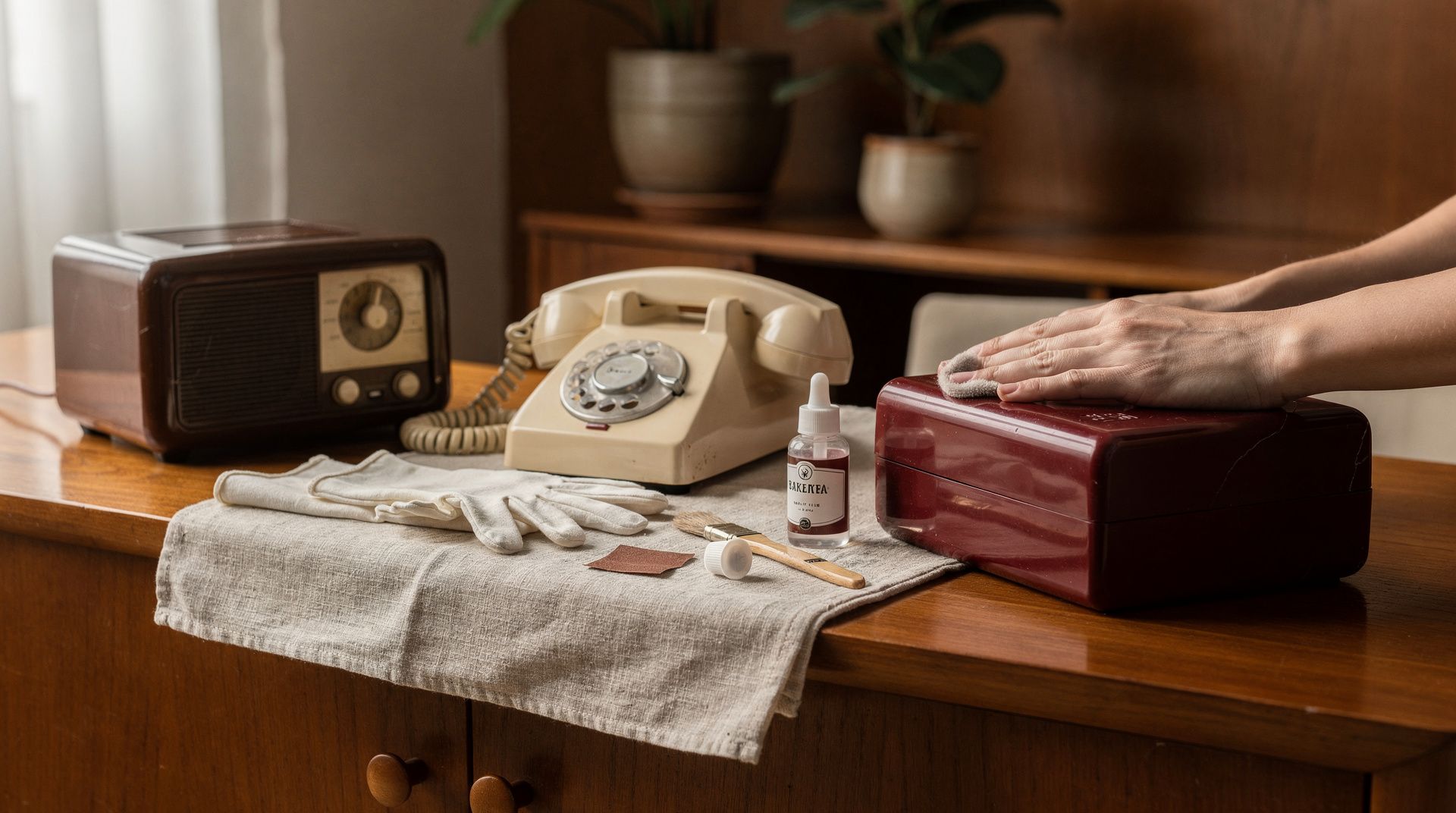
Understanding Bakelite before you treat it
Bakelite is the oldest fully synthetic plastic in design history, patented in 1907 by Leo Baekeland as a phenol-formaldehyde resin and, from the 1920s through the 1950s, the defining material for radios, telephones, camera bodies, jewellery and household appliances. Unlike thermoplastic successors such as cellulose acetate or ABS, Bakelite is a thermoset: once cured, it cannot be remelted. This is precisely what gives rise to the peculiarities you must account for in restoration. The surface oxidises slowly, which is why originally light colours such as ivory, butterscotch or apple green often appear today in amber and caramel tones. This patina is part of the object’s history, not dirt, and how a collector relates to it is a matter of philosophy, not chemistry alone.
Our approach to Bakelite is fundamentally minimal. Less intervention means more substance, more substance means more value. Aggressive polishing, solvents or the popular brightening with hydrogen peroxide strip the object of its time layer and frequently damage the fine moulded surface that is critical for attribution and dating. The sections below summarise what you should know about material types, design origins and condition assessment before you reach for a polishing cloth or adhesive.
1. Characteristic materials and their care
Bakelite in the strict sense is a phenolic resin filled with wood flour, cotton fibres or minerals. The dark radio cabinets of the 1930s — from manufacturers such as Ekco, Philips or AEG — are typically made from this filled moulding compound and display a matt to silky surface. For cleaning, distilled water with a drop of pH-neutral soap and a soft microfibre cloth is generally sufficient. Ammonia, acetone, alcohol and all household cleaners should be avoided entirely, as they dissolve plasticisers and leave the surface dull.
Fine scratches can be reduced with a very mild polishing paste — such as a silicone-free car polish or a classic furniture wax paste based on carnauba — using circular movements. Always work on a small area, check progress against raking light and stop as soon as the sheen becomes even. Deeper scratches are better left alone, because polishing them away destroys the mould edge and the characteristic flow lines. Particular caution is required with layered cast Bakelite used in jewellery: even the warmth of your hand can make colour differences between the core and the oxidised outer layer visible. Never rub aggressively for material testing; instead use the warm-water test or an inconspicuous cotton swab with Simichrome.
Cracks should be bonded exclusively with reversible, age-stable resins. Paraloid B-72 dissolved in acetone has proven its worth in conservation practice because it is light-stable, adheres well to aged phenolic resin and can be reopened later. Cyanoacrylate acts quickly but yellows over time and is virtually irreversible. Two-component epoxy is only appropriate for load-bearing breaks and should be applied in a thin joint. Fill losses with tinted Paraloid or microcrystalline wax — never with modern filler.
2. Regional schools and defining designers
The formal language of Bakelite objects is clearly distinguishable by region and is central to attribution. In the United States, Walter Dorwin Teague, Norman Bel Geddes and above all Raymond Loewy defined the streamlined style: flowing radii, horizontal ribbing, monumental dial faces. Teague’s Sparton radios “Bluebird” and “Nocturne” and Loewy’s Coldspot refrigerator are emblematic examples. Harold Van Doren designed the Air-King radio in 1933, which to this day is regarded as one of the earliest sculptural Bakelite works.
In Great Britain, Wells Coates for Ekco and Serge Chermayeff developed a stricter, more geometric line. Coates’s model AD65 of 1934, with its circular cabinet, is an icon of early industrial modernism and was produced in black, brown and, rarely, green Bakelite — with the coloured variants commanding significantly higher prices today. In Germany, Braun, Mende, AEG and Siemens produced Bakelite radios and telephones in a restrained formal language; the Siemens W28 telephone from 1928 onwards is one of the most sought-after pieces among collectors. In France and Italy, objects were produced at the same time that made greater use of colour and multilayer cast phenolic — for example in the Katalin radios of the Sonora brand or in the early jewellery production around Auguste Bonaz.
For dating purposes, mould marks, foundry abbreviations and patent numbers on the underside are helpful. An object without any moulded markings is unusual for Bakelite and should be examined critically.
3. Authenticity, condition and storage
Material testing begins with smell. Bakelite that has been rubbed or held in warm water releases a characteristic phenol or formaldehyde odour that later plastics such as urea-formaldehyde, cellulose acetate or modern polyester do not exhibit. The Simichrome test on a cotton swab turns yellow with genuine Bakelite, often more intensely with Katalin, and remains clear with replicas. Additionally, pay attention to the weight, the warm sound produced by gently tapping and the presence of mould seams that were finished by hand on originals.
For collectors, the most relevant condition factors are: completeness of original fittings and dials, unaltered surface, no later repainting, no cracks filled with cyanoacrylate, no areas brightened by peroxide baths. A uniformly darkened Katalin radio is considerably more stable on the market than a patchily bleached example that has lost its tone.
Three rules apply to storage. First: a stable climate at approximately 18 to 20 degrees and 45 to 55 percent relative humidity, without fluctuations that trigger stress cracks in the thermoset. Second: no direct daylight and no UV-emitting display lights, because phenolic resins continue to oxidise photochemically. Third: acid-free packaging — no PVC films, no newspaper padding, no contact with rubber or soft polyurethane, which cause migration. Metal parts, Bakelite bodies and textile coverings should be stored separately padded, because moisture and ion migration will otherwise draw corrosion stains through the cabinet.
At mid-centurydesigns.com we check every Bakelite object for material authenticity, completeness and conservation pre-treatment before including it in the catalogue. We document provenance, manufacturer and condition transparently, disclose previous restorations and favour untouched patina over cosmetic brightening. This means you will find in our selection pieces whose substance you can take on, pass on and preserve for the long term without hesitation.
This article was generated automatically by an AI system. Disclosure pursuant to Article 50 of the EU AI Act.