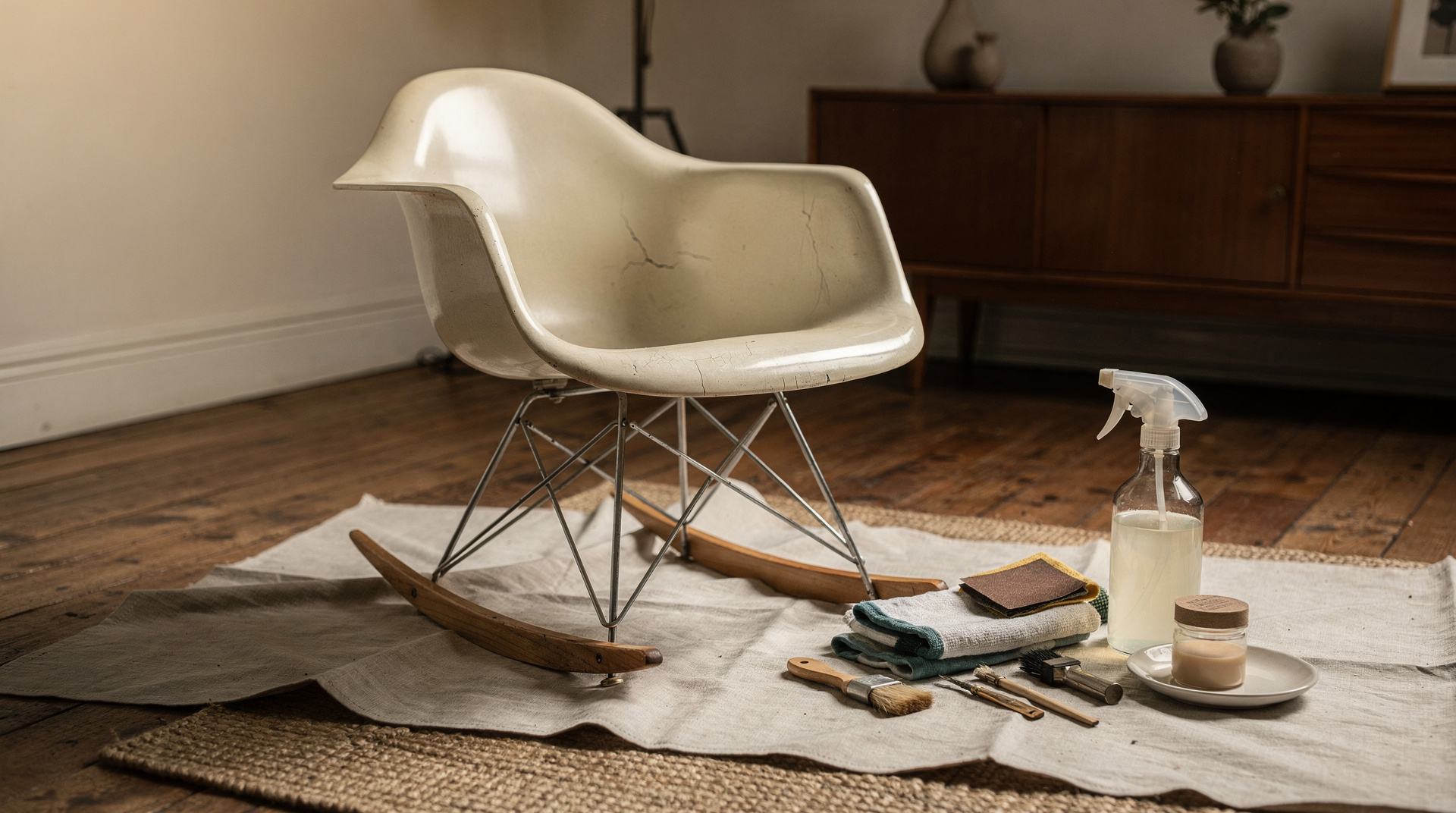
Cleaning and Repairing Fiberglass Shells: Care and Restoration of Vintage Fiberglass Furniture
Fiberglass is one of the defining materials of postwar modernism. What transitioned from military materials research into furniture production in the late 1940s became, within just a few years, the emblem of a new domestic culture — one that was serially manufacturable yet formally ambitious. Glass fiber-reinforced polyester, as developed by Charles and Ray Eames together with Zenith Plastics from 1950 onward for the serial production of the Shell Chairs at Herman Miller, combined sculptural freedom with industrial reproducibility for the first time. Anyone working with original fiberglass shells today is handling a document of that era — not an arbitrary plastic surface.
Care and restoration therefore require restraint. Fiberglass ages visibly: the surface resin layer becomes brittle through UV exposure, the underlying fiber mat emerges as so-called “fiber bloom” after prolonged weathering, edges splinter, and shockmounts detach. Much of this can be stabilized without overwriting the character of the piece. The following sections address the material, its origins, and the criteria by which collectors orient themselves before reaching for a tool or sanding pad.
Characteristic Materials and Their Aging
Classic Mid-Century shells consist of unsaturated polyester resin into which roughly cut fiberglass mats or blown rovings are embedded. On early Eames shells, the fiber texture on the underside is often visible to the naked eye — a characteristic that the second generation from the 1970s onward increasingly concealed with a finer surface finish. Color pigments are embedded directly into the resin, which creates genuine depth of color, but also means that yellowing, chalking, and a slight gray haze are among the typical signs of aging.
For cleaning, lukewarm water with a pH-neutral cleaner and a soft microfiber cloth is generally sufficient. Aggressive solvents such as acetone or chlorine-based cleaners attack the resin surface and destroy the original sheen. For dull, chalky-looking surfaces, a very fine polish using automotive compound (grit from 3000 upward), applied by hand, helps to remove oxidized resin particles without exposing the fiber mat. Small edge chips can be filled with color-matched polyester or epoxy resin; the key is to keep the repair area below the visible level and not to sand it flat over a wide area. The characteristic, slightly cloudy texture of the original shell is part of its value and should remain legible.
A frequently underestimated point is the substructure. Original shockmounts — those small rubber dampers that connect the shell to the base — age chemically and detach after decades. They can be replaced reversibly, but on collector-relevant pieces (such as Zenith shells with a “Rope Edge”) they should be replaced with care, as improper removal can cause the thin resin skin on the underside of the shell to break away.
Regional Schools and Designers
Fiberglass was not exclusively an American phenomenon, but the United States defined its language and standards. Alongside Charles and Ray Eames, Eero Saarinen (Womb Chair, 1948, for Knoll) and later Isamu Noguchi worked with the material. Herman Miller and Knoll established industrial production; suppliers Zenith Plastics (California) and, from 1953 onward, Summit Plastics and Cincinnati Milacron took over the production of the blanks. The early California shells from Gardena are particularly prized among collectors, identifiable by their coarsely textured fiber reverse and the all-around “Rope Edge” — an embedded fiber strand for edge reinforcement.
In Europe, independent interpretations emerged. In France, Charles Zublena with the stacking chair “Chaise Tulipe” (1967, Sam Sièges) and the ateliers of the Prisunic era formulated a lighter, more color-intensive aesthetic. In Italy, Joe Colombo and the circles around Kartell took up the material, though Kartell quickly shifted to injection-molded ABS and polypropylene. In Germany, Herbert Hirche and the Ulm milieu as well as Luigi Colani experimented with organically formed fiberglass elements, often in smaller series and with a more craft-oriented finish. Scandinavia remained faithful to wood but used fiberglass selectively — for example in Yrjö Kukkapuro’s “Karuselli” (1964), whose seat shell showcases the material to this day in an exemplary fashion.
Authenticity and Condition for Collectors
On original Eames shells, stampings on the underside provide information about the manufacturer, production phase, and often also an approximate date. Collectors look for the Herman Miller logo, the Zenith stamping of the first series, the presence of the Rope Edge (up to approximately 1954), and the structure of the fiber reverse. Second production phases from the mid-1950s onward show smoother reverses without the surrounding fiber strand. Reissue models in polypropylene — which Vitra and Herman Miller reintroduced in fiberglass from 1999 onward (Herman Miller 2013, Vitra 2018) — are to be evaluated on their own terms and should not be confused with vintage pieces.
Regarding condition: a uniform patina, light signs of use, and an intact underlying structure are often more valuable to collectors than an over-polished, color-refreshed shell. Critical points are hairline cracks emanating from the shockmount attachment points, deep scratches reaching into the fiber mat, and large-area repainting that conceals the original pigmentation. A look under UV light often reveals later repairs, as modern epoxy resins fluoresce differently from the original polyester. When assessing a base (Eiffel Base, Rocker Base, Stacking Base, DAX), the correspondence between shell generation and base type is important — subsequent combinations are common and diminish provenance.
The pieces we offer on mid-centurydesigns.com undergo exactly this process of scrutiny: assignment of production phase, verification of stampings, assessment of the shell surface, documentation of shockmounts and base. For us, restoration means keeping the original legible and intervening only where substance must be preserved. If you are considering a vintage fiberglass shell or would like to have a piece from your own collection assessed, you will find references with documented provenance in our curated inventory and, in our team, the right contacts for questions about care, spare parts, and professional restoration.