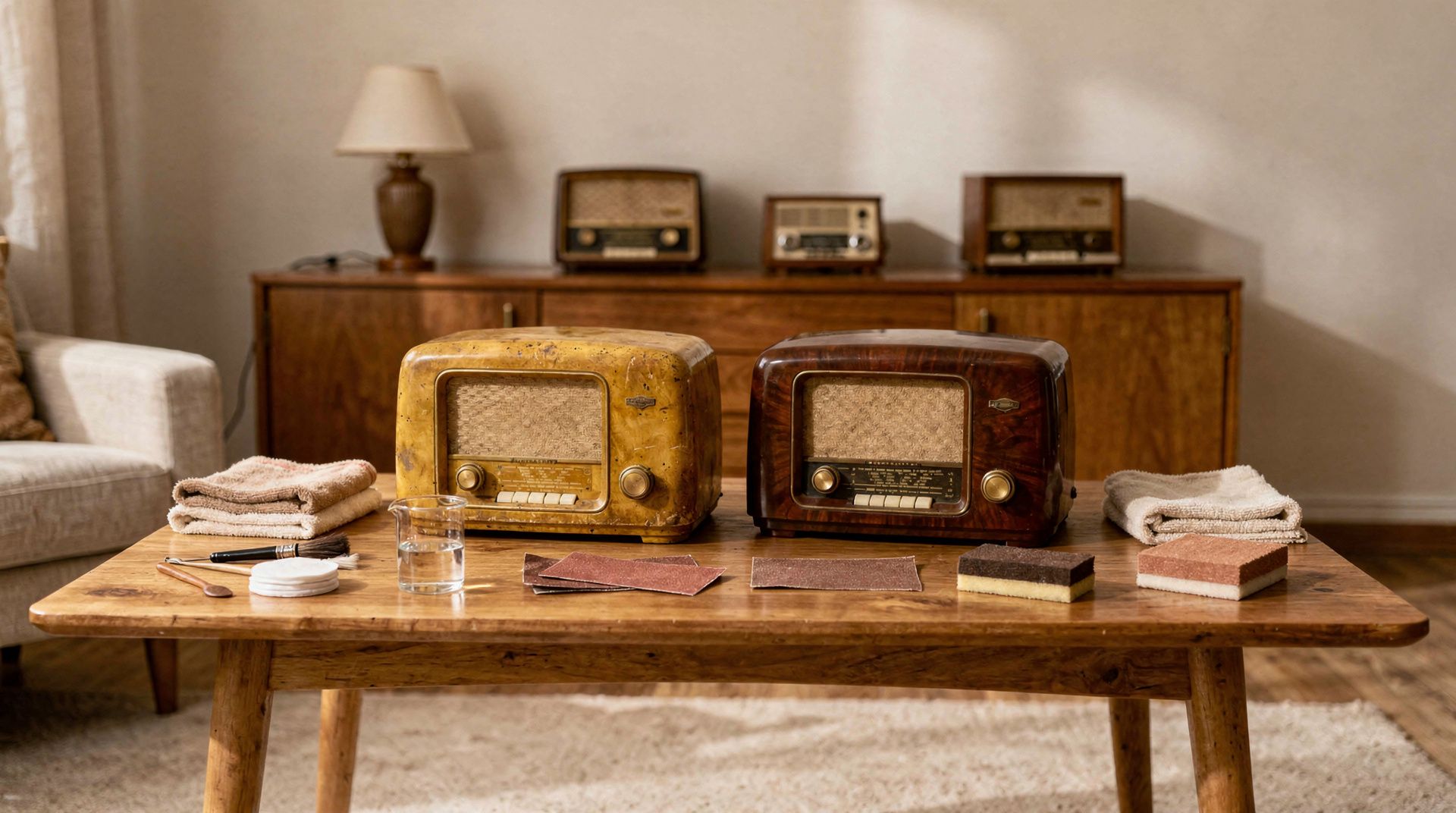
Reversing Bakelite Yellowing
Yellowed housings made of Bakelite, Catalin or early thermoplastics are a well-known phenomenon in vintage radios, telephones and small electrical appliances from the 1930s to the 1960s. The discolouration results from oxidation at the surface, triggered by UV light, heat, smoke and ageing of the resin matrix. With Bakelite (phenol-formaldehyde resin), yellowing typically affects a thin outer layer that can be removed mechanically. With lighter plastics such as urea-formaldehyde or ABS, the effect penetrates deeper and can only be reduced to a limited extent. Anyone who collects or restores should understand the difference between a cosmetic refresh and a substantive intervention: every treatment alters the original surface and, with it, part of the object’s history. Calm restraint is often the wiser approach here than reaching for aggressive agents.
Characteristic Materials and Their Ageing Behaviour
Not every brown housing is Bakelite in the strict sense. Several groups of materials need to be distinguished, each of which ages very differently depending on its formulation.
- Phenol-formaldehyde (Bakelite, patented by Leo Baekeland from 1907): usually dark-coloured, with a wood flour or textile filler. The yellowing resides in a superficial oxide layer. Fine wet-sanding with grits from 1500 to 3000 followed by polishing with a non-silicone plastic polish reveals the original depth of colour.
- Catalin and cast phenolic resins: filler-free, translucent, in vivid colours (butterscotch, marbled, red). The characteristic butterscotch tint is in many cases already an oxidation product of an originally lighter colour. Reversal is only partially possible and is usually undesirable for collector pieces.
- Urea-formaldehyde (e.g. Bandalasta, Beetle): light pastel tones, prone to deep, pervasive yellowing. Chemical methods have little effect here.
- Early ABS and polystyrene (from the late 1950s onwards): this is where the hydrogen peroxide and UV-light process well known from the retro-computing scene – “Retr0bright” – applies, targeting brominated flame retardants. On genuine Bakelite, this method is out of place.
Mechanically, the approach from coarse to fine has proven its worth: degrease, clean with isopropanol, wet-sand, apply polishing compound in several stages, finish with carnauba wax. Chemically, a mild oxalic acid solution is usually sufficient for Bakelite to remove nicotine and limescale haze before polishing begins.
Regional Schools and Designers of the Bakelite Age
The formal language of Bakelite devices is closely linked to the early industrial designers of the 1930s to 1950s and is distinctly regional in character.
- USA: Norman Bel Geddes, Raymond Loewy and Walter Dorwin Teague shaped the Streamline style. Iconic examples include radios such as the Emerson “Patriot” by Norman Bel Geddes (1940) or the Fada “Bullet” series in Catalin. The American school was an early champion of coloured cast resins and plastic volumes.
- Great Britain: Wells Coates designed the Ekco AD-65 for E. K. Cole in 1934 – a round Bakelite radio that today forms part of the V&A collection. The British line is geometrically clear, often black or walnut brown.
- Germany and Central Europe: Braun, Grundig, Telefunken, Siemens and Philips (Eindhoven) initially worked with dark Bakelite before switching to light thermoplastics in the 1950s. With Dieter Rams and Hans Gugelot, Braun began from 1955 to move away from Bakelite aesthetics towards matt-white, understated housings.
- Italy: Castiglioni, Zanuso and Sapper took plastics into a new formal language in the 1960s, as seen in the Brionvega radio TS 502 (1964).
Anyone restoring should be familiar with regional attribution, as the original colour, surface sheen and embossing depth of manufacturer marks are important reference points for any work undertaken.
Authenticity and Condition from a Collector’s Perspective
For collectors, the rule is: an even, aged patina is not a flaw but a testimony. Aggressive polishing can wear away fine casting details, maker’s stamps and value marks, significantly reducing collectability. Before any measure, a condition assessment is essential:
- Material identification via the smell test (phenolic resin smells distinctly of carbolic acid when warmed by friction), a hot-water test and a UV lamp (Catalin often fluoresces greenish).
- Documentation of the initial condition with photographs in daylight.
- Reversibility: cleaning and waxing are reversible; wet-sanding is not. Anyone who sands removes substance.
- Hairline and stress cracks in Bakelite are material-typical and cannot be meaningfully filled. Two-part epoxy bonds are stable but visible.
- Market relevance: for icons such as the Ekco AD-65, Fada 1000 or Braun SK series, original surfaces, unrestored dials and matching power cables count far more than a perfect high gloss.
As a rule of thumb: cleaning yes, conservation yes, radical restoration only after consultation and only for pieces that are already heavily damaged.
At mid-centurydesigns.com we curate Mid-Century Modern furniture and objects with a focus on provenance, original surfaces and documented condition. Electrical appliances and plastic housings from this era are assessed for material, maker’s marks and the extent of previous interventions, so that you can make an informed decision between preserved patina and careful restoration.
This article was generated automatically by an AI system. Disclosure pursuant to Article 50 of the EU AI Act.